





 Portuguese
  English
  Spanish
  4 min of reading
  0 comments


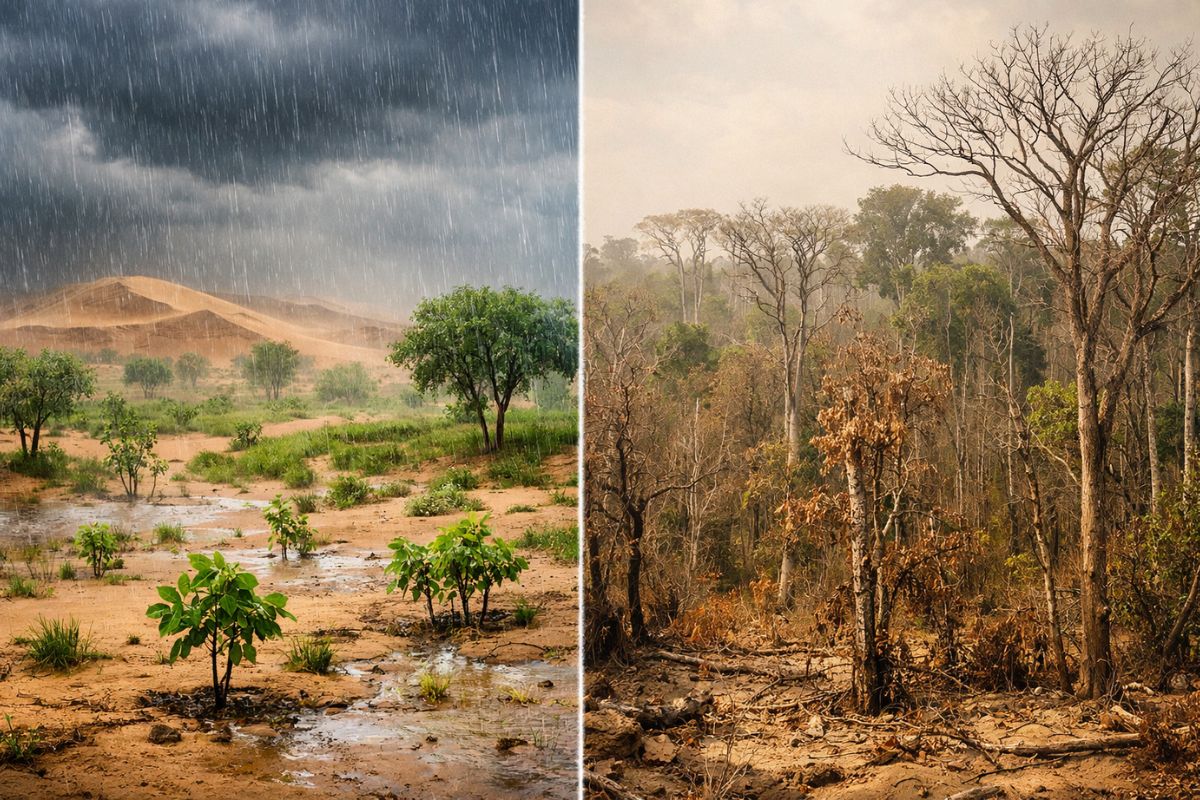
As The Amazon Loses Moisture, Global Warming Could Increase Rainfall in The Sahara by Up to 75% by The End of The Century and Change The Lives of Billions
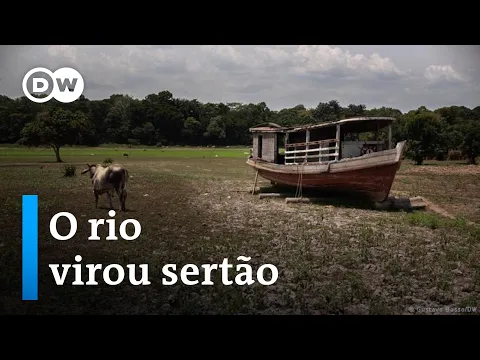
Global warming is associated with profound changes in rainfall patterns, and the foundation below describes a striking contrast: while the Amazon Rainforest may move towards a scenario of extreme drought in the coming decades, the Sahara may head in the opposite direction, receiving much more precipitation.
According to researchers cited in the foundation, the Sahara, currently one of the driest deserts in the world, could receive up to 75% more rainfall by the end of the century, which would pave the way for a broad environmental transformation, with social and economic impacts both within and outside Africa.
The Disturbing Contrast: Drier Amazon, Wetter Sahara
The foundation describes a world in apparent inversion: the Amazon, known for its moisture, could approach desert conditions in the coming decades, while the Sahara could become greener and wetter.
-
Motorola launched the Signature with a gold seal from DxOMark, tying with the iPhone 17 Pro in camera performance, Snapdragon 8 Gen 5 that surpassed 3 million in benchmarks, and a zoom that impresses even at night.

-
Satellites reveal beneath the Sahara a giant river buried for thousands of kilometers: study shows that the largest hot desert on the planet was once traversed by a river system comparable to the largest on Earth.

-
Scientists have captured something never seen in space: newly born stars are creating gigantic rings of light a thousand times larger than the distance between the Earth and the Sun, and this changes everything we knew about stellar birth.

-
Geologists find traces of a continent that disappeared 155 million years ago after separating from Australia and reveal that it did not sink, but broke into fragments scattered across Southeast Asia.

The idea is not that everything will change overnight, but that global warming alters the functioning of the atmosphere and redistributes rainfall.
This contrast is important because it breaks the intuitive expectation that dry regions will always become drier and wet regions will always become wetter. What changes is the pattern, and this can shift risks and opportunities to different places.
Why The Sahara Could Receive Up to 75% More Rain
According to the foundation, researchers indicate that the Sahara could receive up to 75% more rainfall by the end of the century.
The text also recalls a reference point: today, the desert receives about 8 cm of precipitation per year, which helps frame how significant a percentage increase can be for the landscape and land use.
Still, the foundation emphasizes an important limit: the authors do not assert the exact amount of rainfall that will fall in the coming years, only that precipitation is expected to increase. In other words, the trend is upward, but the exact magnitude remains uncertain.
The Statement That Summarizes The Problem: Billions Will Be Affected

The foundation attributes to the lead author, Thierry Ndetatsin Taguela, the central message of the warning: changes in rainfall patterns can affect billions of people, both within and outside Africa. This positions global warming not only as an environmental issue but as a factor in public and private planning.
The highlighted recommendation is straightforward: it is crucial to start planning how to deal with these changes, from flood control to cultivating drought-resistant plants. It’s not just about climate, it’s about infrastructure, agriculture, health, housing, and food security.
Planning in Practice: Floods, Agriculture, and Adaptation
When rainfall changes location and intensity, the impacts appear in a chain reaction. If there is an increase in precipitation in areas that are poorly prepared for larger volumes, the need for drainage and flood control increases.
At the same time, regions that become drier may need more resilient crops and more efficient water-use strategies.
The foundation reinforces this point by treating adaptation as something that needs to be thought of in advance and in a regional manner. Climate planning is economic survival planning, as it affects production, transport, prices, and social stability.
Africa Does Not Change Equally: Regions with More Rain and Drier Regions
An essential detail in the foundation is that the African continent would not exhibit a single behavior. The text points out different trends by region:
- Southeast Africa could record an increase of about 25% in rainfall
- Central-southern Africa could see an increase of around 17%
- The southwestern region of the continent could become drier, with an approximate reduction of 5% in precipitation
These differences matter because they show that global warming can create winners and losers in climate, depending on the type of local economic activity, access to water, and the capacity to adapt.
What Would A Greener and Wetter Sahara Mean
If precipitation increases consistently, the Sahara could, as described in the foundation, head towards a greener and wetter scenario. This does not automatically mean a ready-made forest or a simple transformation, but it indicates a possibility of landscape change and environmental dynamics.
It also means that risk management shifts focus: areas currently dominated by scarcity may have to deal with excess water during certain periods, while areas that are currently wet may face water stress. It’s a swap of challenges, not an automatic happy ending.
The Final Warning: Understanding Rainbecomes a Strategic Issue
The foundation emphasizes that understanding how precipitation may change over the years is vital, as decisions need to be specific to each region. This applies to both governments and communities and economic sectors.
In the end, global warming appears as the engine of this climate reorganization. Even with uncertainties about exact values, the direction indicated by the foundation is clear: rainfall patterns may change broadly, requiring adaptation, investment, and planning.
In your opinion, which scenario is more concerning: a drier Amazon or a Sahara with much more rain and new flood risks?






-

-

-

-

-

16 pessoas reagiram a isso.