





 Portuguese
  English
  Spanish
  4 min of reading
  0 comments


Technology Uses Heated Sand With Renewable Energy To Store Heat For Months And Transform Urban Heating In Small Towns
A small town in southern Finland decided to face the harsh winter with an unusual solution. In this scenario, in Pornainen, local managers adopted technology that uses heated sand to store thermal energy. As a result, the municipality managed to reduce carbon emissions linked to urban heating by up to 70%.
According to information released, the site Live Science published the report in September 2025. According to the portal, the city installed the largest “sand battery” in the world. Currently, the system operates integrated with the local heating network and serves residents during the coldest periods of the year.
How The Sand Battery Used To Store Thermal Energy Works
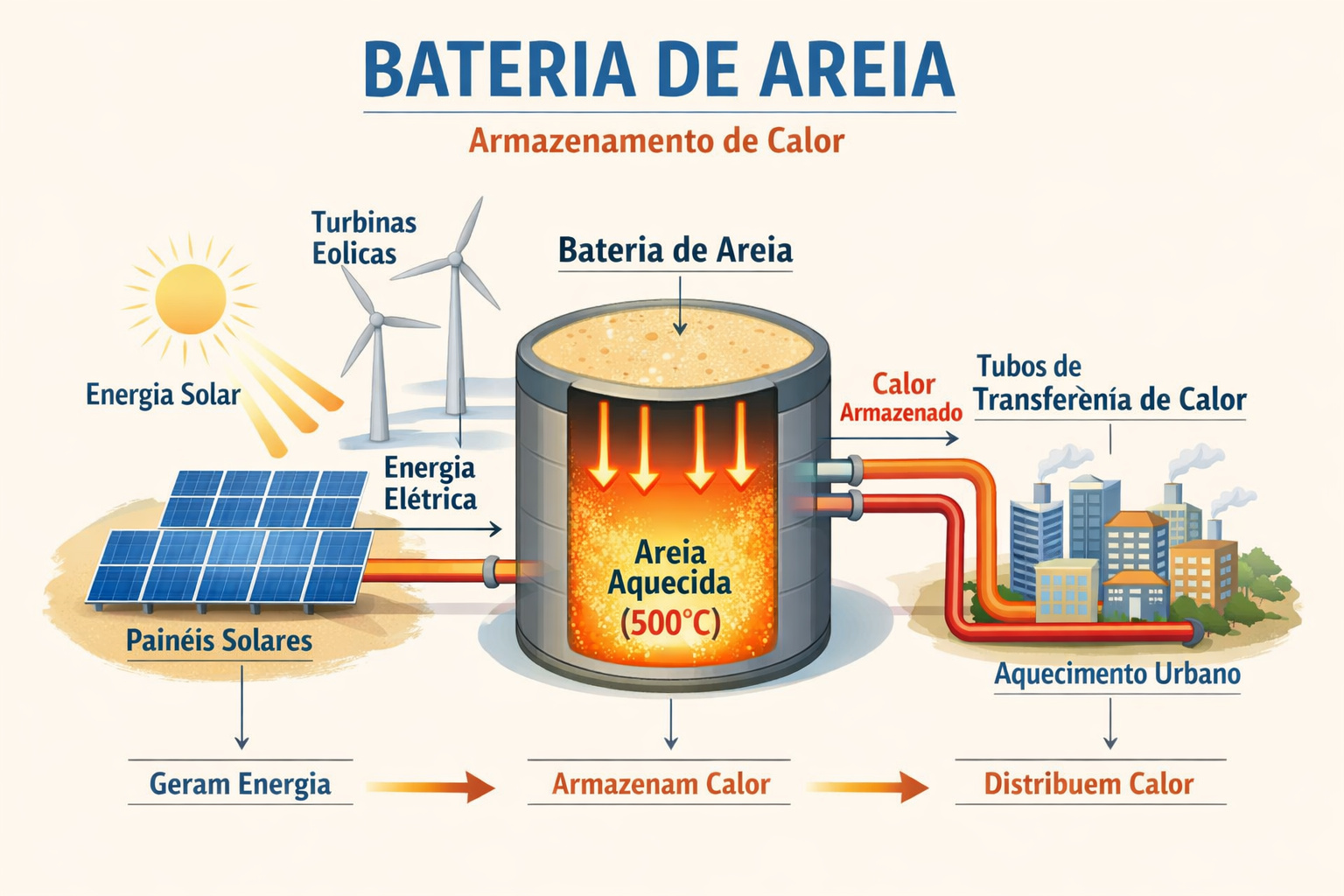
In practice, the sand battery acts as a large heat reservoir. In this model, the equipment installed in Pornainen measures approximately 43 feet in height by 49 feet in width, equivalent to 13 meters by 15 meters. Inside this structure, a steel container stores tons of regular sand.
-
The Brazilian state accelerates industrial competitiveness with a focus on the extraction of strategic minerals to boost the energy transition in Goiás.

-
A Canadian retiree creates a hydroelectric system on a real river, generating energy continuously throughout the day and demonstrating how the power of water can supply a house with stability even in a simple structure.
-
Petrobras reaffirms its commitment to the market and ensures that it will carry out the energy transition safely to maintain national sovereignty.

-
Researchers discover a possible hydrogen deposit of up to 46 million tons beneath an ancient coal basin, and the volume could exceed half of the entire global production.

To do this, the system uses closed-loop heat transfer tubes. Through them, surplus energy from the electric grid and local generation of solar and wind energy heats the sand. Thus, the material reaches extremely high temperatures, reaching 842 degrees Fahrenheit, equivalent to 450 degrees Celsius.
In addition, the structure features two layers of steel and an insulating material between them. As a result, heat remains stored for long periods. When necessary, the system injects cold air into the tubes. Then, this air returns heated and generates hot water, steam, or warm air for urban distribution.
Energy Storage Faces The Main Challenge Of Renewable Sources

Although essential, renewable sources such as solar and wind present a significant challenge. This is because production varies throughout the day and seasons. For this reason, storage has become one of the largest bottlenecks of the energy transition.
According to professor Matteo Chiesa, from Khalifa University of Science and Technology, storage limits the expansion of renewable energies. In an interview with Live Science, he explained that thermal systems help balance supply and demand. In this context, the sand battery stands out as a viable alternative.
Additionally, the system can store heat for months, which is difficult for conventional electric batteries. By directing surplus renewable energy to the sand, the city ensures heating even during periods of low solar or wind generation.
Thermal Power Meets Urban Demand During Winter
From a technical standpoint, the system developed by Polar Night Energy offers a thermal power of 1 megawatt. In other words, it can provide 1 million joules per second. Additionally, the battery operates within a temperature range of 140 to 752 degrees Fahrenheit, equivalent to 60 to 400 degrees Celsius.
With this capacity, the system meets much of Pornainen’s heating demand. According to experts, the performance observed in Finland indicates potential for replication in other cold regions. Moreover, Chiesa stated that the model works well at an urban scale.
On the other hand, the professor highlighted that the cost still prevents residential applications. According to him, the large amount of metal makes the structure expensive. Therefore, future versions should prioritize simpler and more economical solutions.
Why Sand Works So Well As A Thermal Storage Material
Historically, the use of sand to retain heat is not a new concept. For example, brick ovens have been using the same principle for centuries. This happens because sand can withstand very high temperatures before melting. Additionally, it releases heat slowly.
Chemically, sand is primarily composed of silicon and oxygen. For this reason, it is available in almost the entire planet. Unlike conventional batteries, the sand battery does not generate electricity. In practice, it functions as a thermal storage system, focused on heating.
Seasonal Storage Expands The Potential Of The Technology
Another relevant point involves seasonal storage. As sand loses heat slowly, the system can store energy generated in the summer. After that, it releases this heat during winter when demand increases.
According to Chiesa, storing solar heat from summer for winter use represents a powerful solution. Currently, Polar Night Energy uses the system to balance short-term fluctuations in wind generation. Nonetheless, the seasonal potential remains evident.
Local Solution Indicates Global Paths To Reduce Emissions
Although installed in a small town, the sand battery points to pathways for the future of clean energy. This is because the technology combines renewable energy, long-duration thermal storage, and urban infrastructure.
With simple solutions, cities can reduce emissions and ensure energy security. Thus, Pornainen becomes a practical example of how accessible innovation can accelerate the global energy transition.
In your opinion, could thermal storage technologies like the sand battery help Brazilian cities reduce costs and emissions in the long term?









-

Uma pessoa reagiu a isso.