





 Portuguese
  English
  Spanish
 5 min of reading
  0 comments


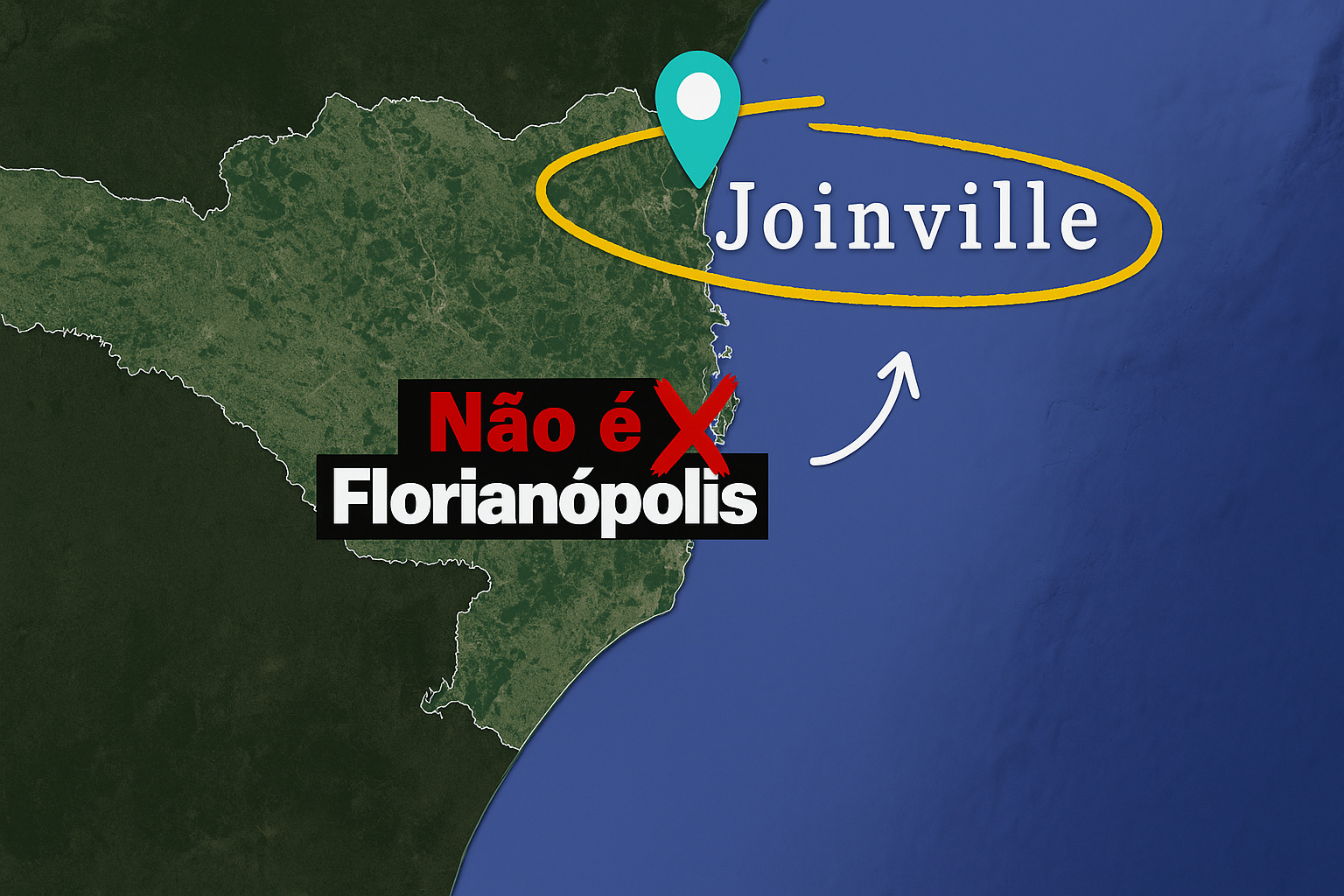
Joinville Has Surpassed Florianópolis In Population And Economy, But Remains Outside The Capital Position. Understand The Historical And Political Reasons Behind This Choice In Santa Catarina
Joinville, the largest city in Santa Catarina, surpasses Florianópolis in population, economy, and influence — yet many people are unaware of this fact. Although it is not the capital of the state, Joinville stands out for its industrial strength, urban development, and quality of life. According to IBGE, Joinville has over 616,000 inhabitants, while Florianópolis has about 537,000. The forecast is that Joinville’s population will reach over 1.37 million in its urban area by 2025, maintaining its population and economic leadership in the state.
Today we will answer the question why Joinville is not the capital, understand the Joinville x Florianópolis relationship, present curiosities about SC’s capital, and explore the latest data on the largest city in the state.
Joinville x Florianópolis: Comparative Data
Current And Estimated Population
Joinville is, in absolute numbers, the most populous city in Santa Catarina. According to IBGE, its population exceeds 650,000 inhabitants in 2024, while Florianópolis has just over 537,000. When considering the metropolitan area, Joinville also stands out, with about 1.48 million inhabitants — surpassing Florianópolis, which reaches approximately 1.32 million.
-
Friends have been building a small “town” for 30 years to grow old together, with compact houses, a common area, nature surrounding it, and a collective life project designed for friendship, coexistence, and simplicity.

-
This small town in Germany created its own currency 24 years ago, today it circulates millions per year, is accepted in over 300 stores, and the German government allowed all of this to happen under one condition.

-
Curitiba is shrinking and is expected to lose 97,000 residents by 2050, while inland cities in Paraná such as Sarandi, Araucária, and Toledo are experiencing accelerated growth that is changing the entire state’s map.

-
Tourists were poisoned on Everest in a million-dollar fraud scheme involving helicopters that diverted over $19 million and shocked international authorities.


Economy And Development
Joinville leads the economic ranking of the state. Its industry is diverse and modern, with a focus on the metallurgical, textile, technology, and service sectors.
The city is among the 25 largest exporters in Brazil and contributes significantly to the state GDP. Florianópolis, in turn, has an economy more focused on tourism, services, and technology, with a growing hub of startups and IT companies.
Quality Of Life And HDI
Both cities have a high Human Development Index (HDI). Joinville has an HDI of 0.809 (IBGE 2021), with good indicators in education, health, and safety. Florianópolis also performs excellently in these aspects, standing out for urban mobility and the quality of higher education, such as the Federal University of Santa Catarina (UFSC).
Why Joinville Is Not The Capital Of Santa Catarina
Historical Origin Of The Capital
Florianópolis, founded in 1673 as Nossa Senhora do Desterro, was chosen as the capital due to its strategic location on the Island of Santa Catarina and for housing a protected natural harbor. During the Empire, its coastal position facilitated communication with other regions of Brazil and justified its administrative centrality.
Political And Administrative Criteria
The choice of a state capital does not depend solely on population size. Florianópolis hosts the three state powers — Executive, Legislative, and Judiciary — and has maintained this structure since the 19th century. The transfer of the capital would require extensive administrative reform, along with costs and political disputes.
Joinville Grew, But The Structure Remained
Despite Joinville’s growth and its importance in the Santa Catarina landscape, there have been no concrete proposals to change the capital. Capital status is determined by historical and symbolic criteria, not just by numbers. This helps to understand why Joinville is not the capital, even being the largest and most influential city in the state.
Joinville Population 2025: Accelerated Growth
Projections indicate that Joinville will reach over 1.374 million inhabitants by 2025, considering the metropolitan area. This population growth results from various factors, such as job creation, quality of life, and urban infrastructure.
Reasons For Growth
- Strong Economy: Joinville is home to over 11,762 industries and about 106,000 companies, with a strong presence in the automotive, metallurgical, plastic, and technology sectors.
- Efficient Logistics: the city is connected by BR-101 and is close to important ports, such as São Francisco do Sul and Itajaí. It also has an expanding regional airport.
- Quality Of Life: good availability of public services, education, and health makes Joinville an attractive city for families and businesses.
- Attraction Of Investments: the favorable business environment and municipal incentives contribute to the establishment of national and foreign companies.
SC Capital Curiosities: Florianópolis And Its Permanence
Even surpassed by Joinville in numbers, Florianópolis maintains the status of capital for a variety of historical and institutional reasons.
- Administrative Tradition: the city has hosted state power headquarters since the 19th century. Its role as the capital has never been officially questioned.
- Strategic Location: in the past, being on the coast facilitated communication and control over Santa Catarina’s territory.
- Symbolic Value: Florianópolis is a cultural and political symbol of the state, with historical constructions such as the Cruz e Sousa Palace and the Hercílio Luz Bridge.
- Academic And Technological Influence: with UFSC and a consolidated technology park, Florianópolis stands out as a hub of innovation, reinforcing its relevance.
Joinville x Florianópolis: Main Differences
| Aspect | Joinville | Florianópolis |
| Population | ~654,888 (2024) / region: ~1.374 million | 537,211 (2022) / region: ~1.323 million |
| Urban Function | Industrial And Logistic Hub | Political And Tourist Center |
| HDI | 0.809 | Slightly Above 0.81 |
| Economy | Industries, Exports, Services | Tourism, Technology, Public Services |
| Infrastructure | BR-101, Regional Airport, Access To Ports | Airport, UFSC, Government Headquarters |
| History | Founded By European Immigrants (1843) | Portuguese Colonial Origin (1673) |
| Innovation | Growing Presence Of Technological Hubs | Consolidated Innovation Ecosystem |
What This Difference Reveals About Santa Catarina
The question of why Joinville is not the capital allows for reflection on what defines the political centrality of a city. Joinville, the largest city in Santa Catarina, has the strongest economy, largest population, and increasing influence. However, Florianópolis maintains its position due to tradition, location, and historical weight.
The contrast between Joinville x Florianópolis reveals two distinct models of urban leadership: one based on production, innovation, and economic growth; the other on institutional stability, culture, and governance.
Among the curiosities of SC capital, it stands out that only two Brazilian states do not have their most populous city as the capital: Santa Catarina and Espírito Santo. This peculiarity sparks the interest of scholars, journalists, and public managers.
As we move towards 2025, with the projected population and economic growth of Joinville, the debate about its state relevance is only likely to increase. Even if it is not the capital, the city has already established itself as the true engine of Santa Catarina, combining development, regional leadership, and quality of life like few others in the country. Understanding this dynamic is essential to appreciating the different roles a city can play within a state.










Seja o primeiro a reagir!