





 Portuguese
  English
  Spanish
  5 min of reading
  0 comments


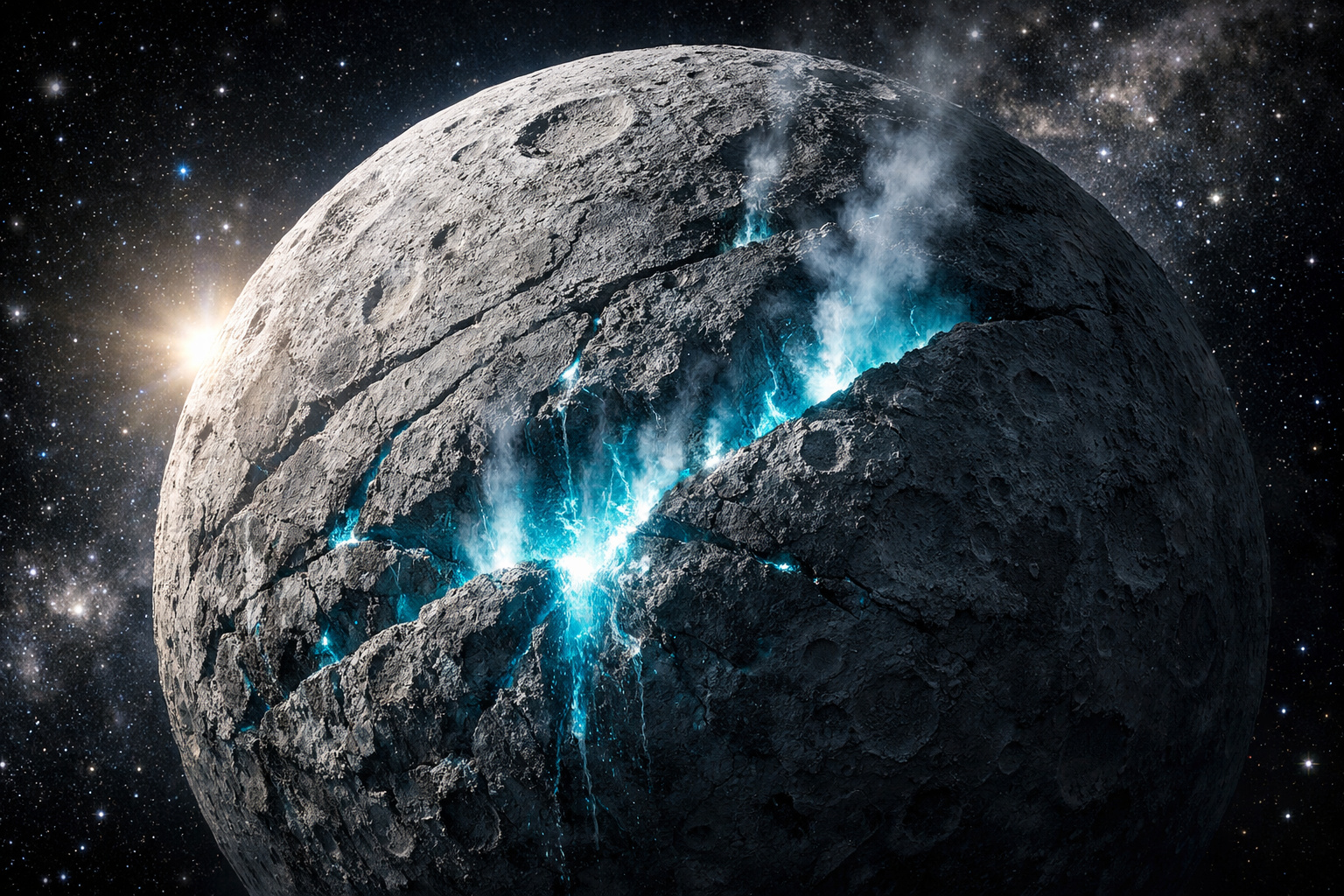
With Less Than 1,000 Km, Ceres Revealed Recent Salty Water on the Surface, Indicating Unexpected Geological Activity and Challenging the Idea That Small Worlds Are Inert.
For a long time, small bodies in the Solar System were classified as cold, geologically inert worlds doomed to a distant past. Ceres, about 940 km in diameter and located in the Asteroid Belt between Mars and Jupiter, fit perfectly into this stereotype. This changed radically when NASA’s Dawn mission revealed that the dwarf planet not only contains water, but also shows signs of recent geological activity, something unexpected for an object of this size.
What appeared to be a bleak world turned out to be a dynamic body, with internal processes capable of mobilizing salty water from the interior to the surface in geologically recent times.
What Makes Ceres So Different From Other Small Bodies
Ceres is the largest object in the Asteroid Belt and the only one classified as a dwarf planet in that region. Unlike common rocky asteroids, it has:
-
With a cost per shot close to zero, the DragonFire laser could change naval warfare in 2027 and provide British ships with nearly unlimited defense against drones.

-
A British startup creates tires that generate electricity in electric vehicles when passing over potholes, speed bumps, and cracks.

-
Scientists have created robots made with living cells that have their own nervous system, swim on their own, explore the environment, and self-organize without any genetic engineering, and now they want to do the same with human cells.

-
Students create a solar-powered ambulance that operates without a plug, without fuel, and still keeps medical equipment running in remote areas.


- a high fraction of ice and hydrated minerals
- relatively low density
- clear signs of past and recent interaction with water
These characteristics already indicated something unusual, but no one expected to find evidence of active processes occurring just millions of years ago or less.
The Dawn Mission and the Discovery That Changed Everything

The scientific turning point occurred when the spacecraft Dawn orbited Ceres between 2015 and 2018, mapping its surface with incredibly high resolution. Among ancient craters and seemingly stable terrain, scientists found something strange: extremely bright deposits made up of salts.
These deposits, especially those located in the Occator Crater, did not behave like ancient materials exposed by impacts. They were young, much brighter than the surroundings, and had a chemical composition inconsistent with simple space dust.
The conclusion was surprising: brines from the interior of Ceres had reached the surface recently.
Salty Water Rising From the Inside Out
Spectral analyses showed that the deposits are rich in sodium carbonate, a salt highly soluble in water. This type of compound does not easily form on Ceres’ cold, dry surface. The most accepted scenario today is that:
- salty water remained liquid at depth
- fractures allowed its ascent
- upon reaching the surface, the water evaporated
- the salts were left behind, forming bright spots
This process indicates that Ceres retained enough internal heat to allow the mobility of liquids for much longer than previously thought.
Recent Geological Activity on a Planetary Scale

The most startling aspect is the timing. Models indicate that some of these brines reached the surface just a few million years ago, possibly even hundreds of thousands of years ago.
In geological terms, that’s practically “yesterday.”
For a body with less than 1,000 km in diameter, this breaks paradigms. Objects of this size should have completely cooled billions of years ago. Ceres, however, has maintained:
- residual internal heat
- confined liquid water
- the ability to move fluids
This places it in a completely different category from other asteroids.
An Ancient Ocean That Did Not Disappear Completely
Internal models suggest that Ceres may have housed a global subsurface ocean in the past. Over time, this ocean would have:
- partially frozen
- fragmented into pockets
- remained salty, lowering the freezing point
These pockets of brine explain how liquids could still circulate long after the “end” of the main ocean. The presence of salts acts as a natural antifreeze, keeping liquid water even at extremely low temperatures.
Why This Matters for the Search for Life
On Earth, brine-rich environments like hypersaline lakes and deep aquifers — harbor microbial life that is highly specialized. These organisms do not depend on sunlight and survive by exploiting chemical gradients.
Ceres contains fundamental ingredients:
- liquid water (even if salty)
- reactive minerals
- available chemical energy
This does not mean there is life there, but it shows that potentially habitable environments may exist in much smaller bodies than planets.
A Small World With Enormous Lessons
The discovery at Ceres forces science to rethink old concepts. If a dwarf planet in the Asteroid Belt managed to maintain internal activity for billions of years, how many other small worlds might hide similar processes?
This expands:
- the number of candidate locations for habitability
- the understanding of planetary thermal evolution
- the significance of salts and water in geological longevity
Ceres has ceased to be merely “another icy body” to become a natural laboratory on how small worlds remain active.
Inevitably Comparisons With Ocean Worlds
Though Ceres does not have the thick global ocean of moons like Europa or Enceladus, it shares an essential principle: the persistence of internal liquids far beyond what was expected. The difference is that Ceres did this:
- without intense tidal heating
- without proximity to a gas giant
- only with residual internal heat and suitable chemistry
This makes the case even more intriguing.
The Future of Ceres Exploration
Following the Dawn mission, Ceres entered the list of priority targets for future scientific missions. Directly exploring these salt-rich regions could reveal: the exact composition of the brines; the actual duration of activity; the chemistry available inside.
Each answer could help understand not only Ceres but the evolution of countless small bodies scattered across the Solar System.
Ceres challenges the narrative that size defines destiny. Even small, even distant from the Sun, even isolated among asteroids, it managed to maintain liquid water and internal activity for much longer than science considered possible.
This changes the game. And reinforces a powerful idea: the Solar System still holds surprises where least expected.









-

-

-

-

-

14 pessoas reagiram a isso.