





 Portuguese
  English
  Spanish
  6 min of reading
  0 comments


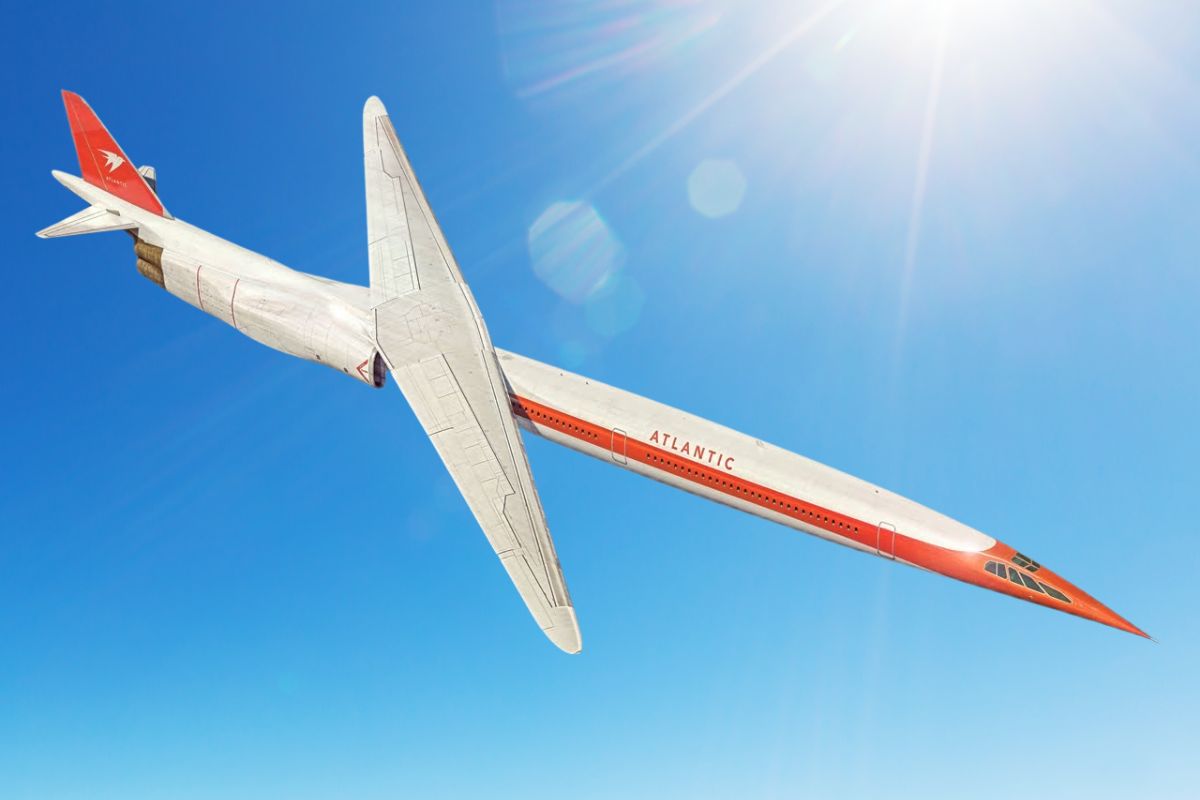
Created by Robert Thomas Jones at NASA, the oblique wing rotates to be straight on landing and inclined in cruise, reducing wave drag and induced drag. After OWRPRA in 1976 and the AD-1 in 1979, the supersonic plan with F-8 was canceled due to budget, and it still divides engineers today.
The oblique wing has resurfaced in technical discussions because it touches on what seemed untouchable: symmetry as an automatic rule in aircraft design. By allowing a single wing to rotate around the fuselage, the concept promises to reduce drag in transonic and supersonic regimes while maintaining efficiency at low speed.
What makes the topic uncomfortable for the industry is that the oblique wing is not an abstract hypothesis. There has been structured research, evaluation by manufacturers, and NASA flight tests, including the AD-1, with enough results to keep the idea alive even after budget cuts and changes in priority over the following decades.
Symmetry, Nature, and the Psychological Barrier of Supersonic

Bilateral symmetry is treated as a silent premise in aviation because almost everything that flies in nature is symmetrical.
-
Archaeologists discover in China a 5,000-year-old tomb with over 350 artifacts, nearly 200 jades, and signs of intentional destruction, in a discovery that could be the gateway to a lost prehistoric kingdom.

-
A vacuum robot with a five-axis mechanical arm capable of picking up objects from the floor, avoiding obstacles in real time, and continuing to clean on its own inaugurates a new generation of appliances that see, think, and act within the home.
-
Geographers redefine the Brazilian relief and confirm the presence of mountains in 14 states with a new system that changes historical criteria and alters the way the territory is classified.

-
At a depth of 3,800 meters in the Atlantic, scientists have discovered a “lost city” with white towers up to 60 meters tall that has been active for over 120,000 years without relying on volcanoes.

However, this parallel has an obvious flaw: birds do not fly at supersonic speeds, and the design of aircraft that cross the sound barrier adheres to a different family of aerodynamic restrictions.
As flight approaches transonic and becomes supersonic, wave drag increases, and the control margin changes.
It was at this point that symmetry ceased to be merely aesthetic and became an operational cost.
Maintaining symmetry may mean accepting greater drag and compensating for loss with more thrust, more fuel, and more noise.
Traditional engineering responds to this problem with swept wings and thinner profiles, trying to “trick” the flow at high speeds.
The point is that these solutions exact a toll at low speeds, with more demanding takeoffs and landings.
It is in this friction between regimes that the oblique wing aims to enter, precisely because it does not accept that a single fixed shape serves for everything.
What Is an Oblique Wing and Why Does It Aim to Solve Two Regimes at Once

The oblique wing is a single, asymmetric wing capable of rotating around a central pivot.
During takeoff and landing, the configuration can be close to a straight wing, favoring lift at low speeds.
In cruise at transonic or supersonic speeds, the oblique wing tilts and simultaneously minimizes both wave drag and induced drag.
In practical terms, the rotation alters the “effective sweep” that the air perceives. This changes how shocks form and how lift distributes along the wingspan, directly impacting drag.
The promise of the oblique wing is to be a geometric shortcut: to reduce penalties of supersonic flight without the complexity of traditional variable geometry wings.
The central argument is one of system efficiency.
Variable geometry wings attempted to reconcile low speed and supersonic flight but paid the price with complex mechanisms, weight, and compensations at the center of lift.
In the oblique wing, the promise is of a lighter solution with fewer moving parts, and a relatively stable center of lift throughout the pivot, reducing structural corrections.
From the Drawing Board to the Sky: What NASA Measured with OWRPRA and AD-1
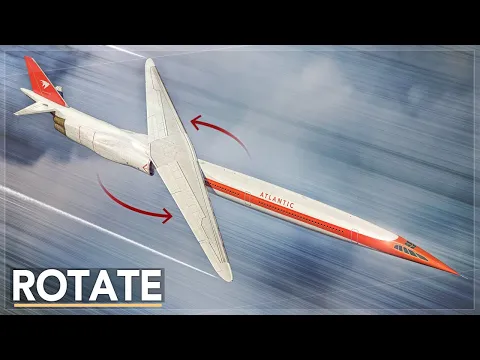

In the 1950s, engineer Robert Thomas Jones developed the theoretical basis and tested the concept in a wind tunnel, as well as in radio-controlled models.
The leap to practical evaluation came in the 1970s when the agency began more intensive studies and launched the OWRPRA, a remotely piloted research aircraft that flew in 1976.
The program had its showcase in 1979 with the AD-1, a subsonic oblique wing aircraft piloted by humans.
Built on a tight budget, the AD-1 used fiberglass reinforced plastic and foam core, with two small jet engines totaling less than 227 kg of thrust, and a basic instrument cockpit.
In 79 flights, the AD-1’s wing was gradually rotated from 0 to 60 degrees.
Even without fly-by-wire, control was considered manageable at lower angles, but above 45 degrees, cross-coupling appeared, when pitch and roll commands begin to interfere and require continuous correction from the pilot.
The most relevant data was the diagnosis: the limits were not mystical; they were of control and structural rigidity.
The Promised Gain and the Shadow of Supersonic Transport
The measurements indicated that the oblique wing could be particularly relevant where commercial aviation has always paid the highest price: in the transonic and supersonic regimes.
Therefore, Boeing and Lockheed were invited to evaluate the concept for commercial transport.
The reading was straightforward: with less drag at high speeds, it would be possible to maintain speed with less thrust, reducing consumption and operational cost.
The historical context weighed heavily.
The Concorde exposed the dilemma of a design optimized for supersonic that suffers at low speeds, requiring noisy and fuel-intensive solutions during takeoff.
At the same time, prohibitions and noise restrictions related to sonic booms reduced the operational space for supersonic aircraft.
The studied hypothesis was that a transport with an oblique wing could cruise around Mach 1.2 without an audible sonic boom on the ground, accelerating transcontinental flights over populated areas by up to 50% compared to existing commercial jets.
The power demand for takeoff, landing, and waiting at busy airports would also be lower, reducing noise and local pollution.
Why the Program Stopped: Control, Budget, and the Cost of Asymmetry
There was a planned step to test the oblique wing in supersonic flight with a faster platform.
The continuity contemplated included a modified F-8 fighter, in a joint program with the U.S. Navy. An investment of $36 million was cited to take the project through 1990, with the first flight planned for May 1991.
The plan did not take off. In 1986, funding cuts related to deficits and cost overruns in other programs interrupted the partnership, and cancellation was formalized in 1987.
From the beginning of the 1990s, intensive research programs on the oblique wing became practically paralyzed, reinforcing the feeling that asymmetry was technically intriguing but industrially unpalatable.
The practical effect of this hiatus is simple: the oblique wing has not undergone the real-scale testing in transonic and supersonic regimes, where it promises the greatest advantages.
Without this step, the concept remains caught between two incompatible demands: the industry asks for flight demonstration, and flight demonstration requires an industry willing to bear the risk.
What Would Change Today and Why Symmetry Still Wins
The AD-1 tests themselves indicated that many control problems at extreme pivots could be mitigated with automation, as the difficulty above 45 degrees arises from dynamic couplings that a control system can compensate for quickly.
In other words, the oblique wing relies less on pilot muscle and more on control logic, something that is now standard in modern aircraft.
Materials and methods have also changed.
Stiffer composites, digital modeling, and simulation validation reduce the cost of early mistakes but do not eliminate the cost of late certification.
And, in civil transport, certification includes maintenance and operational predictability, two items where symmetry still serves as a common language for designers, regulators, and pilots.
Still, civil aviation is conservative by design.
Certification, maintenance, training, and risk perception compose an equation that rarely accepts radical asymmetry without proof of net gain at scale.
Between a new concept and incremental gains in a proven design, the industry tends to choose symmetry, even when physics suggests that symmetry is not always the most efficient solution.
The oblique wing, therefore, remains a technical and cultural question.
It points to a possible error of habit, not of mathematics: insisting on symmetry because it has always been this way.
And if aviation is stuck in a pattern that makes sense in subsonic but costs dearly when the goal is transonic and supersonic?
The oblique wing has been theory, turned into experimentation, and reached real flight with NASA and the AD-1, but has not crossed the decisive phase of supersonic for reasons that mix control, budget, and industrial risk aversion.
The concept continues to point to the same dilemma: what seems strange may just be what has yet to be normalized.
If a commercial aircraft with an oblique wing promised less drag and faster transonic cruise, would you trust asymmetry, or would symmetry still be a psychological safety criterion? What would be, for you, the acceptable limit between innovation and predictability when it comes to air transport?







-

-

-

-

-

-

36 pessoas reagiram a isso.