





 Portuguese
  English
  Spanish
  6 min of reading
  1 comment


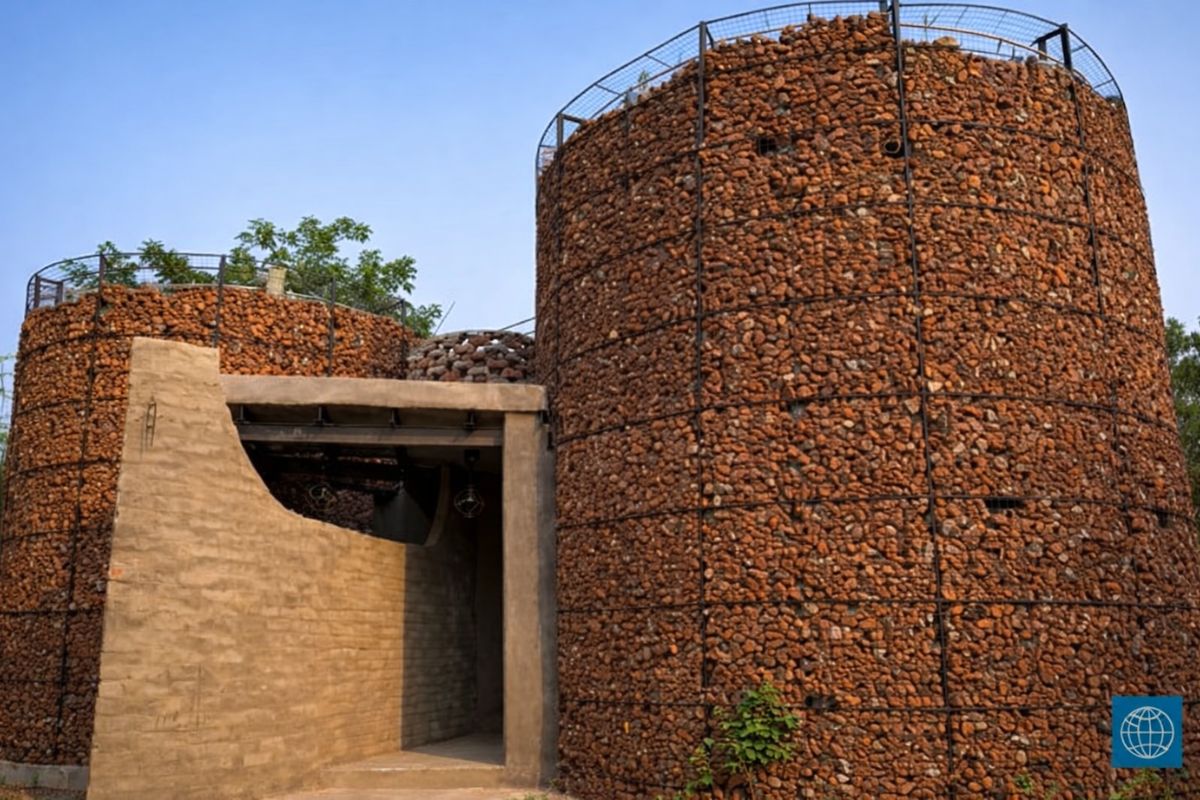


Amid Frequent Power Outages and Sweltering Heat, Architect Creates Terracotta System to Cool Buildings Without Air Conditioning, Inspiring Natural Solutions in an Increasingly Hot City.
In New Delhi, there are nights when the heat exceeds 95 ºF and the air feels almost palpable. To withstand these temperatures, millions of people turn on the air conditioning at the same time, and when the grid can’t handle it, power outages spread for hours. In this scenario of extreme heat and pressured energy, a bold alternative arises: using water, clay, and natural ventilation to cool buildings without air conditioning.
Instead of relying solely on machines, an Indian architect decided to revisit millennia-old cooling techniques with terracotta, adjust the design for the reality of large cities, and create structures that function as a mix of vertical garden, wind filter, and evaporative system.
The proposal is both simple and ambitious: to reduce the load on air conditioning and show that it is possible to cool buildings without air conditioning all the time, using nature as an ally.
-
While the world looks at oil, the war with Iran is already disrupting helium supply from Qatar, affecting car and iPhone chips, threatening AI expansion, and putting pressure on aluminum packaging at the highest value in four years.

-
Global warming will expose a treasure hidden under the ice of Antarctica and may spark an international dispute over gold and valuable minerals.

-
A street vendor from Praia Grande built a robot made of scrap from scooters and washing machines that pulls his popcorn cart on the beach, emits sounds, and interacts with customers, becoming an attraction on the coast of São Paulo.

-
The specifications of the Xiaomi 18 Pro Max have been leaked, and the highlight is a dual 200 MP camera with a new 22-nanometer technology that promises to consume less energy and capture details in shadows and bright areas using LOFIC HDR.


When Extreme Heat and Power Outages Meet
During the latest heatwaves, nights in Delhi recorded lows around 95 degrees Fahrenheit, equivalent to about 35 ºC.
This means that the body hardly gets a break from the heat even at night. Under these conditions, the use of air conditioning spikes precisely when the power grid is most vulnerable, causing blackouts that can last for hours.
With high heat inside and outside the home, and without the guarantee that air conditioning will work all the time, the search for solutions that do not depend solely on compressors, gas, and outlets increases.
That’s where the idea of cooling buildings without air conditioning as a general rule comes in, using artificial cold air only during critical moments, for less time.
The logic behind this movement is pragmatic.
This is not about demonizing air conditioning, but about recognizing that, in many places, electrical infrastructure cannot support all people cooling all environments, all the time, solely with machines.
If part of the cooling comes from natural systems, the overall system becomes more stable and less vulnerable to blackouts.
A System Based on Nature, Not on Sealing Heat
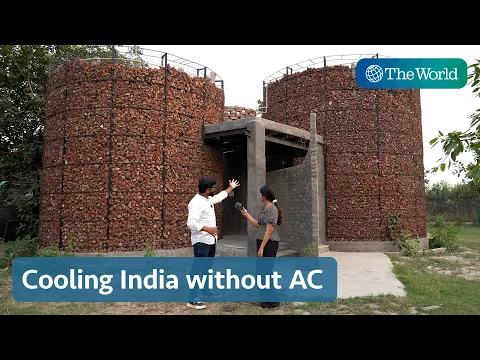

The starting point of this project is the concept of a system based on nature. Instead of sealing the building to prevent any air exchange, the proposal is exactly the opposite: to keep the space naturally ventilated, allow wind flow, and create cycles of energy exchange between the interior and exterior.
The architect behind this solution, Monish Siripurapu, saw in terracotta and water a way to reduce reliance on mechanical systems.
Instead of creating yet another machine, he designed structures that function as the skin of the building, filtering and cooling the air that enters.
The central idea is simple: if the facade or window starts to contribute to the cooling, the building requires less effort from air conditioning.
This makes it more feasible to cool buildings without air conditioning all the time, using the equipment only in essential areas or during the hottest hours.
Terracotta, Water, and Inspiration from a Beehive
In the studio set up in an old stable on the outskirts of Delhi, the architect and his team test different shapes and arrangements of terracotta pieces.
One of the most striking structures is inspired by a beehive. Instead of smooth walls, a panel with dozens of hollow clay cones, fitted side by side, emerges.
When water is poured over the top, these cones become moist and begin to act as small cooling surfaces.
When touching the terracotta, it is possible to feel that it is cooler than the surrounding air, even without visible droplets of water running down.
The wind that passes between the cones contacts this moist surface and reaches the interior of the space at a lower temperature, thanks to evaporative cooling.
The innovation is not just in the physics of the process, which has been known for centuries, but in how to apply this logic. In some prototypes, the same terracotta panel functions as a hybrid of vertical garden and evaporative system, combining shade, evaporation, and air filtration.
Thus, a single structure can simultaneously block direct radiation, reduce the temperature of the wind that passes through, and create an aesthetic element on the facade.
By updating this technique, the architect revives traditional practices such as using clay pots and water jars to cool spaces and, at the same time, transforms these elements into repeatable modules.
The goal is for cooling buildings without air conditioning to stop being just a memory of vernacular architecture and become a real alternative in super-hot cities.
From Experimental to 70 Installations in Homes, Factories, and Public Spaces

The system has not been confined to the lab. According to the architect himself, there are already about 70 installations spread across India, in homes, public spaces, and factories.
In some projects, the terracotta panels are installed in windows; in others, they become large facades that wrap part of the building.
The energy required to operate is minimal: basically, moving the water from time to time, by pump or gravity, to keep the surface moist.
Other than that, the system works with the wind that already exists and with the terracotta’s ability to retain and release moisture.
This energy simplicity works especially well in contexts where there are recurring blackouts.
If the goal is to continuously cool buildings without air conditioning, it makes a difference to have a solution that continues to function even when the grid fails or when the use of machines needs to be reduced to relieve the electrical system.
Each Climate, A Different Solution for Natural Cooling
An important point is that these systems do not work like conventional air conditioning, which theoretically can be installed anywhere and programmed to deliver the same result every time. In the case of nature-based solutions, the local climate and environmental conditions are part of the project.
Therefore, there is no single solution valid for 100% of spaces. Instead of a standard model, the team develops variations in design and different combinations of shading, evaporation, and ventilation to adapt the system to each use and each city.
The idea is to customize the way to cool buildings without air conditioning based on the climate, humidity, wind direction, and type of building.
This approach recognizes that there is no perfect solution and that the gain lies in reducing the reliance on mechanical systems, not in eliminating them entirely.
In some situations, the natural aspect accounts for most of the thermal comfort, and air conditioning appears only as a supporting element. In others, the two technologies work in parallel, with a more balanced division of effort.
Less Than Eight Hours of Air Conditioning, More Balance in Indoor Climate
In practice, the impact of this type of system shows up in the usage time of cooling machines.
Instead of keeping the air conditioning on eight hours a day, the goal becomes to concentrate use in two or three hours, during extreme heat moments, and rely on the natural system during other hours.
This load reduction has a direct effect on both the electricity bill and the pressure on the grid.
On a neighborhood or city scale, if many buildings adopt similar strategies to completely cool buildings without air conditioning, the result is a lower consumption peak and less likelihood of cascading blackouts.
At the same time, the resident begins to experience a different relationship with the indoor environment.
Instead of depending on hermetically closed windows and a single machine, thermal comfort also comes from shade, airflow, and interaction with simple materials.
It is a combination of current technology with ancient wisdom, aimed at a future where extreme heat is likely to be more frequent.
Given this scenario, where nights of 95 ºF and power outages are already part of the routine, what path do you think is more promising for the future of cities: to increasingly rely on traditional air conditioning or to bet on solutions that help to cool buildings without air conditioning all the time, combining nature and technology?







THANKS FOR HIGHLIGHTING THIS PROJECT!
Where is the source for the project info & results?
Also: 1) in what climate conditions does this method work, 2) how will it work in future climate scenarios, 3) is microbial growth a problem over time, 4) how much water is needed ?