





 Portuguese
  English
  Spanish
  5 min of reading
  0 comments


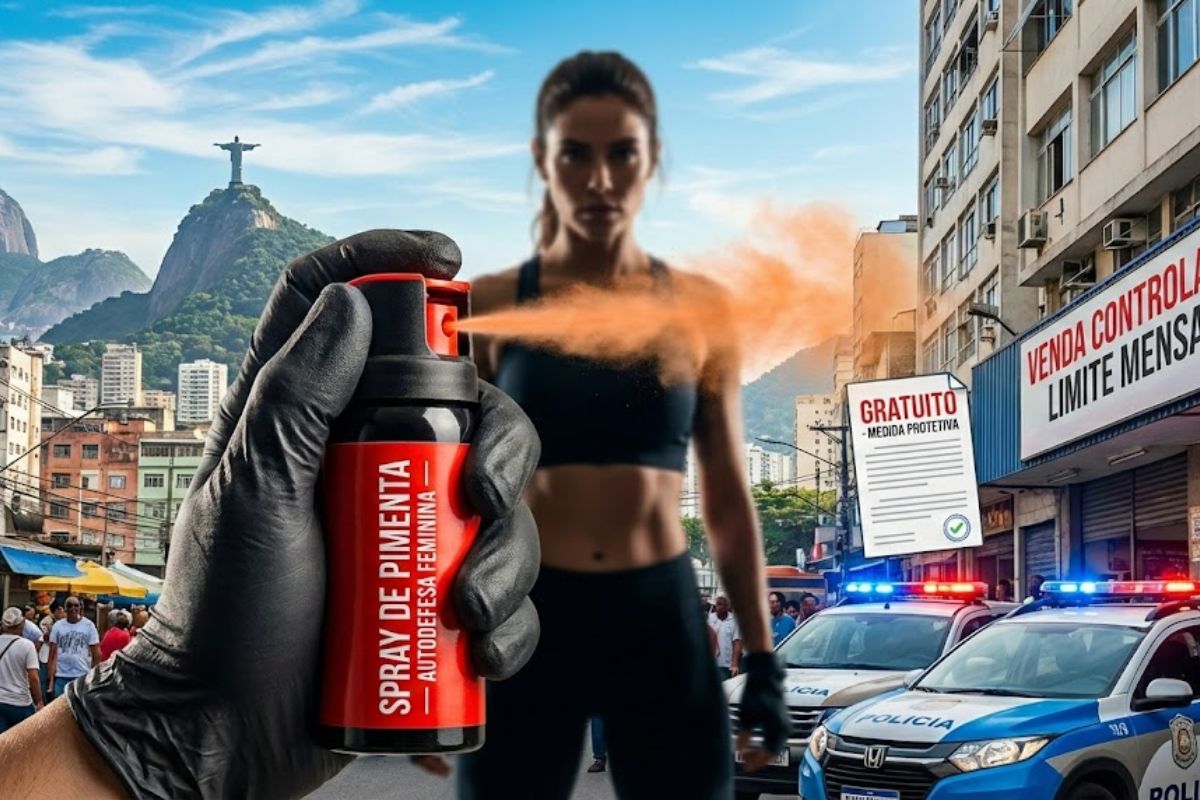
Castro Law Regulates Pepper Spray Allowed in RJ, Sold Only in Pharmacies, Concentration Limited to 20 Percent, Two Units Per Month, Minimum Age of 18 Years, and Free for Women with Protective Measures Reimbursed Later by Convicted Aggressors, While the State Becomes a Reference in National Female Self-Defense.
With the pepper spray allowed officially for female self-defense, Governor Cláudio Castro signed a law that makes Rio de Janeiro the first Brazilian state to regulate the civil use of the product. The measure creates specific rules for sale, maximum quantity, and free provision in cases of violence, directly targeting the protection of women in vulnerable situations.
In practice, the text defines where the spray can be sold, to whom, in what quantity, and with what concentration limit. The proposal combines the allowed pepper spray for civil use with a package of strict controls, trying to balance the right to defense of women and concerns about the misuse of the product on the state’s streets.
How the New Pepper Spray Law Works in RJ
The law signed by Castro authorizes the use and sale of sprays with plant extracts, like pepper, for female self-defense purposes. With this, Rio becomes the first state in the country to have pepper spray allowed clearly for the civil public, but within a closed set of rules.
-
Italian researchers have detected what appears to be a second Sphinx buried under the sands of Egypt, and satellite scans reveal a gigantic underground megastructure hidden beneath the Giza Plateau for over 3,000 years.

-
There are 4,223 drums and 1,343 metal boxes concreted with 50-centimeter walls that store the radioactive waste from Cesium-137 in the worst radiological accident in Brazil, just 23 kilometers from Goiânia, with environmental monitoring every three months.

-
Giant Roman treasure found at the bottom of Lake Neuchâtel in Switzerland reveals an advanced trade system, circulation of goods, and armed escort in the Roman Empire about two thousand years ago.

-
He buried 1,200 old tires in the walls to build his own self-sufficient house in the mountains with glass bottles, rainwater, and an integrated greenhouse.


According to the text, the spray can only be sold in pharmacies, and the maximum authorized concentration is 20 percent. This limitation seeks to prevent stronger products, aimed at professional security use, from circulating freely in common retail.
The authorization specifically applies to female self-defense, focusing on situations of real risk.
Who Can Buy and What Are the Limits of Use
Even with the pepper spray allowed, not just anyone can simply walk into the pharmacy and fill their bag. The law requires buyer identification and establishes a strict ceiling: a maximum of two units per person per month.
Another barrier is age. Purchase is allowed from 18 years old. For young people between 16 and 17, access is only permitted with formal authorization from guardians.
In practice, the state allows pepper spray, but ties its use to age criteria and monthly limits to avoid excessive stockpiling and diversion of purpose.
Additionally, the text defines physical parameters of the product. Packages of up to 70 grams are considered suitable for civil use, while bottles over 50 milliliters are classified as restricted use for security forces.
In other words, what is valid for the population is the small, portable bottle, designed for short-distance self-defense.
Free Provision for Women with Protective Measures
One of the most sensitive points of the law is the treatment given to women who already live under concrete threat. For those with a valid protective measure, the pepper spray allowed can be provided free of charge.
The idea is simple and direct: if the court has already recognized that the woman is at risk, the state helps ensure a minimum defense instrument.
The cost of this free spray does not fall on the victim. The law stipulates that the amount must be reimbursed by the aggressor while the court decision is in effect.
In other words, the one who caused the risky situation is the one who pays for the increase in protection, aligning the discourse of accountability with a concrete financial mechanism.
Controlled Sale and Regulated Civil Use
By detailing concentration, monthly limits, points of sale, and free provision, Rio de Janeiro inaugurates an experience of pepper spray allowed with controlled sale.
It is not a loose authorization, but a model in which the state knows where the product is sold, to whom, and under what conditions.
The parameters defined in the law, such as packages of up to 70 grams for civil use and the classification of larger bottles as exclusive to security forces, work as a regulatory fence.
The message is that pepper spray is accepted as a tool for self-defense, but not as a toy or weapon for indiscriminate use in any context.
Political Reaction and Impact on the Protection of Women
Deputy Sarah Poncio, author of the proposal, celebrated the sanction and emphasized the practical weight of the measure in real life.
According to her, the existence of allowed pepper spray can be decisive in critical seconds, that interval when a woman is at risk and help has not yet arrived.
In public statements, the parliamentarian stated that she did not see resistance among women to the measure. During the deliberation, she reported that she found no negative comments from the female public, only from men, which, in her view, reveals some discomfort from them with the fact that women seek instruments for their own right to protect themselves.
RJ as the First Laboratory of Allowed Pepper Spray in the Country
With the sanction, Rio takes on the role of the first state laboratory with allowed pepper spray and regulated for civil use.
The way the law will be applied in practice, the behavior of pharmacies, the uptake of women with protective measures, and the impact on cases of violence may become a reference for other states.
If the results show a reduction in risks, strengthening of the sense of security, and good control of sales, it is likely that the discussion will spread.
The experience in Rio de Janeiro can pave the way for allowed pepper spray, under clear rules, becoming part of the protective policy for women in other states.
Given all this, do you think having pepper spray allowed with controlled sale and free provision for protected women really increases their safety in daily life, or should it come along with other even harsher measures against aggressors?










-

2 pessoas reagiram a isso.