Portuguese
  Spanish



Find in Switzerland details how the transport of goods and logistical protection worked in the ancient Roman world
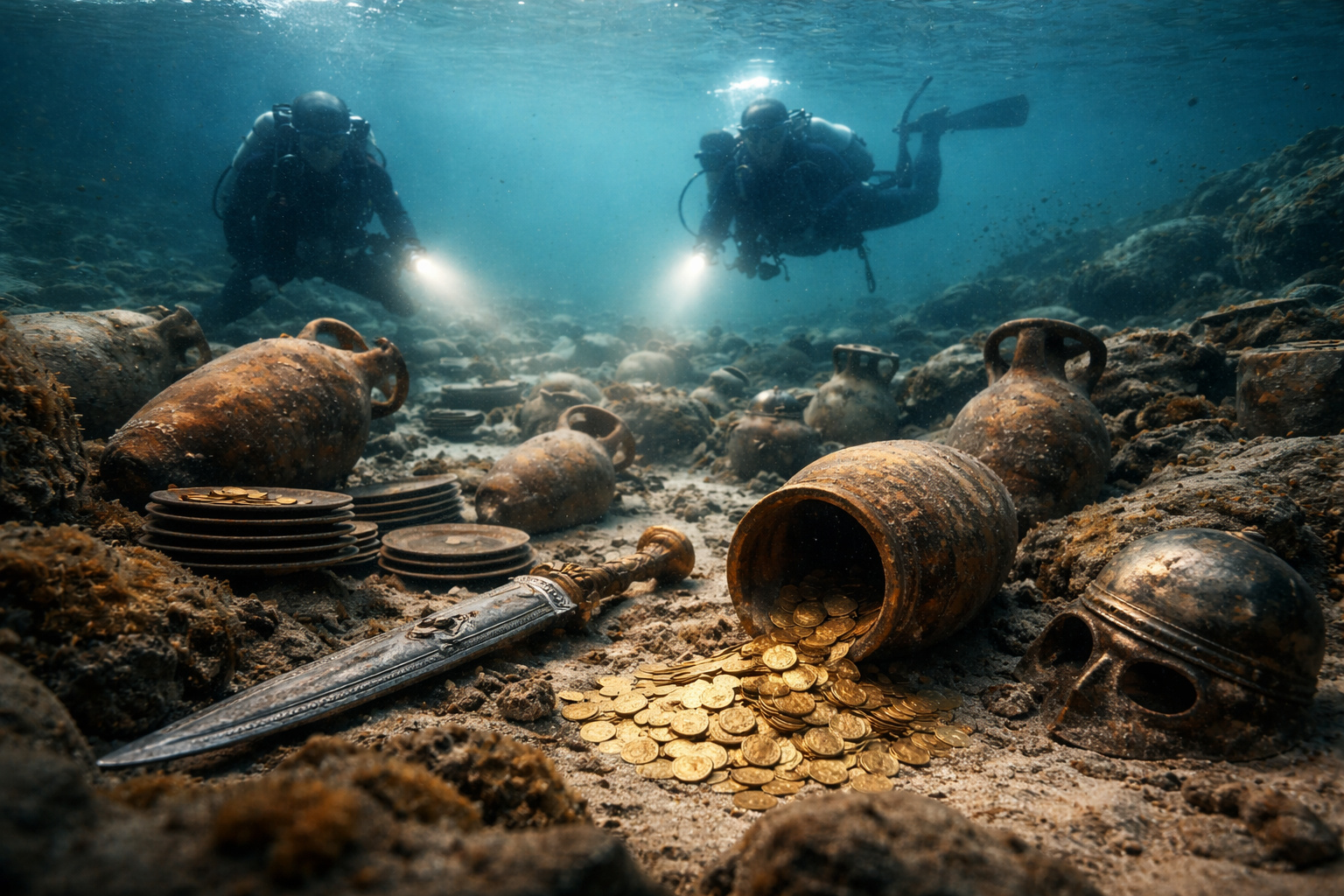
Excavations began in March 2025, when divers confirmed the presence of unusual submerged materials. From there, teams recovered hundreds of objects, expanding the understanding of Roman trade.
Among the items found are ceramics, oil amphorae, and weapons, which help reconstruct how trade exchanges operated during the period. The discovery reinforces the importance of submerged environments for historical preservation.
-
13-Year-Old Raises Funds to Build Well, Transforming Lives in Cambodian Community Lacking Clean Water

-
Man with Metal Detector Finds Medieval Silver Seal in England, Uncovers 2,000-Year-Old Roman Gem with ‘Richard’s Secret’

-
Thailand Converts 8 Tons of PET Bottles into 3,500 School Backpacks, Showcasing Circular Economy with Over 40 Factories Involved

-
Mysterious Bats Spotted in Paris’s Père Lachaise Cemetery, Drawing Tourists to the “Vampire Cemetery”




Archaeological investigation reveals dynamics of Roman trade
The investigation began after images indicated unusual structures on the lake’s bottom. Consequently, teams initiated technical dives to verify the origin of the materials.
Experts confirmed that the traces belong to a shipwreck that occurred between 20 and 50 AD, a period of intense economic activity in the Roman Empire.
The structure of the vessel did not withstand the test of time, which is common in submerged environments. However, the cargo remained preserved and caught the attention of archaeologists.
Researchers identified several items that help understand the circulation of goods:
- Plates, bowls, and ceramic cups, linked to regional production
- Amphorae used to transport oil, from the Iberian Peninsula
- Various objects indicating constant trade exchanges

The diversity between local and imported items highlights the commercial integration between regions. The site functioned as an active point for the circulation of goods through land and water routes.
Presence of weapons suggests protection in cargo transport
The presence of weapons changed the interpretation of the shipwreck. Archaeologists identified gladii, short swords typical of Roman soldiers.
This detail indicates that the vessel was not military. Still, it operated with armed protection during transport.
The evidence shows that trade routes presented significant risks. Therefore, some level of security was necessary to protect the goods.
The presence of these items broadens the understanding of Roman logistics. It demonstrates that protection was part of commercial operations.
State of preservation allows new analyses on the Roman Empire
The excellent state of preservation of the objects caught the attention of specialists. The submerged environment preserved the materials over two thousand years.
This factor allows for more detailed analyses in the future. Researchers will be able to deepen studies on production and trade.
Among the main points that should be analyzed, the following stand out:
- Manufacturing techniques used at the time
- Economic organization of the Roman Empire
- Structure of ancient trade routes
The data helps to better understand Roman logistics. The discovery reinforces the value of submerged finds for science.