





 Portuguese
  English
  Spanish
  6 min of reading
  0 comments


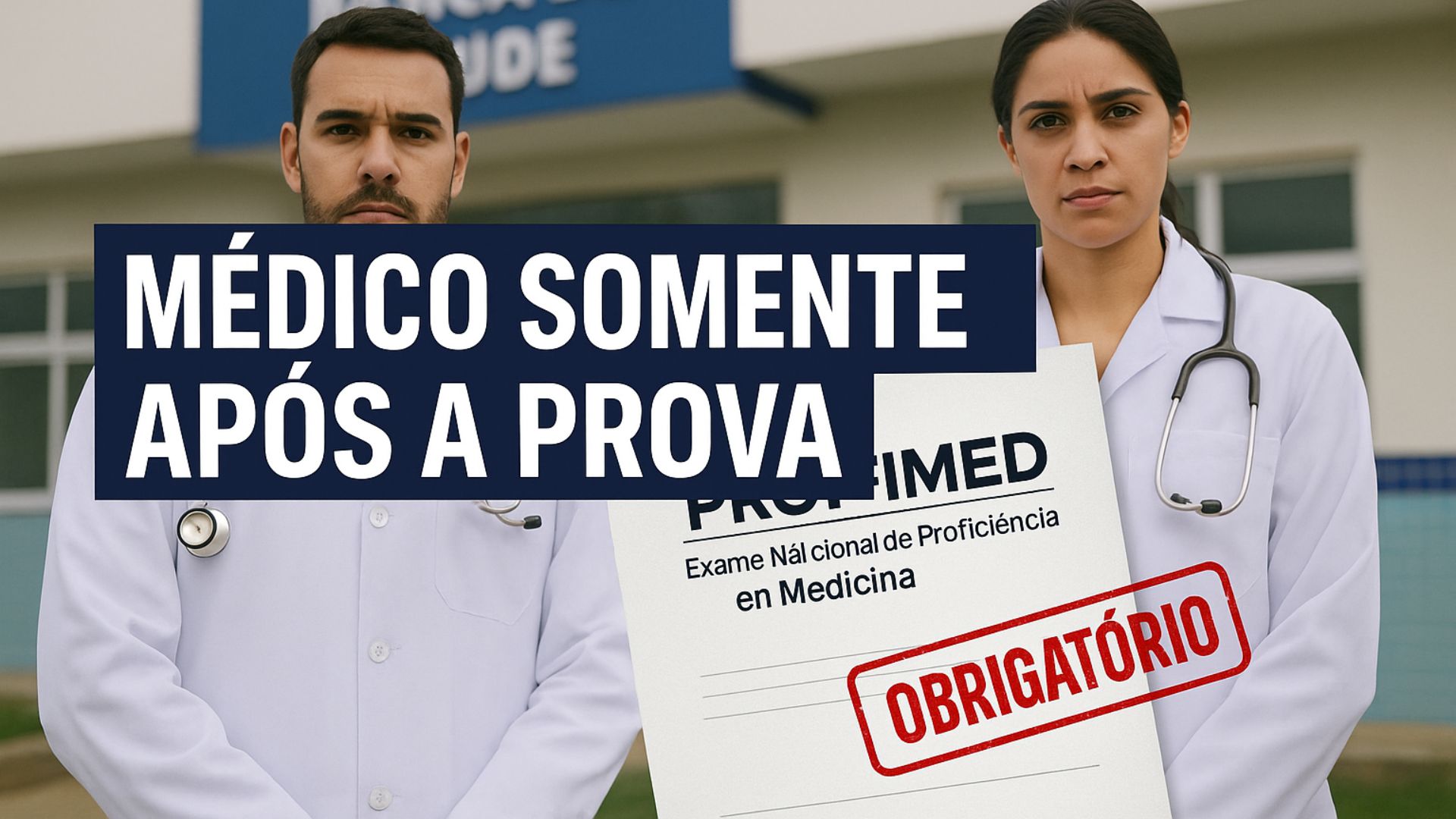
National Exam Will Redefine Entry into Medicine, Change Evaluation Rules for Colleges, and May Impact Residency Offers, Creating a New Professional Filter in the Country.
The Senate’s Social Affairs Committee (CAS) approved, on Wednesday (3), by 11 votes to 9, the bill that establishes the National Proficiency Exam in Medicine (Profimed) as a mandatory condition for new doctors to obtain registration with regional councils and practice clinically in the country.
The proposal still needs a second round of voting in the CAS itself before going to the Chamber of Deputies.
The exam, nicknamed “OAB of Medicine”, will be coordinated and administered by the Federal Council of Medicine (CFM).
-
The Argentine government celebrates the lowest poverty rate in 7 years, but experts warn that the methodology has changed, real wages have fallen, unemployment has risen, and the number of people on the streets of Buenos Aires has increased by 57% since Milei took office.

-
7.8 magnitude earthquake in Indonesia frightens the population, triggers tsunami alert, and hits an island with over 200,000 inhabitants this Thursday.

-
Google will finally let you change that embarrassing Gmail address you created in your teenage years without losing any accounts, logins, or old emails: the feature is already available in the United States.

-
Heading to Brazil in a Bonanza F33 single-engine aircraft: a couple departs from Florida on a visual flight, makes technical stops in the Caribbean to refuel and organize paperwork, and begins the staged crossing until they reach the country.


The evaluation is expected to occur at least twice a year and will focus on verifying professional and ethical competencies, theoretical knowledge, and minimum clinical skills for the safe practice of the profession.
Individual results will be confidential and sent only to the ministries of Education and Health, which may use them for regulatory purposes.
According to the text under discussion, the model will reference exams adopted in countries such as Canada, the United States, and the United Kingdom, with an emphasis on objective criteria centered on patient safety.
The national exam will become a prerequisite for the issuance of the professional registration number, which is the CRM.
Medical Education and New Evaluation Rules
The bill approved in the CAS is a substitute presented by Senator Dr. Hiran (PP-RR) to PL 2.294/2024, authored by Senator Astronaut Marcos Pontes (PL-SP).
The proposal is not limited to creating the Profimed; it reorganizes evaluation instruments throughout medical education.
The text enshrines into law the National Evaluation Exam for Medical Education (Enamed), currently structured as a federal government program.
Fourth-year medical students will be required to take this exam, under the coordination of the Ministry of Education (MEC), with the goal of assessing the quality of courses and mapping deficiencies in practical and theoretical training.
The Profimed, taken at the end of the degree, will be the responsibility of the CFM.


The rationale advocated by the councils is that the MEC will remain responsible for evaluating students and institutions, while the professional councils will be tasked with verifying whether graduates are qualified to practice medicine.
The proposal also indicates that aggregated performance in Enamed and Profimed could serve as a basis for supervisory measures and potential penalties for courses with systematically unsatisfactory results.
Colleges with a high failure rate may be subject to actions by the MEC, ranging from improvement plans to restrictions or closure of vacancies.
Another significant point is the provision that passing the Profimed will be equivalent to passing both stages of Revalida, an exam used to validate medical diplomas obtained abroad.
The intention is to avoid duplicity of requirements for those who have already passed a national proficiency exam.
Who Will Need to Take the Profimed
The text establishes that the Profimed will be mandatory for newly graduated doctors who complete their course after the law comes into effect.
Without passing the exam, the doctor will not be able to obtain registration for clinical practice.
The proposal exempts two main groups from the new requirement: doctors who already have active registration with regional councils and students who began their courses before the law’s enactment.
In these cases, practicing the profession remains subject to the current rules.
For those who graduate under the new regime and do not achieve the cutoff score, the project creates the Graduate Registration in Medicine (IEM).
With this specific registration, the professional will only be able to perform technical-scientific activities, without direct patient care and always under supervision.
In practice, those with the IEM may work, for example, in clinical research, in technical areas of the health industry, in specialized consultancy, or in support roles in health teams, but without assuming responsibility for consultations, prescribing treatments, or invasive procedures.
The comparison made by representatives of the CFM is with law.
“In law, for example, individuals who do not pass the bar exam can take tests and work in certain office roles.”
Medical Residency and Effects on Colleges
The project also mandates that the ministries of Health and Education develop a joint plan for expanding medical residency positions, aiming to achieve, by 2035, at least 0.75 residency positions for each graduate from medical school.
The expansion, however, is conditioned on meeting minimum quality criteria, such as adequate healthcare structure and qualified teaching staff in training services.
There is also a reinforcement of the Union’s authority to authorize, accredit, and supervise medical courses.
In a scenario of strong expansion in the number of medical schools in the country, the performance of classes in the Enamed and Profimed should serve as an objective indicator to support decisions about opening vacancies, renewing recognition, and potential sanctions for institutions with persistently poor results.
CFM-affiliated doctors, such as counselor Antônio Meira, argue that the exam can serve as an incentive for colleges to revise pedagogical projects, enhance practical training, and closely monitor the performance of their graduates.
In interviews, he argues that high failure rates in the Profimed will highlight deficiencies in teaching and pressure for internal improvements.
Criticism of the Single Exam Model and CFM’s Oversight
Despite the approval in the CAS, the debate was marked by divergences.
Senators from different parties agreed on the need for a national evaluation standard, but questioned the idea of concentrating the decision about the graduate’s professional future in a single exam at the end of the course.
Parliamentarians also expressed concern that the exam would be conducted by the CFM rather than the MEC.
Critics argue that the evaluation of graduates should remain within the state’s educational structure, under the coordination of the ministry responsible for higher education policy.
In the view of the majority of the CAS, however, the model that separates responsibilities prevailed: MEC evaluates courses and students during their education while CFM verifies readiness for professional practice.
Another recurring criticism concerns the possibility that the exam may exacerbate inequalities among students from different socioeconomic backgrounds.
The concern is that those with more resources could invest in specific preparatory courses, potentially widening the gap between graduates from public institutions and those from private institutions with lesser resources.
Members of the CFM respond that a good education over the six years of the course should be sufficient to ensure the minimum required performance.
What the Profimed Will Be Like and CFM’s Justification
The final format of the Profimed is not yet defined.
A technical group, with expected participation from the MEC, the Ministry of Health, and medical entities, is working on designing the evaluation.
The announced intention is to build an exam with clear questions, objective criteria, and practical components that allow assessing essential skills for care in common and emergency clinical situations.
The CFM states that it has studied models used in countries such as Canada, the United States, and England, where national evaluations of graduates are conducted by bodies independent of universities.
The central defense is that Brazil is experiencing rapid and unequal expansion of medical courses, often without adequate practical training opportunities, insufficient faculty, or structures incompatible with the number of vacancies.
For the entity, the Profimed would function as a filter to ensure a minimum standard of quality in medical training and, at the same time, as a patient protection mechanism.
This raises a broader debate: Will the mandatory exam increase the safety of medical care or create a new barrier for those completing their degree?








-

-

-

5 pessoas reagiram a isso.