





 Portuguese
  English
  Spanish
  6 min of reading
  1 comment


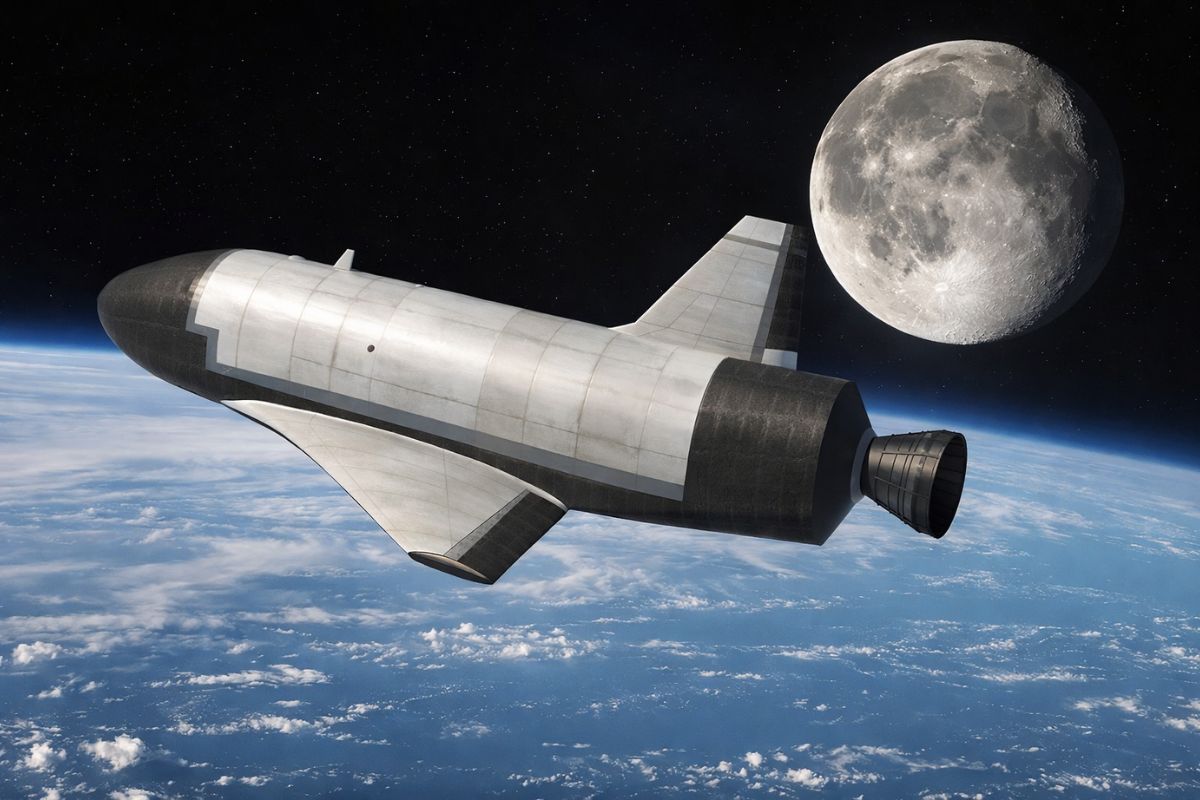


China Confirms, In Brief Note From Xinhua, The Launch Of A Reusable Craft On A Long March-2F Rocket, Without Revealing Form, Mission Or Cargo. It Is The Fourth Mission Since 2020, With Flights Of 2, 276 And 268 Days, Targeting Data For The Moon Before 2030 And Pressuring Western Rivals.
China has carried out another test of its reusable spacecraft with a level of secrecy that, in itself, communicates intent. For years, Elon Musk and SpaceX have insisted that Mars would be the next leap, while others have insisted that the Moon remains strategic, and the landscape shifted when Beijing accelerated its own plans.
What is known now comes from a few sentences: there was a launch from one of its bases, with the vehicle attached to a Long March-2F rocket, and the mission was described as “experimental,” aimed at technological verification. When China publishes little and repeats flights, it forces the world to read the program by its pace, duration in orbit and the declared target, the Moon before 2030.
Secrecy As A Method And What China Really Confirms

The statement claims that the reusable craft will perform technological verification and provide data and technical support for the “peaceful use of space.”
-
Motorola launched the Signature with a gold seal from DxOMark, tying with the iPhone 17 Pro in camera performance, Snapdragon 8 Gen 5 that surpassed 3 million in benchmarks, and a zoom that impresses even at night.

-
Satellites reveal beneath the Sahara a giant river buried for thousands of kilometers: study shows that the largest hot desert on the planet was once traversed by a river system comparable to the largest on Earth.

-
Scientists have captured something never seen in space: newly born stars are creating gigantic rings of light a thousand times larger than the distance between the Earth and the Sun, and this changes everything we knew about stellar birth.

-
Geologists find traces of a continent that disappeared 155 million years ago after separating from Australia and reveal that it did not sink, but broke into fragments scattered across Southeast Asia.

It is a broad statement, with no list of systems, no description of cargo, no indication of flight profile, and no details that would allow for comparisons of architecture, dimensions, or capabilities.
Even so, the minimum information is important because it defines the framing. By confirming the launch on the Long March-2F, China makes it clear that the mission enters the backbone of its access to space.
The secrecy may conceal the design, but it does not hide the repetition, and repetition in space programs usually means accumulated learning.
This pattern also pushes the debate into a delicate territory: “transparency” becomes a political choice.
China calls the vehicle a “experimental” reusable craft and speaks of peaceful use, but the lack of technical data pushes observers to work with indirect signals, such as timeline and time in orbit, instead of specifications.
Fourth Mission Since 2020 And Why The Duration In Orbit Becomes A Strategic Piece Of Data
According to reports, this is the fourth mission of the reusable craft since 2020. In the first flight, in 2020, the vehicle is said to have remained in orbit around Earth for two days.
Subsequently, the program extends the time: launch in 2022 and return in 2023, after 276 days, and another launch in September 2024, with return after 268 days.
The point is not just the number of days; it’s what the duration suggests in terms of objectives.
The longer China keeps a reusable craft in orbit, the more opportunities it has to test materials, control systems, operational routines, and return conditions, as well as measure degradation and performance over an extended cycle.
There is also the risk management aspect. Long missions require planning, monitoring, and tolerance for uncertainties.
By repeating flights and maintaining stays of 276 and 268 days, China signals that it is collecting data from a complete cycle, from launch to return, with a design that could be reused in future missions, including on the way to the Moon.
X-37B, Shenlong And The Border Between Speculation And Official Information
As the secrecy is almost total, the gap becomes a ground for comparisons. The report mentions speculation that China’s reusable craft could be a response to the U.S. Air Force’s robotic X-37B vehicle in the United States.
The hypothesis works as a narrative because reusable programs and long-duration missions in orbit tend to be placed on the same shelf, even when the details do not emerge.
But it is necessary to separate what is stated from what is suggested. Neither Reuters nor Xinhua comment that the vehicle could be the Shenlong, the “Divine Dragon,” often pointed out as a competitor to the X-37B.
Without confirmation of name, shape, or role, the comparison becomes a political thermometer, not a technical description.
The same applies to the parallel with reusable rockets. The report reminds us that if the conversation is about responses to the Falcon, China also has a name on the table: LandSpace.
What ties it all together is the practical effect of secrecy: the West needs to plan without knowing parameters, and this asymmetry could turn into an advantage through accumulated testing, not a single announcement.
80 Launches In 2025 And The Pace That Changes The Conversation
The reusable craft is the most mysterious piece, but it appears within a larger framework of acceleration. The report states that China conducted 80 orbital launches in 2025, surpassing the previous record of 68.
At the beginning of December, it completed four space missions in four days, in a test described as overload, aimed at measuring whether its systems can handle multiple missions simultaneously.
This type of test matters less for the spectacle and more for the capability to sustain a continuous agenda.
A China that operates at a high cadence reduces the interval between failure, correction, and new flight, accelerating technological, logistical, and organizational maturity. In the space race, schedule and repetition count almost as much as hardware.
It is here that the reusable craft gains another layer of meaning. If China increases launches and also sustains long missions, it attacks two fronts at once: quantity and persistence.
And since the recent launch was confirmed in a brief note, with Long March-2F, the message is clear that the country treats the program as part of the core, not as a showcase.
Moon Before 2030, Artemis And The Logic Of Space Sovereignty
The cited medium-term objective is straightforward: China wants to send astronauts to the Moon before 2030.
The report frames this as competition with NASA and its Artemis mission to establish a research base on the satellite, while Beijing finalizes the construction of its own space station.
In this context, the reusable craft enters as a learning tool, even without public details. Reuse, controlled return, and prolonged operation programs align with a vision of autonomy.
Reaching the Moon is not just about landing; it is about sustaining logistics, testing systems, reducing costs through repetition, and turning data into operational advantage, and China seems to be pursuing exactly this type of incremental gain.
The report also points out why the Moon has returned to the center: value for experiments related to sovereignty on other planets and the prospect of resources exploitable and transferable to Earth.
In this scenario, each confirmed mission, each repeated cycle, and each time in orbit becomes a sign of direction, especially when the explicit target is the Moon before 2030.
With few sentences and much silence, China has added another chapter to its reusable craft program, already in its fourth mission since 2020, reinforcing a strategy of advancement through cadence and persistence in orbit.
The confirmation of the launch on the Long March-2F keeps the project at the center of the space effort, while the Moon appears as the horizon before 2030.
In your reading, what decides the dispute from 2026 onwards: China accumulating data with a reusable craft in secrecy, the rhythm of 80 launches in 2025, or the goal of the Moon before 2030 that forces the West to redo plans and deadlines?








Quando é da China ou da Russia é misterioso, incerto, paira desconfiança, etc, mas quando é de Elon Musk ou EUA, aí é tudo previsível, claro, honesto e humanista. Esses americanos sâo gente boa, tão bonzinhos.