





 Portuguese
  English
  Spanish
  3 min of reading
  0 comments


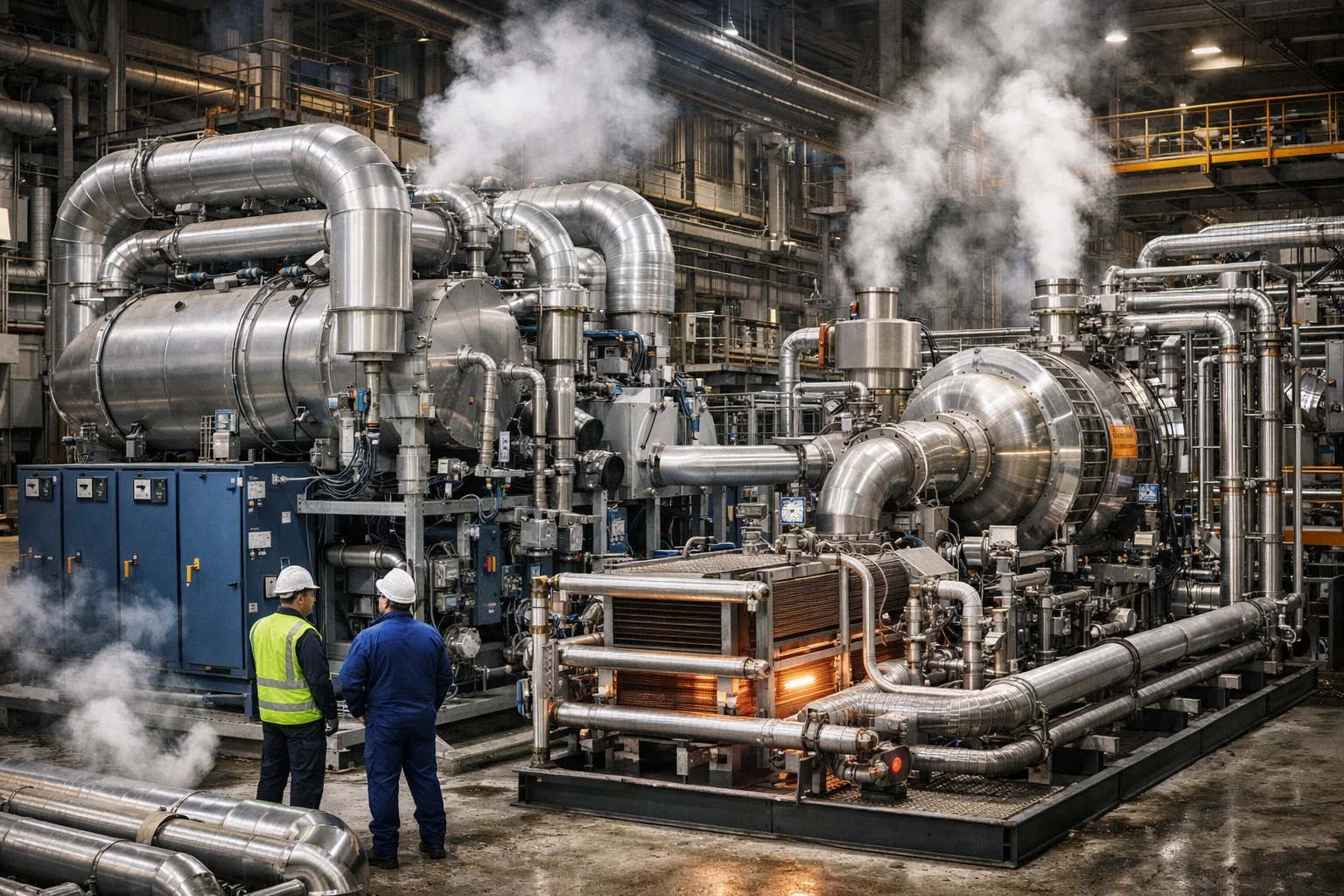
Mitsubishi Starts Up The World’s Largest Vapor Heat Pump Operating At 12 MW Thermal, Producing Superheated Steam Up To 180 Degrees Using Carbon-Free Electricity And Promising To Cut 19,000 Tons Of CO2 Annually In Heavy Industry.
The heavy industry has just gained a direct competitor to traditional combustion boilers. What is described as the world’s largest vapor heat pump is now operational, capable of generating 12 MW thermal and producing superheated steam for demanding industrial processes.
The target is clear: replace steam produced with fossil fuels and cut about 19,000 tons of CO2 per year. In a sector known for high emissions, this changes the game.
And this isn’t a laboratory prototype. The system is already operating inside a real factory.
-
Motorola launched the Signature with a gold seal from DxOMark, tying with the iPhone 17 Pro in camera performance, Snapdragon 8 Gen 5 that surpassed 3 million in benchmarks, and a zoom that impresses even at night.

-
Satellites reveal beneath the Sahara a giant river buried for thousands of kilometers: study shows that the largest hot desert on the planet was once traversed by a river system comparable to the largest on Earth.

-
Scientists have captured something never seen in space: newly born stars are creating gigantic rings of light a thousand times larger than the distance between the Earth and the Sun, and this changes everything we knew about stellar birth.

-
Geologists find traces of a continent that disappeared 155 million years ago after separating from Australia and reveal that it did not sink, but broke into fragments scattered across Southeast Asia.

The Billion-Dollar Challenge of Heavy Industry That Depends On Steam Above 150 Degrees And Still Burns Fossil Fuel
A large part of the paper, chemical, and food industries relies on steam at high temperatures, often above 150 degrees.
For decades, the dominant solution was the gas or other fossil fuel-fired boiler. The result is a heavy environmental bill.
According to industry estimates, industrial steam production accounts for billions of tons of global emissions over the years. Only initiatives aimed at replacing boilers point to a massive reduction potential.
The problem has always been technical and economic: how to generate sufficiently hot steam, with stability and industrial volume, without burning fuel?
The Secret Behind The Electric Giant That Transforms Wasted Heat Into Superheated Steam
The answer came with an unusual combination at scale: a large-scale heat pump integrated with a mechanical vapor recompression system.
What happens is that the installed system generates 12 MW thermal, superheated steam at 3.4 bar of pressure, and temperatures between 150 and 180 degrees.
It captures low-temperature waste heat that would previously be discarded in the industrial process and elevates it to a useful level using carbon-free electricity.
This is the detail that attracts attention behind the scenes: transforming thermal waste into strategic energy. It is fine engineering applied to heavy decarbonization.
According to the company responsible, the equipment is operating with a performance about 10 percent above the guaranteed coefficient of performance, a sign of efficiency beyond expectations.

The Silent Dispute Between Fossil Boilers And Thermal Electrification Enters A New Chapter Inside A Real Factory
The system was installed at the Delfort plant, a global manufacturer of specialty papers. The requirement was clear: completely decarbonized steam, but with the same reliability as conventional boilers.
The solution had to fit within an existing area of the factory. Limited space, complex integration, and continuous operation were challenges faced in the project.
The electric thermal power plant was fully connected to the plant’s heat generation infrastructure. In other words, this is not an isolated test. It is embedded in the core of industrial operation.
This move puts pressure on the traditional boiler market. If the technology proves commercially viable on a large scale, fossil equipment manufacturers will have to react.
The Domino Effect That Could Accelerate The Electrification Of Industrial Heat In The Coming Years
Industry experts see the electrification of heat as one of the last frontiers of the industrial energy transition.
While electric generation is already advancing with renewable sources, process heat still relies heavily on fossil fuels.
Projects like this show that it is possible to achieve high industrial temperatures using carbon-free electricity and residual heat recovery.
If replicated in other paper, chemical, and food plants, the impact could be significant in reducing direct emissions, known as Scope 1.
The question that is beginning to circulate in the industry is straightforward: how many factories will still maintain fossil boilers if a viable technical alternative exists at an industrial scale?
The startup of the world’s largest vapor heat pump is not just a technical milestone. It is a clear message to heavy industry that the decarbonization of heat has ceased to be a promise and has become an operational reality.
And you, do you believe that the electrification of industrial steam can eventually replace combustion boilers in the coming years? Leave your opinion in the comments.








-

-

-

4 pessoas reagiram a isso.