





 Portuguese
  English
  Spanish
  4 min of reading
  0 comments


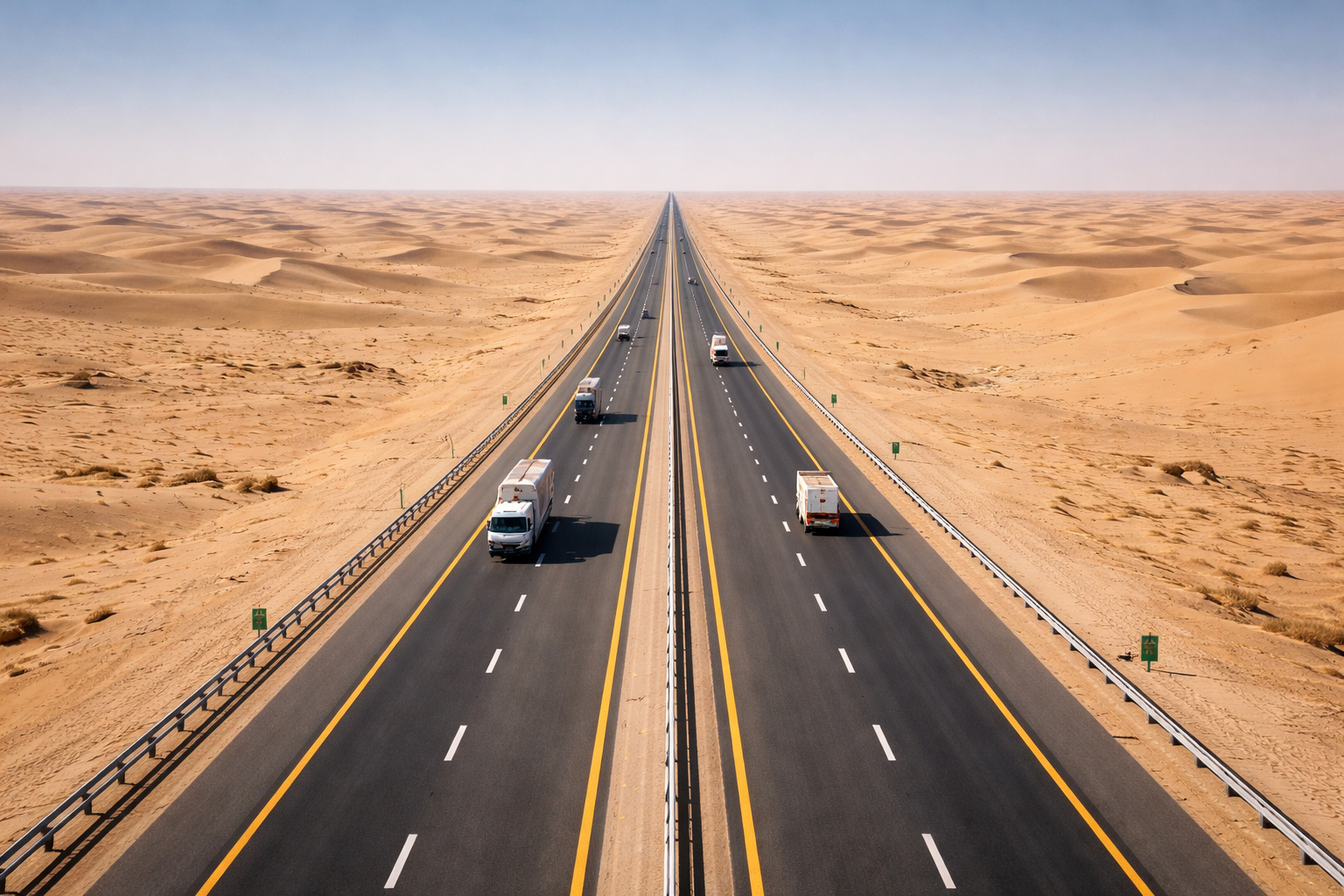
Linear Stretch of Highway 10 Crosses the Rub’ al Khali, Sustains Heavy Truck Traffic, and Challenges Drivers Mentally
The Highway 10, in Saudi Arabia, entered the Guinness World Records by registering a continuous stretch of 240 kilometers completely straight. Guinness confirmed the record after technical measurements and officially recognized the segment between Haradh and Al Batha as the longest linear stretch on the planet.
Drivers travel for more than two hours without moving the steering wheel, in the heart of the Rub’ al Khali desert. The highway extends for 1,480 kilometers and connects Ad Darb to the border with the United Arab Emirates.
The Saudi government initially built the road for the use of King Fahd. Later, it integrated the road into the public network and transformed it into a strategic freight transport corridor.
-
Friends have been building a small “town” for 30 years to grow old together, with compact houses, a common area, nature surrounding it, and a collective life project designed for friendship, coexistence, and simplicity.

-
This small town in Germany created its own currency 24 years ago, today it circulates millions per year, is accepted in over 300 stores, and the German government allowed all of this to happen under one condition.

-
Curitiba is shrinking and is expected to lose 97,000 residents by 2050, while inland cities in Paraná such as Sarandi, Araucária, and Toledo are experiencing accelerated growth that is changing the entire state’s map.

-
Tourists were poisoned on Everest in a million-dollar fraud scheme involving helicopters that diverted over $19 million and shocked international authorities.



Rub’ al Khali Desert Explains Completely Linear Path
The highway crosses the Rub’ al Khali, known as the Empty Quarter, noted by the Encyclopedia Britannica as the largest continuous sand desert in the world. As the region has no significant mountains, valleys, or natural obstacles, engineers designed a completely straight path.
The landscape displays only sand and a fixed horizon, with no significant visual changes over hundreds of kilometers. The structure features full asphalt, and for most of the route, offers two lanes in each direction.
Trucks cross the desert daily and maintain a heavy flow of goods between the center and west of the country. This scenario reinforces the uniqueness of the highway in a global context.
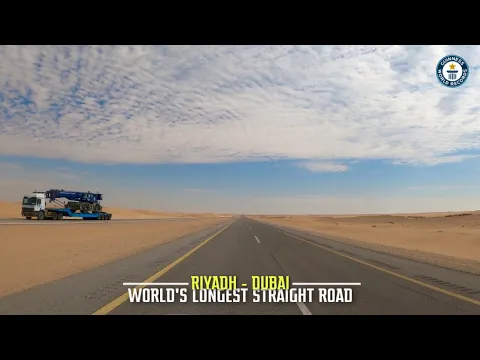

Speed Limits and Heavy Traffic Shape the Road’s Dynamics
Authorities set limits based on the type of vehicle. Cars can reach up to 120 km/h in certain stretches, while buses circulate at up to 100 km/h.
Trucks operate with a limit of 80 km/h, which directly influences the flow dynamics on the highway. In 2018, the Saudi government announced the possibility of 140 km/h for light vehicles in specific points.
In practice, however, constant heavy traffic reduces the viability of these maximum speeds. Drivers must adapt their driving to the real conditions of the road.
Mental Challenge Draws Attention from Experts
Although the route seems simple from a technical perspective, drivers face a challenge primarily psychological. The monotony of the landscape and the absence of curves foster fatigue and drowsiness at the wheel.
Continuous driving without significant visual stimuli requires constant concentration, especially on long journeys. In addition, camels occasionally cross the road, increasing the need for vigilance.
The specialized site Dangerous Roads included the stretch in its list of challenging routes from a mental perspective. Experts highlight that the driver’s focus becomes central to safety.
Safety Measures Have Been Strengthened Over the Years
In light of these characteristics, the Ministry of Transport and Logistics of Saudi Arabia has implemented structural improvements over the years. The department installed paved shoulders and protective barriers.
Teams also implemented detailed directional signage and mileage signs along the stretch. Reflective strips known as “cat’s eyes” have been applied to enhance visibility.
These measures reduce risks associated with monotony and constant heavy traffic. The set of actions reinforces safety in one of the most linear stretches on the planet.
Other Straight Roads Have Also Made History
Before the Saudi record, the Eyre Highway, in Australia, led with 146 kilometers of straight stretch in the Nullarbor Desert. The Australian road remains one of the most unique driving experiences on the continent.
In the United States, ND-46, in North Dakota, features long linear stretches. In Argentina, sections of Route 40 cover nearly continuous kilometers.
Yet, none of these roads reach the 240 kilometers absolutely straight of Highway 10. The Saudi road has established itself as a technical reference in global road engineering.
Would you face more than two hours driving in a straight line in the middle of the largest sand desert in the world?










-

-

-

-

6 pessoas reagiram a isso.