





 Portuguese
  English
  Spanish
  4 min of reading
  2 comments


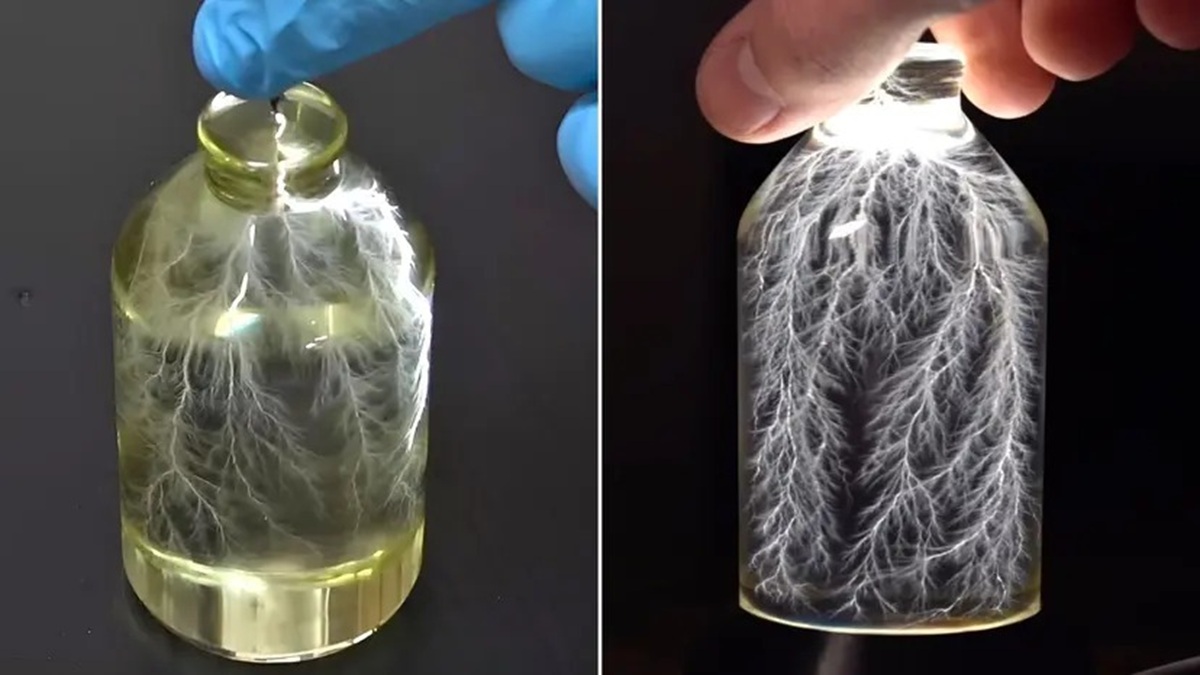


Unprecedented Experiment Uses Particle Accelerator to Create Lichtenberg Figures in Cylindrical Shape, Resulting in Permanent Three-Dimensional Electric Patterns That Simulate the Visual Effect of a Lightning Captured Inside a Transparent Acrylic Tube.
The creator Electron Impressions used a particle accelerator to generate three-dimensional Lichtenberg figures inside two-centimeter acrylic cylinders, capturing permanent electric patterns in a two-second technical exposure.
The experiment aimed to transform the metaphor of bottled lightning into a concrete physical reality. To achieve this, the researcher fired high-energy electrons into a transparent cylindrical insulating material.
The technique allowed for the freezing of branched electric patterns that trace the path of internal dielectric breakdown. The final result presents three-dimensional structures resembling lightning fixed inside a plastic tube.
-
Motorola launched the Signature with a gold seal from DxOMark, tying with the iPhone 17 Pro in camera performance, Snapdragon 8 Gen 5 that surpassed 3 million in benchmarks, and a zoom that impresses even at night.

-
Satellites reveal beneath the Sahara a giant river buried for thousands of kilometers: study shows that the largest hot desert on the planet was once traversed by a river system comparable to the largest on Earth.

-
Scientists have captured something never seen in space: newly born stars are creating gigantic rings of light a thousand times larger than the distance between the Earth and the Sun, and this changes everything we knew about stellar birth.

-
Geologists find traces of a continent that disappeared 155 million years ago after separating from Australia and reveal that it did not sink, but broke into fragments scattered across Southeast Asia.

Traditionally, this type of artistic and scientific production was limited to flat surfaces or discs. The transition to cylindrical shape required unprecedented engineering solutions to ensure the necessary symmetry.


The Role of the Particle Accelerator in Creation
The use of a linear accelerator was essential to ensure that the electrons penetrated the acrylic. The depth of charge deposition is determined by the specific energy applied during atomic bombardment.
In flat pieces, the charge concentration occurs in a centralized and predictable manner under the beam. However, a static cylinder would receive radiation on only one side, generating completely irregular and asymmetric electric patterns.
To solve this problem, the acrylic object needed to rotate continuously under the electron beam. The accelerator is fixed, which required the development of an external mechanical rotation support.
The rotation ensured that the electric charge entered from all angles around the central axis. This procedure created a uniform radial distribution of electrons throughout the polymer’s structure.
Technical Control and Precision Mechanics
The mechanism operated at approximately 150 rotations per minute during the controlled irradiation process. This specific speed allowed the cylinder to pass several times under the beam in just two seconds.
The precision in exposure time was fundamental to avoid irregular accumulation of internal energy. A too-slow rotation would concentrate excessive charge, while a too-fast rotation would prevent deep penetration of the electrons.
The environment inside the accelerator chamber presents extreme radiation levels that destroy common electronics. For this reason, the rotating system was built with simple and robust components to withstand the impact.
A brushed DC motor provided the necessary traction for the tube’s rotation. The system was powered by a 12-volt lead-acid battery, a material resistant to radiative damage.
Materials and Protection Against Intense Radiation
Lead-acid batteries were chosen over lithium versions for their greater chemical stability. A thin layer of lead was added as extra reinforcement to protect vital electrical components.
The support structure was manufactured through 3D printing using black PETG plastic. This material demonstrated technical reliability and structural resilience during previous tests under high doses of radiation.
The mechanical assembly used staggered rollers to securely and firmly hold the acrylic cylinder. The design allowed the tube to rotate smoothly without harmful oscillations during the bombardment phase.
Two identical cylinders with a diameter of two centimeters were machined to ensure the completion of the test. The use of computer-aided design software ensured the exact dimensions required by the experiment.
Visual Results and Captured Physical Phenomena
A protected GoPro camera recorded the moment when the electrons hit the transparent surface of the acrylic. The images revealed a characteristic blue Cherenkov glow resulting from the interaction of charged particles in the insulating material.
The first cylinder received the charge and was intentionally discharged through touches on its sides. This process caused the sudden release of energy, forming the detailed and quite symmetrical electric branches.
The second unit experienced an early discharge while still under the direct influence of the light beam. The result generated more chaotic and unpredictable internal structures compared to the model that had controlled manual discharge.
The curvature of the cylinder acts as a natural lens that visually amplifies the internal branching generated. The refraction of light makes the Lichtenberg figures appear larger and more dramatic to the observer.
The final pieces demonstrate how cylindrical geometry alters the perception of a common physical phenomenon. The experiment transformed a figure of speech into a tangible object through engineering and physics.








birborbirudtazdxFCfzafxafxagxagvhscub7ag7ahueg6gwyagyvyGhvYgsycyabhavtgaycatgagvahvgavyavhvhavacgavhCygYYvagvayvGchVgachahuaguvyabuafhUvIhaanshshshsusgsjsgs nnihubibiNIBubwixbeuxbibzibzmxs.csmxmkdclcijij,iihiahxihihiHiBihjidjcownisnihiHusgudcixbxhaijw7h7huhauhahuwhiaxh&Guha7cs7ha7gIbisxmskainxac.slx.ljijiJohIhaixwh8hwibaojXbaxmL
a.xs.xc.a cladwodkwokwonKa.alxalmxalxoqxnonljXhiaxjaixnonaoxxmxoaxakxosiexisjcosncosjsocsc.sc.sc.sc.scd.cd.cd.cs.cs.csc.vr.ve.rvrv..b.tb.gb.y.tb.rg.wf.w.cb.tb.g.tb.ef.af.vrvkeohajaijaojojoIHia7whi27eyiwhxeijxaj9jc
Very cool.