





 Portuguese
  English
  Spanish
  4 min of reading
  0 comments


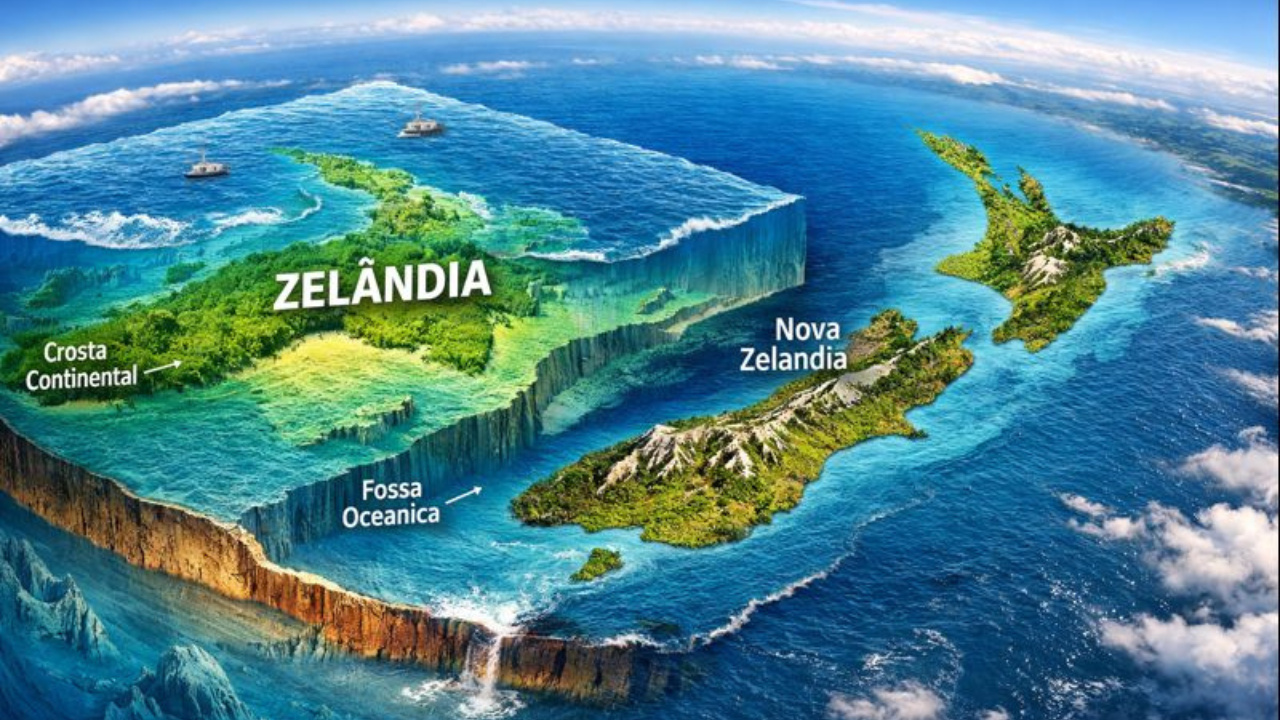
Discovered in 2017, Zealand Is a Submerged Continent Linked to Terra Australis, Gondwana, and the Geology of New Zealand.
An entire continent had been hidden beneath the oceans for millions of years. This is Zealand, a submerged continent officially revealed by geologists in 2017, rewriting classic concepts of world geography.
The discovery was made by scientists from New Zealand and other countries, based on geological and satellite data, showing that the planet has not seven, but eight continents.
Located in the southwest Pacific Ocean, Zealand helps explain ancient theories like Terra Australis, the fragmentation of Gondwana, and the very geology of New Zealand.
-
Friends have been building a small “town” for 30 years to grow old together, with compact houses, a common area, nature surrounding it, and a collective life project designed for friendship, coexistence, and simplicity.

-
This small town in Germany created its own currency 24 years ago, today it circulates millions per year, is accepted in over 300 stores, and the German government allowed all of this to happen under one condition.

-
Curitiba is shrinking and is expected to lose 97,000 residents by 2050, while inland cities in Paraná such as Sarandi, Araucária, and Toledo are experiencing accelerated growth that is changing the entire state’s map.

-
Tourists were poisoned on Everest in a million-dollar fraud scheme involving helicopters that diverted over $19 million and shocked international authorities.


Although almost entirely submerged, Zealand has an area of about 4.9 million square kilometers.
Thus, even invisible at first glance, it meets the scientific criteria to be considered a continent.
The recognition resolves a debate that has spanned centuries and connects modern science with explorations that began as early as the 17th century.
Zealand and the Ancient Search for Terra Australis
Long before the scientific confirmation, European navigators believed there must be a large landmass in the Southern Hemisphere.
This idea, called Terra Australis, originated in Ancient Rome and persisted for centuries as a geographical hypothesis.
In 1642, the Dutch navigator Abel Tasman set out from Southeast Asia in search of this unknown territory.
He reached present-day New Zealand, but conflicts with the Māori people interrupted the expedition.
Without landing, Tasman returned to Europe convinced that he had found part of the southern continent, although without sufficient proof.
Only centuries later did it become clear that Tasman was, in essence, correct.
Terra Australis was not just a myth but an incomplete concept of something greater: Zealand.
How Zealand Was Recognized as a Submerged Continent
The confirmation of Zealand required decades of studies. Initially, scientists observed that the geology of New Zealand displayed continental characteristics, such as rock diversity and a thicker crust than the oceanic.
In the 1960s, science began to adopt clearer criteria to define what a continent is. Still, progress was slow, especially due to the high cost of deep-sea research.
The landscape changed in the 1990s, when new geophysical surveys and satellite data revealed a massive submerged continental mass.
The definitive turning point occurred in 2017 when researchers gathered enough evidence to announce to the world that Zealand was real.
The Connection Between Zealand and Gondwana
From a geological perspective, Zealand is a direct fragment of Gondwana, the supercontinent that existed over 500 million years ago and included almost all the land in the Southern Hemisphere.
Africa, South America, Antarctica, Australia, and India were part of this structure.
About 105 million years ago, Zealand began to separate from Gondwana.
During this process, tectonic forces stretched the crust and made it much thinner than normal.
As a result, the continent gradually sank, becoming a submerged continent, with only a few areas emerging.
This origin explains why Zealand has rocks typical of continents, such as granite and limestone, and not just basalt, which is common on the ocean floor.
Geological Mysteries and Fossils of the Submerged Continent
Despite the recognition, Zealand still holds many unknowns. One of them is whether the continent was ever fully emerged or if it has always existed mostly under the sea.
Another question involves the presence of terrestrial life.
Research indicates that fossils found in New Zealand, including dinosaur remains, date from periods after the separation from Gondwana.
This raises the possibility that parts of Zealand may have served as a refuge for ancient species.
Additionally, studies with deep drilling found pollen and marine microfossils, suggesting shallow coastal environments in the past.
According to scientists, these clues reinforce the idea that the submerged continent had phases of greater exposure.
Why Zealand Is Important for Science Today
Zealand is not just a geographical curiosity. It has direct implications for understanding plate tectonics, the biodiversity of the Southern Hemisphere, and the Earth’s climatic history.
It also has economic relevance as it enhances the understanding of continental shelves and marine natural resources.
More than 400 years after the search for Terra Australis, science confirms that there are still entire chapters of the planet’s history hidden beneath the oceans.
Zealand proves that world geography is still under construction and that the geology of New Zealand is a key piece in understanding this global puzzle.
To read more, visit: The Lost Continent That Took 375 Years to Be Discovered – BBC News Brasil










-

-

3 pessoas reagiram a isso.