





 Portuguese
  English
  Spanish
  3 min of reading
  0 comments


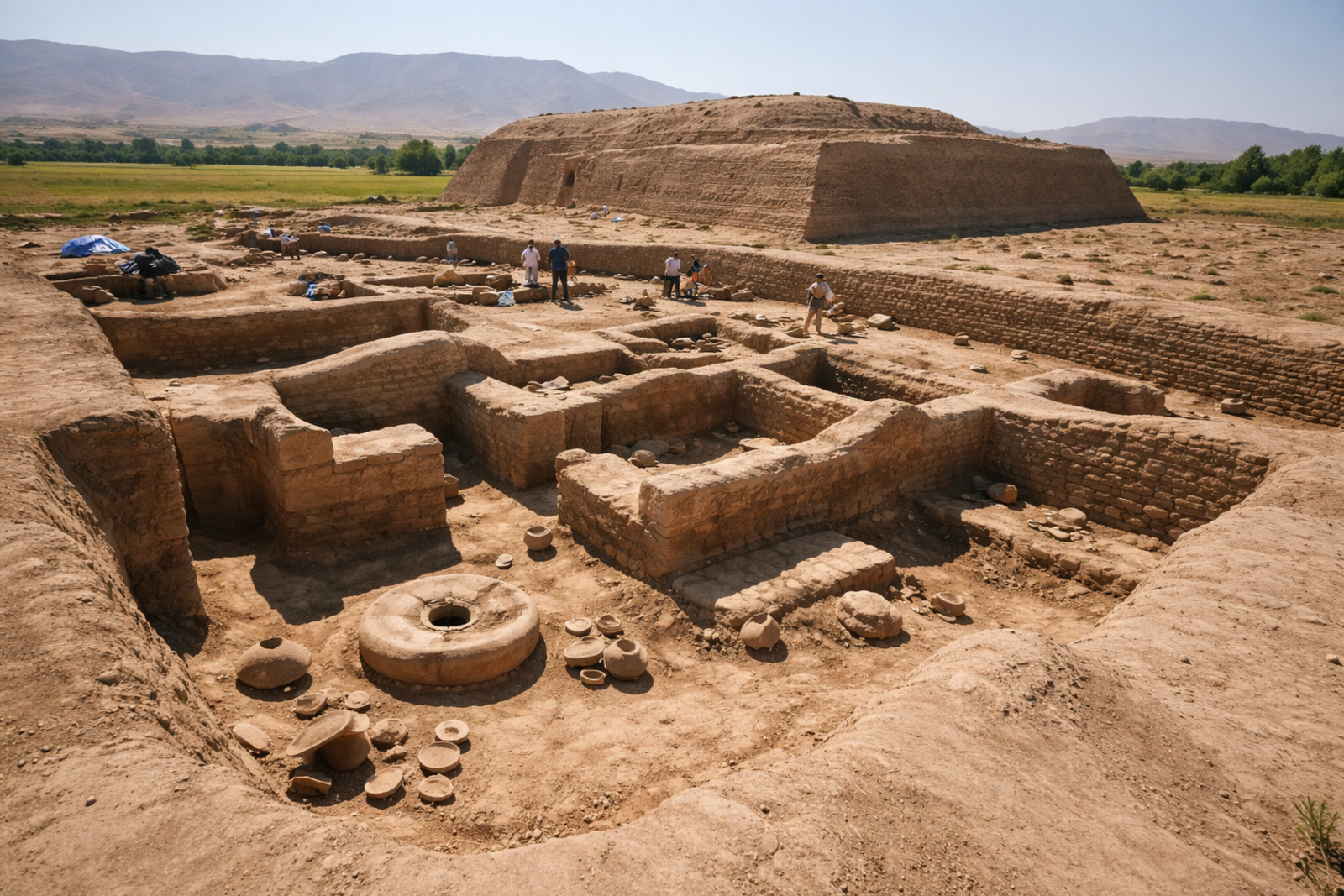
Excavations in Bandikhan II, Uzbekistan, reveal a 3,000-year-old Silk Road city with walls, interconnected rooms, and artifacts from the Yaz culture.
A Sino-Uzbek archaeological team has discovered a 3,000-year-old city in Bandikhan II, southern Uzbekistan, along the Silk Road, revealing walls, rooms, and artifacts that help explain urban development in the early Iron Age in Central Asia.
Excavation resumes known site
Bandikhan II was discovered in 1969, but excavations only began recently, in 2023.
The site occupies 107,639 square meters in the Bandikhan oasis, in the Surxondaryo region, an area known for concentrating ancient settlement mounds.
-
Central Asian country will install devices capable of inducing artificial rain to combat drought and extreme heat, and the project could completely change the air quality in the region by 2027 using large-scale cloud seeding.

-
Rare phenomenon of silent electric flashes in trees on the east coast of the United States intrigues researchers, confirms century-old suspicion, and raises alarm about invisible environmental impacts.
-
A leak shows that Sony is preparing a more ambitious PlayStation in the PS6, with a handheld running current games natively.

-
China’s space solar power station could function as a military weapon by transmitting microwaves with high precision, supporting electronic warfare and protecting communications, says a study.

The new investigation identified the location as a center of the Silk Road and allowed for a reevaluation of the city’s size.
The Sino-Uzbek team began to investigate how this core was planned, occupied, and preserved.


Walls and rooms reveal the city
During the work, archaeologists located remnants of the eastern wall of the city, as well as interconnected structures and rooms.
The findings helped classify Bandikhan II as a settlement linked to the Yaz culture, associated with ancient Bactria.
So far, only 3,229 square feet of the 107,639 square feet of the site have been explored, in the eastern section.
Even so, researchers confirmed that it is the largest and best-preserved settlement in the Bandikhan oasis.
The eastern wall exhibited a trapezoidal cross-section. This feature allowed for observations of the construction techniques used during the period and reinforced the site’s value for the study of urban evolution.

Everyday life inside
Inside the city, archaeologists identified five interconnected rooms. One of them was used for sleeping and contained a niche where a lamp was placed, an interpretation based on internal hardening caused by repeated burning.
The discoveries are providing crucial evidence to understand the shape of the first city-states of the Iron Age in southern Central Asia.
They also help track the transition of urban plans from the Bronze Age to the early Iron Age.
Ceramics, tools, and differences
Among the collected materials were carinated jars, bowls, and flat-bottomed plates. The shapes and decorations of these objects matched pieces found at other Yaz sites, such as Kuchuktepa and Yaztepa.
Bandikhan II shares structural similarities with these locations but also presents important differences.
The main one is the absence of semicircular defensive towers along the outer walls, a detail that distinguishes the city within the Silk Road.
Researchers also found grinding plates, mortars, and pestles, indicating grain processing on site.
Bronze knives, arrowheads, and seashells were found, expanding the picture of ancient local life.
Next steps and training
The initial excavations in Bandikhan II have sparked expectations for the upcoming work seasons.
The Silk Road city continues to be unearthed, while researchers aim to expand the investigation of its layout, use, and preserved legacy.
In response to the findings, a two-week training program on Silk Road archaeology has been created.
The initiative seeks to strengthen the protection and transmission of the cultural heritage linked to this regional historical corridor.
With information from Interesting Engineering.






Seja o primeiro a reagir!