





 Português
  Inglês
  Espanhol
  4 min de leitura
  0 comentários


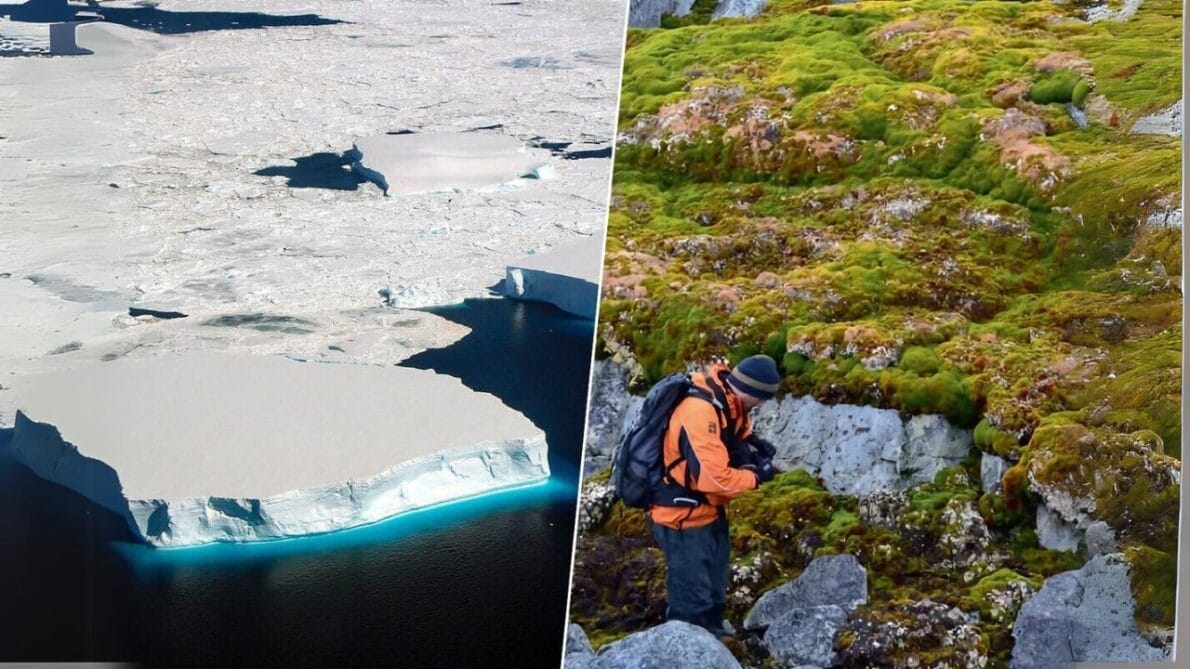
Climate Shock in Antarctica! Vegetation Increases Tenfold in One of the Most Hostile Places on Earth. What Does This Mean for the Future of the Planet? Find Out Now!
Antarctica is increasingly experiencing vegetation, which is a concerning issue. Antarctica has become one of the thermometers scientists use to measure the effects of climate change. For instance, a few weeks ago, we noticed that Antarctica is rising about five centimeters per year. The phenomenon is fascinating, but it also raises questions about how this will affect sea level rise.
Now, researchers have compared satellite images from the last 30-40 years, and the conclusion is that plant life is gaining ground in relation to ice. And at a terrifying speed.
The Green Antarctica. Let’s look at the data: plant life in this extremely hostile environment has increased more than tenfold in the last 40 years. The research was conducted by scientists from the British universities of Exeter and Hertfordshire who, as noted in the Nature publication, carried out the work thanks to satellite images taken by NASA’s Landsat program and the use of multispectral images to monitor vegetation.
-
The world’s first octopus farm wants to open in the Canary Islands and is already provoking an international reaction: the plan aims to produce 3,000 tons per year.

-
Drought may be creating stronger superbugs in the soil and helping antibiotic resistance reach hospitals, warns a study highlighting a problem that could grow alongside extreme weather.

-
The biggest scam in history: Napoleon’s France deceived the United States by selling them a territory that was Spanish.

-
Why is the Danakil Desert so dangerous? It has unstable terrain and how extreme temperatures and toxic gases turn the region into one of the most hostile environments on Earth.

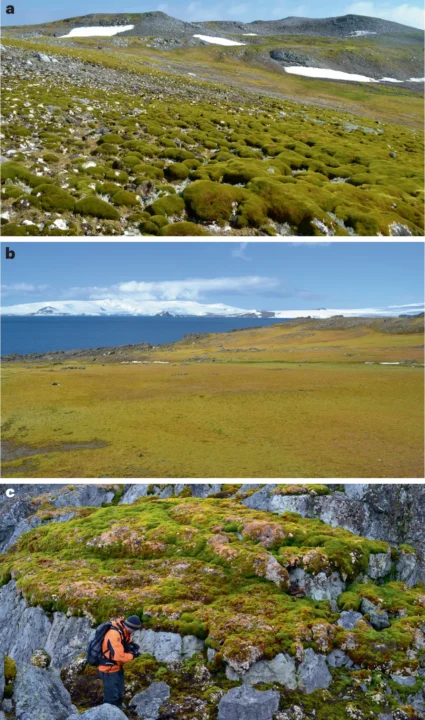
They found that in 1986 there was less than one square kilometer of green color on the Antarctic Peninsula, which increased to 11.9 km² in 2021. The trend from 1986 to 2016 was an increase of 0.31 km² per year, but this surged between 2016 and 2021, reaching an annual increase in vegetated area of 0.42 km². Currently, the density of vegetation continues to rise, and this is something that can be clearly seen in the images:
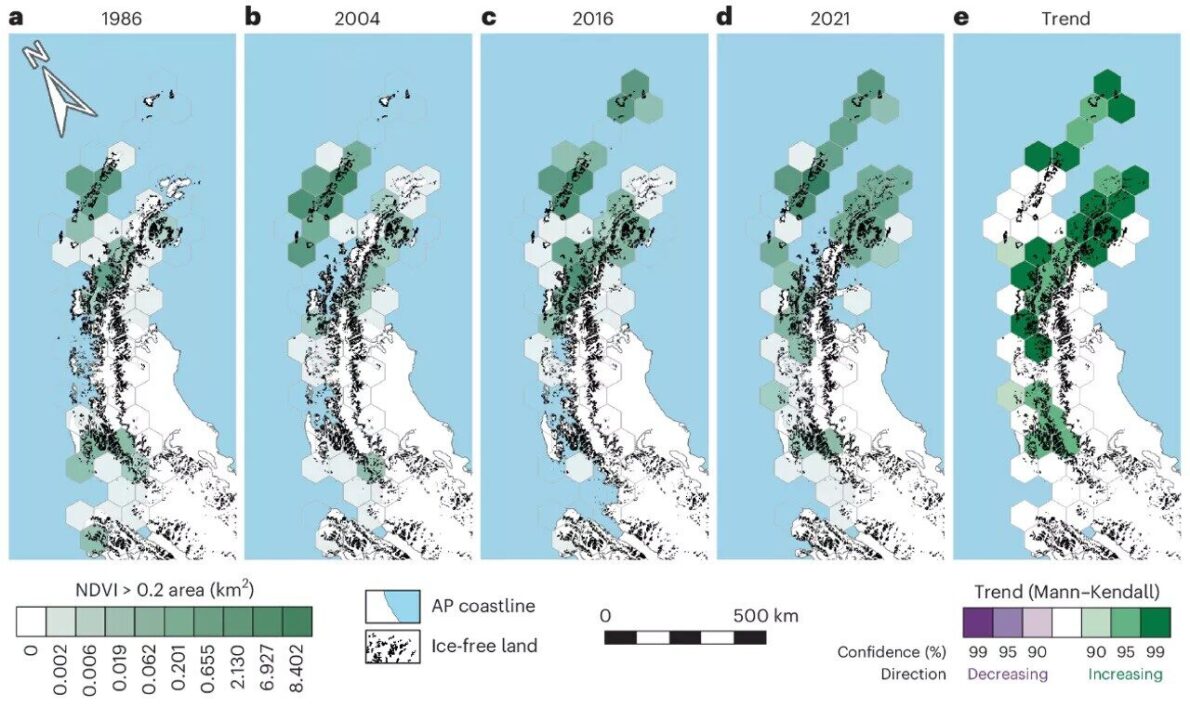
Accelerated Warming of Antarctica: A New Ecosystem in Formation
It’s Heating Up. And heat is the main culprit behind all this. Over the last 60 years, Antarctica has warmed significantly and at a faster rate than the rest of the world. The more recent summers are examples of this, with temperatures up to 20 degrees above normal in 2022 and about 10 degrees above normal in mid-July 2024. And models predict that the region will continue to warm until 2100 at an average rate of 0.34 degrees per decade.
Traveling Seeds. The more ice melts, in addition to contributing to rising sea levels, the more space there will be for vegetation and more rain in the region, which will help develop this vegetation. But… how are the seeds getting to Antarctica? In statements to CNN, Thomas Roland —one of the study’s authors— says that “seeds, spores, and plant fragments can easily reach the Antarctic Peninsula on the boots or equipment of tourists and researchers, but also through more ‘traditional’ routes, such as migratory birds or the wind.”
Colonizing Vegetation. However, these nearly 12 km² of green area are just a tiny fraction of the 522,000 km², but the problem is not the size of the green Antarctica, but rather the speed at which the vegetation is expanding and the fact that an increase in the pace of plant colonization has been observed in recent years due to higher temperatures.
Invasive Vegetation: A Threat to the Native Ecosystem
For native living beings, this is also a problem. This colonization of non-native plants will quickly occupy the space of native wildlife. Furthermore, although the results presented by the team are already worrying, Professor Matthew Davey from the Scottish Association for Marine Science states that there may be more vegetation than the researchers found. The reason is that the study focuses on moss fields, but there are also lichens, grasses, and green and red algae that contribute to the increase of vegetation area in Antarctica.
Goodbye to the Great Mirror. Other researchers who did not participate in the study, such as Andrew Shepherd —head of the Geography Department at Northumbria University— state that the results are “very interesting” and agree that these are the ideal conditions for life to now have a base for development. And everything could accelerate not only due to the rising temperatures that are already happening but also because of secondary effects.
As most of the surface is covered in ice, the Antarctic Peninsula acts as a large mirror reflecting solar radiation into space. However, as the ice disappears and rock and vegetation appear, less radiation will be reflected, and more heat will be absorbed. Olly Bartlett is another author of the study and states that the impact of this will likely be local but will help accelerate the growth of plant life.
It Wasn’t Always White. It is clear that researchers will have work investigating how plants are able to colonize the barren lands of the Antarctic Peninsula. However, it seems that, millions of years ago, vegetation dominated the region. Just as some of the world’s largest deserts were once forests or jungles, Antarctica was a forest.
This occurred 40 million years ago when carbon dioxide levels in the atmosphere triggered a potent greenhouse effect that created a living ecosystem with vegetation and prehistoric animals. Returning to that scenario… would not be positive for the rest.








Seja o primeiro a reagir!