





 Portuguese
  English
  Spanish
  6 min of reading
  0 comments


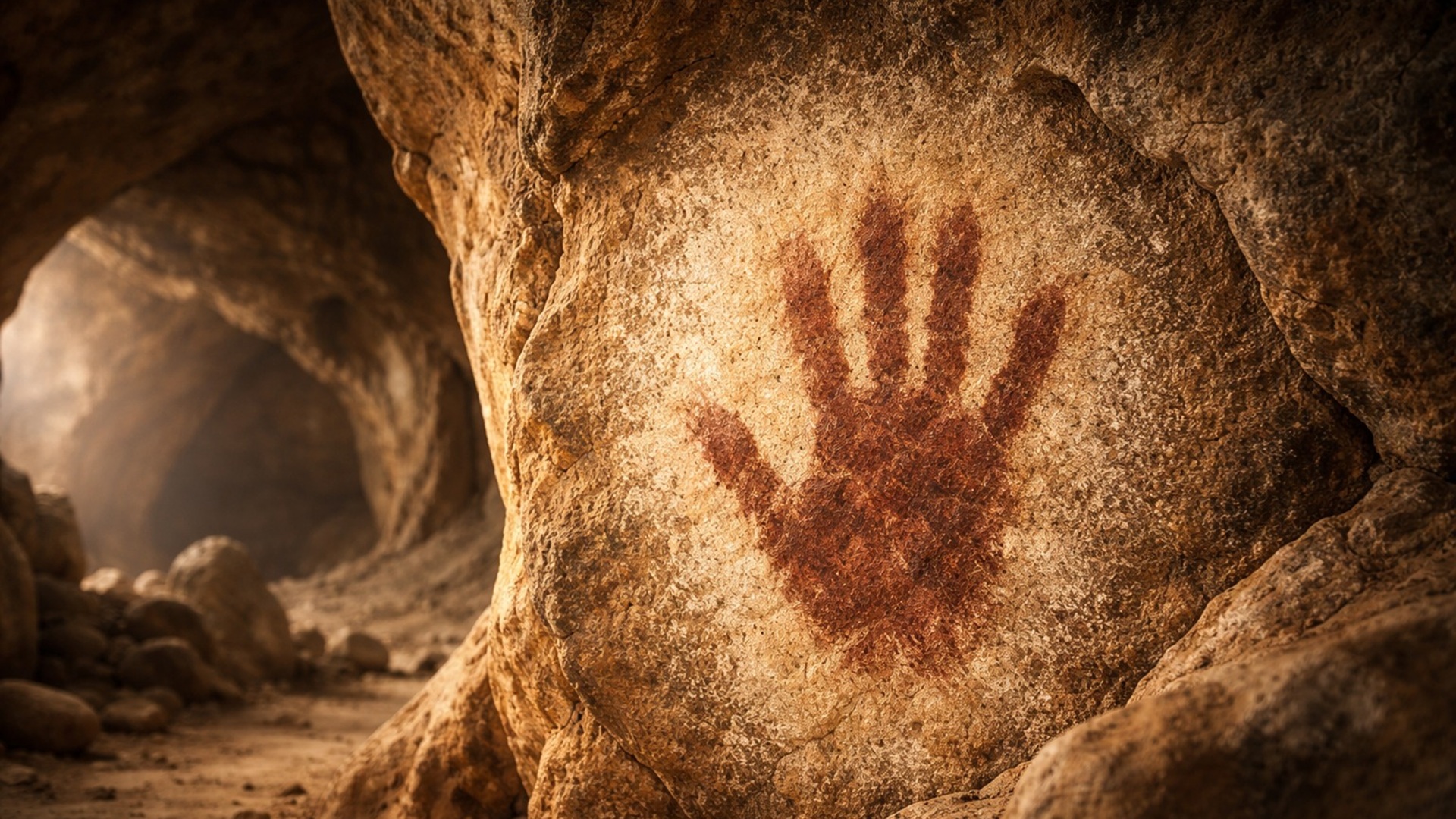
Discovery Of A Hand Stencil At Least 67,800 Years Old In A Cave In Sulawesi, Indonesia, Redefines The Record Of The Oldest Rock Art In The World And Anticipates The Proven Presence Of Homo Sapiens In Insular Southeast Asia Before The Arrival Of Modern Humans In Europe
A hand stencil created at least 67,800 years ago in a cave in southeastern Sulawesi, Indonesia, has been identified as the oldest rock art in the world and as the oldest archaeological evidence of the presence of modern humans in the region, according to a study published in the journal Nature on January 21.
The discovery was made by scientists who analyzed rock art located in a cave in Sulawesi and dated a hand stencil measuring 14 by 10 centimeters, the traces of which still allow for the recognition of fingers and palm, despite the wear of time.
The find is significant because it significantly anticipates the known oldest record of rock art associated with modern humans and helps fill gaps about the migration of the ancestors of Australian aborigines before they reached the continent.
-
With a cost per shot close to zero, the DragonFire laser could change naval warfare in 2027 and provide British ships with nearly unlimited defense against drones.

-
A British startup creates tires that generate electricity in electric vehicles when passing over potholes, speed bumps, and cracks.

-
Scientists have created robots made with living cells that have their own nervous system, swim on their own, explore the environment, and self-organize without any genetic engineering, and now they want to do the same with human cells.

-
Students create a solar-powered ambulance that operates without a plug, without fuel, and still keeps medical equipment running in remote areas.


According to the study, the rock art of Sulawesi represents the oldest evidence of the presence of Homo sapiens on the islands situated between the Asian and Australian continental shelves, a key region in prehistoric migratory routes.

Discovery In Sulawesi And Archaeological Context
The cave where the stencil was found houses different layers of rock art, including another, more recent hand stencil located about 11 centimeters away from the oldest image, painted with darker pigment.
This second stencil was dated to a maximum of 32,800 years ago, indicating that the cave was used as an artistic support by prehistoric humans for a period of at least 35,000 years.
According to Adhi Agus Oktaviana, an archaeologist from the Indonesian National Research and Innovation Agency and the first author of the study, it is very likely that the authors of these paintings were part of a larger population that spread throughout the region.
This population would have moved on, according to the researcher, to reach Australia, where modern humans have been present for at least 60,000 years, according to data mentioned in the study.
The discovery reinforces the importance of Sulawesi as a strategic point in human displacement between continental Asia and the ancient continent of Sahul, which included Australia and New Guinea.
Dating Technique And Analysis Of Traces
The researchers analyzed 11 prehistoric drawings found in eight caves in Sulawesi, including seven hand stencils, two human figures, and two geometric patterns.
All these works displayed deposits of calcium carbonate known as “cave popcorn,” which form naturally on rock surfaces over time.
Since these deposits develop after the art is created, their dating provides a minimum age for the underlying images, allowing an estimate of when the drawings were made.
In some cases, the researchers were also able to obtain maximum ages, as they observed situations where the pigment of the rock art overlapped these mineral deposits.
The combination of these analyses allowed for determining that the oldest hand stencil was created at least 67,800 years ago, making it 1,100 years older than the rock art associated with Neanderthals in Spain.
Comparison With Other Ancient Artistic Expressions
Before this discovery, the oldest identified rock art was a hand stencil about 66,700 years old found in Spain, which was believed to have been produced by Neanderthals.
This attribution was based on the fact that evidence indicates modern humans arrived in Europe only about 54,000 years ago, although the dating technique used in this case is debated.
Prehistoric art on rock surfaces is known in various regions of the world, with examples ranging from engravings 12,000 years old in Saudi Arabia to paintings 4,000 years ago on the border between the United States and Mexico.
Additionally, there are even older records of symbolic expression, such as a hashtag-shaped drawing dated to 73,000 years ago in South Africa.
Another example cited in the study is a shell from Indonesia with zigzag carvings, dated to 540,000 years, which may have been produced by Homo erectus.
Artistic Characteristics And Authorship Of The Paintings
The oldest hand stencil from Sulawesi presents a unique characteristic: the fingers were purposefully tapered, a technique considered artistically complex.
According to the researchers, this type of detail has only been found in Sulawesi, which reinforces the idea of a specific local artistic tradition.
Though other human species inhabited Sulawesi in the past, the authors of the study attribute these works to Homo sapiens, due to the technical complexity involved and the proven presence of modern humans in the region at that time.
The oldest image is quite faded but still allows for the vague identification of the contours of the fingers and the palm of the hand, preserving essential elements for analysis.
These stencils with tapered fingers have also been found in other locations on the island, such as Leang Jarie, in southern Sulawesi, indicating a recurring practice.
Cultural Meaning Of Hand Stencils
Although the original meaning of the rock art is unknown, researchers suggest that the hand stencils may indicate the existence of a relatively large group with its own cultural identity.
According to Maxime Aubert, an archaeologist and geochemist at Griffith University and co-author of the study, these stencils could symbolize affiliation with a specific group.
He notes that knowledge of the cave and the associated rock art could serve as a marker of cultural belonging among individuals who frequented the site.
This interpretation points to the existence of complex symbolic traditions among modern humans inhabiting Sulawesi during this remote period.
The continuous presence of art over tens of thousands of years suggests that the cave held lasting importance for different generations of prehistoric inhabitants.
Implications For Human Migratory Routes
The identification of the oldest rock art in Sulawesi adds a new data point to the understanding of human dispersion throughout insular Southeast Asia and Australia.
The authors of the study highlight that the cave’s location supports the hypothesis that modern humans reached Australia via a northern route.
This route would have started from present-day Borneo, passed through Sulawesi, and headed towards Papua Barat, in the western half of New Guinea, or the Indonesian island of Misool.
The geographical position of Sulawesi as an intermediary link reinforces its central role in human migrations that involved significant maritime crossings.
The discovery also suggests that these populations not only moved but maintained elaborate cultural practices during their journeys.
External Evaluation And Importance Of The Find
Chris Clarkson, a professor of archaeology at Griffith University who did not participate in the study, described the discovery as impressive in communication sent to Live Science.
He agreed that ancient modern humans are the most probable artists of the hand stencils, as the dates obtained coincide with the arrival of Homo sapiens in the region.
Clarkson highlighted that the works are located exactly on a migratory route to Australia, reinforcing the interpretation presented by the authors of the study.
According to him, the find demonstrates that the early inhabitants of Australia had a rich and complex cultural life, not merely survival strategies.
For the researcher, these groups crossed oceans, produced art, and carried elaborate symbolic traditions with them, revealing a deep cultural dimension from the early stages of human occupation in the region.








-

2 pessoas reagiram a isso.