





 Português
  Inglês
  Espanhol
  5 min de leitura
  0 comentários


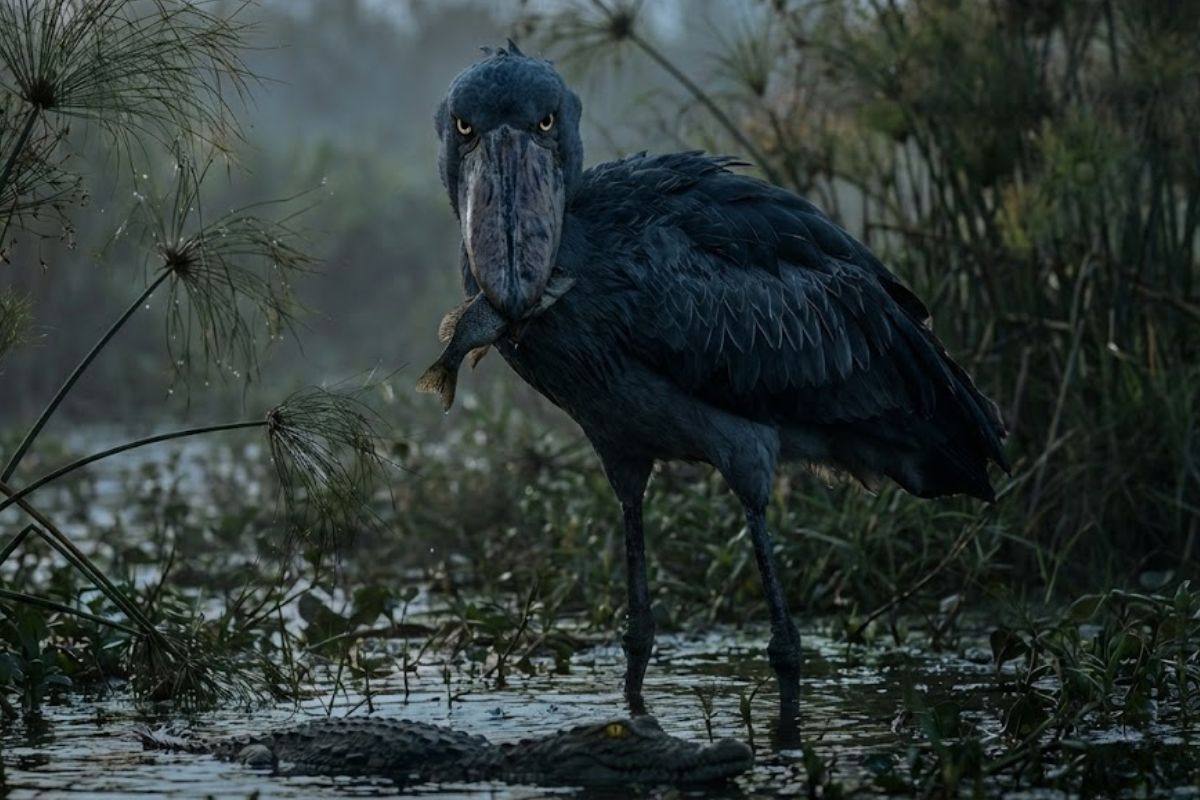
Described In The 19th Century, The Prehistoric Bird That Looks Like A Dinosaur Impresses With Its Shoe-Shaped Beak, Reaches 1.5 Meters In Height, Lives In African Swamps, Swallows Huge Fish Whole, And Remains Surprisingly Calm Near Humans In Controlled Environments Such As Well-Structured Zoos, Attracting Nature Enthusiasts Worldwide.
Since the scientific description made in the 19th century to the recent viral videos on the internet, the prehistoric bird that looks like a dinosaur, known as the shoebill stork, has become a symbol of a distant past still present in today’s fauna, with its enormous body, fixed eyes, and behavior that mixes long periods of immobility with swift and precise attacks on prey.
Today, estimates suggest that there are only between 5,000 and 8,000 individuals in the wild, distributed across countries such as Sudan, Congo, Rwanda, Uganda, Tanzania, Zambia, Kenya, Ethiopia, Cameroon, and the Central African Republic, forming populations spread across flooded areas, where this giant bird walks slowly through shallow water and suddenly swallows fish nearly 1 meter long and even young crocodiles whole, while still maintaining a temperament described as surprisingly calm in controlled contact with humans.
Dinosaur-Like Appearance In The Modern Era

The most striking image of the prehistoric bird that looks like a dinosaur is its huge, thick, and pointed beak, shaped like a shoe or clog.
-
The world’s first octopus farm wants to open in the Canary Islands and is already provoking an international reaction: the plan aims to produce 3,000 tons per year.

-
Drought may be creating stronger superbugs in the soil and helping antibiotic resistance reach hospitals, warns a study highlighting a problem that could grow alongside extreme weather.

-
The biggest scam in history: Napoleon’s France deceived the United States by selling them a territory that was Spanish.

-
Why is the Danakil Desert so dangerous? It has unstable terrain and how extreme temperatures and toxic gases turn the region into one of the most hostile environments on Earth.


The upper part can reach around 24 centimeters in length, creating a “head” that is disproportionate to its already robust body.
Viewed from the front, the shoebill stork looks like an animal straight out of a Jurassic scene.
This bird can reach almost 1.5 meters in height, with a wingspan of about 2.6 meters and a weight of up to 7 kilograms.
For a flying species, that is a considerable weight, as most birds need to keep their bodies relatively light to use less energy in flight.
The wide and powerful wings, together with long legs, allow for large movements in search of food, even in flooded environments full of obstacles.
Research conducted with DNA and egg shell analyses has shown that the shoebill stork’s closest relatives are not the other classic storks, but rather pelicans.
This reinforces the idea that behind the dinosaur-like appearance is a unique evolutionary history, which connects the species to modern groups specialized in fishing and aquatic environments.
Where It Lives And How It Behaves In African Swamps

The prehistoric bird that looks like a dinosaur lives exclusively on the African continent.
Records show populations in Sudan, Congo, Rwanda, Uganda, Tanzania, Zambia, Kenya, Ethiopia, Cameroon, and the Central African Republic, always associated with flooded areas, swamps, and regions with abundant aquatic vegetation.
In these environments, the shoebill stork often spends long periods nearly motionless, observing the water.
The still body, rigid neck, and fixed gaze enhance the impression that it is a living statue.
However, when prey appears, the attack is swift, with a sudden movement of the neck and beak, which acts as a giant clamp to grasp fish, amphibians, and reptiles.
Despite its intimidating appearance, reports of handling in zoos indicate that the animal is surprisingly calm.
Individuals raised under supervision can get used to the constant presence of caretakers and visitors, remaining calm even with people nearby, as long as there is no rough or invasive contact.
Carnivorous Diet And Impressive Hunting Power
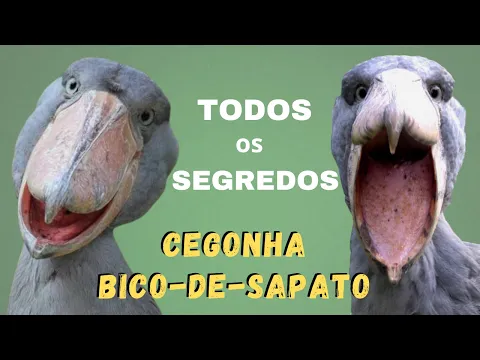

The diet of the prehistoric bird that looks like a dinosaur is entirely carnivorous.
It feeds on snails, fish of various species, snakes, lizards, frogs, turtles, and even young crocodiles.
The hunting behavior is based on patience and precision: the animal waits for the right opportunity and, when the prey approaches, strikes powerfully.
Some captured fish can reach nearly 1 meter in length, but are still swallowed whole.
The shoe-shaped beak, combined with its firm neck and powerful muscles, allows the shoebill stork to capture, hold, and swallow animals that seem too large for the size of its head.
The bird uses the curved part of the tip of its beak to secure the slippery prey, preventing the fish from returning to the water.
Afterward, it adjusts the catch, raises its head, and swallows in one single motion, reinforcing its image as a large predator in the midst of a swamp landscape.
Giant Floating Nest And Reproduction Strategy
The prehistoric bird that looks like a dinosaur also impresses when building its nest.
The couple constructs a large structure, about 1.7 meters wide, always in water areas, as if creating a floating base.
The nest is made of intertwined branches, twigs, and aquatic plants, forming a sturdy platform.
Reports indicate that the structure is so stable that an adult could stand on it without sinking.
This architecture serves as a breeding island: it keeps terrestrial predators away, protects the eggs and chicks, and keeps the couple in direct contact with the aquatic environment where the bird hunts.
The choice of swampy areas reduces access to terrestrial mammals while keeping the chicks close to the adults’ feeding zones.
Therefore, the nest is central to the survival of the species in regions filled with natural risks.
Why The Species Intrigues Scientists And Fascinates The Public
With a population estimated between 5,000 and 8,000 individuals in the wild, the prehistoric bird that looks like a dinosaur is considered rare and has become the subject of scientific curiosity.
Ornithologists are interested in the combination of characteristics: ancestral appearance, genetic relationship with pelicans, specialized fishing habits, and high weight for a bird that still flies.
At the same time, the public is enchanted by its appearance.
Videos and reports highlight its fixed gaze, motionless posture, and gigantic beak, while nature communicators showcase scenes of the bird swallowing huge fish and walking slowly through the water.
This mix of visual oddity and calm behavior has turned the shoebill stork into a modern icon of a fauna that still holds traces of its prehistoric past.
The presence of the species in zoos helps to spread its story to those who would never travel to African swamps.
In captivity, many individuals become tame, accepting the routine of feeding and observation, allowing for detailed studies on anatomy, behavior, and reproduction, without relying solely on field observations.
In light of such a unique species, which survives in only a few thousand individuals and combines characteristics of both a dinosaur and a modern aquatic bird, do you think the prehistoric bird that looks like a dinosaur should be remembered primarily as an exotic zoo curiosity or as a symbol of the need to preserve swamps and natural environments that still support rare animals on the African continent?









Seja o primeiro a reagir!