





 Portuguese
  English
  Spanish
  5 min of reading
  0 comments


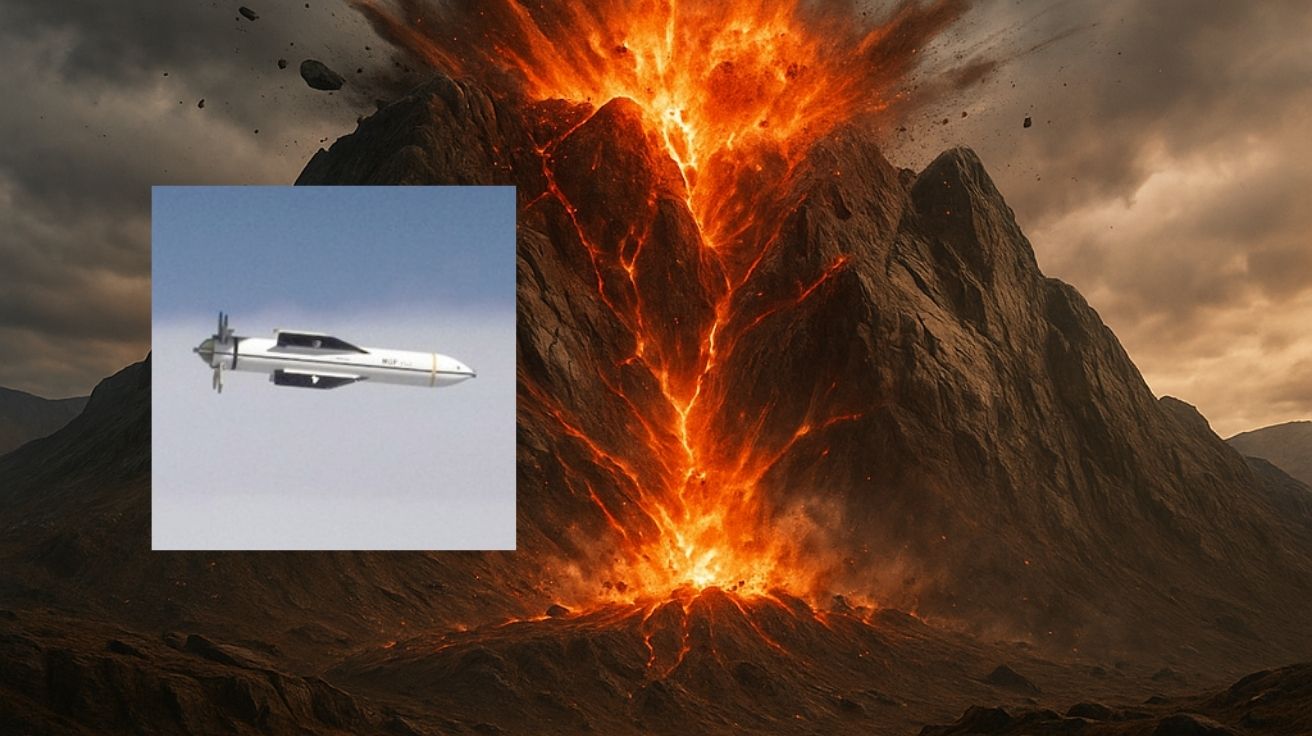
The GBU-57 Massive Ordnance Penetrator Was Designed to Destroy Underground Facilities Like Those in Fordo, Iran, and Is Considered the Most Powerful Conventional Bomb Today
The GBU-57 is the most powerful bomb in the United States’ conventional arsenal; it is not just any explosion. It is known as the Massive Ordnance Penetrator (MOP), a 30,000-pound weapon, about 14,000 kg, that can penetrate up to 61 meters of reinforced concrete or soil before exploding. Exclusively used by the stealth bomber B-2 Spirit, this bomb is considered the only one capable of destroying heavily protected facilities like the Fordo underground nuclear facility in Iran. See below a demonstration video of the bomb exploding:
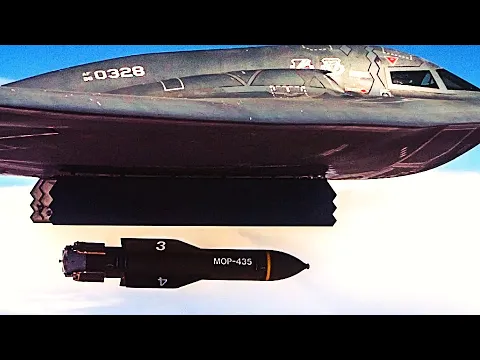

Interest in this super weapon has recently grown after Israel pressured the United States to use it in a possible offensive against the Iranian nuclear program. According to technical data from the US Air Force, the GBU-57 is a lethal combination of weight, precision, and technology.
ARTICLE CONTINUES BELOWSee also
(Video): Italian pilot lands plane on moving train at 120 km/h and achieves unprecedented feat in aviation, even with a narrow runway and without direct visual contact.

It seems to have come out of a science fiction movie: A Brazilian city where it rains almost every day, recording over 4,000 mm per year, driven by climatic factors — a direct result of its strategic location in the Amazon.

The water crisis that could change everything this year has already begun; it’s not just about the climate, it affects technology, raises product prices, and can halt entire companies without warning.

A Japanese mason transforms raw granite into small cups and handcrafted utensils, collects giant stones, cuts with precision, and impresses with detailed manufacturing and finishing.

The 14,000 Kg Bomb That Penetrates the Ground Like No Other Conventional Weapon
Developed after 2003, the GBU-57A/B was the Pentagon’s response to the realization that existing weapons could not efficiently hit underground targets. Designed by Boeing with support from the Air Force Research Laboratory, the MOP is 6.2 meters long, with 80% of its weight concentrated in a special steel body and carries 5,342 lb of AFX-757 and PBXN-114 explosives, optimized for controlled detonation in confined environments.

Its power lies in the combination of mass, aerodynamics, and precise guidance using military GPS. Bombing occurs from high altitudes to ensure that the bomb accumulates enough kinetic energy and reaches very high speeds during descent, allowing it to penetrate buried structures.
The warhead enters the ground and explodes only after reaching the desired depth, regulated by a smart fuse system called LPSF (Large Penetrator Smart Fuze), which adapts the explosion timing to the material’s resistance.
Only the B-2 Spirit bomber, with a payload capacity of up to 18,000 kg, can carry it, taking two GBU-57 per mission. Israel, even with its advanced air force, lacks planes capable of operating it, which reinforces the strategic dependence on the US.
How the Super Bomb That Can Collapse a 20-Story Buried Building Works
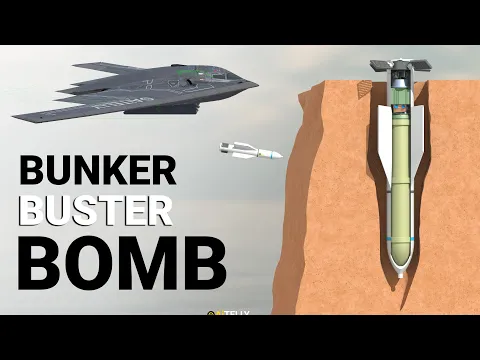
The process of using the GBU-57 involves five crucial steps. First, the B-2 bomber flies at high altitude to the target area. Then, the device is released, falling in free fall guided by four lattice fins, which adjust the trajectory according to data from the embedded GPS and inertial navigation system.
In the third stage, these systems correct the bomb’s course in real time, even without thrusters, relying solely on aerodynamic control. In the fourth stage, the bomb impacts with extreme force, penetrating layers of concrete and soil with its high-density iron-cobalt structure.
The final stage is the explosion, triggered by dual fuses that combine impact sensors and timers, allowing for maximum destruction inside the target. The effect is similar to a mini-earthquake, with the capability to bury or disintegrate bunkers 60 meters below the surface.
Comparatively, other bombs like the GBU-28 penetrate about 20 feet (6 meters) and the BLU-109 only 5 feet (1.8 meters). The MOP is unmatched.
The Only Bomb Capable of Destroying Fordo, Iran’s Secret Nuclear Facility
The Fordo facility, located 80 meters deep under a mountain, represents the biggest military challenge for anyone looking to disrupt Iran’s nuclear program. Fortified against conventional attacks, the base can only be hit by something like the GBU-57, due to its depth and natural shielding.
According to the International Atomic Energy Agency (IAEA), Fordo has been enriching uranium U-235 to 83.7%, almost at the threshold for use in nuclear weapons. The destruction of this facility is considered essential by Israel to eliminate the Iranian nuclear threat.
Even though the bomb is conventional, the impact on a nuclear facility like this could cause localized contamination, according to the IAEA. This was the case with a previous attack on Natanz, where the effect was contained on-site.
Due to being in highly monitored territory, with Russian and Iranian anti-aircraft missile systems, Fordo requires a mission of absolute precision, with high penetration capacity and range — central attributes of the GBU-57A/B.
Difference Between the GBU-57 MOP and the MOAB, the “Mother of All Bombs”
Many confuse the GBU-57 with the GBU-43/B MOAB (Massive Ordnance Air Blast). Although both are colossal, their purposes are completely different. The MOAB is designed for surface explosions and weighs 21,600 lb (9,800 kg), being dropped by a C-130 with a pallet and parachute system.
It explodes in the air with a massive shock wave, devastating open areas like caves or surface facilities. In contrast, the MOP is made to burrow deeply before exploding, destroying underground facilities without visual contact.
Additionally, the MOAB lacks a penetration system or smart fuse like the GBU-57. Its use in 2017 against Taliban tunnels in Afghanistan had a significant impact, but it did not reach buried targets like the MOP would.
In terms of cost, the MOAB is worth about US$ 170,000 per unit, while the GBU-57 reaches US$ 3.5 million, with development costs estimated between US$ 400 million and US$ 500 million.
Future of the Weapon: The Next Penetrator and the B-21 Raider Plans
With the arrival of the B-21 Raider, the USAF plans to expand the transport capabilities of the GBU-57 or develop a new generation of smaller penetration bombs, like the Next Generation Penetrator project.
The idea is to create lighter weapons with the same destructive effect, allowing use on more accessible aircraft. Some studies indicate the use of auxiliary propulsion to increase impact speed, akin to the old Disney bombs from World War II.
Another current limitation of the GBU-57 is the absence of a cavity detection fuse, meaning it detonates only when it stops moving, even if it has passed the ideal point.
Nonetheless, the GBU-57 MOP remains the primary conventional weapon of the US against buried threats, with a proven capability to destroy targets inaccessible by any other means.







-

-

-

5 pessoas reagiram a isso.