





 Portuguese
  English
  Spanish
  6 min of reading
  0 comments


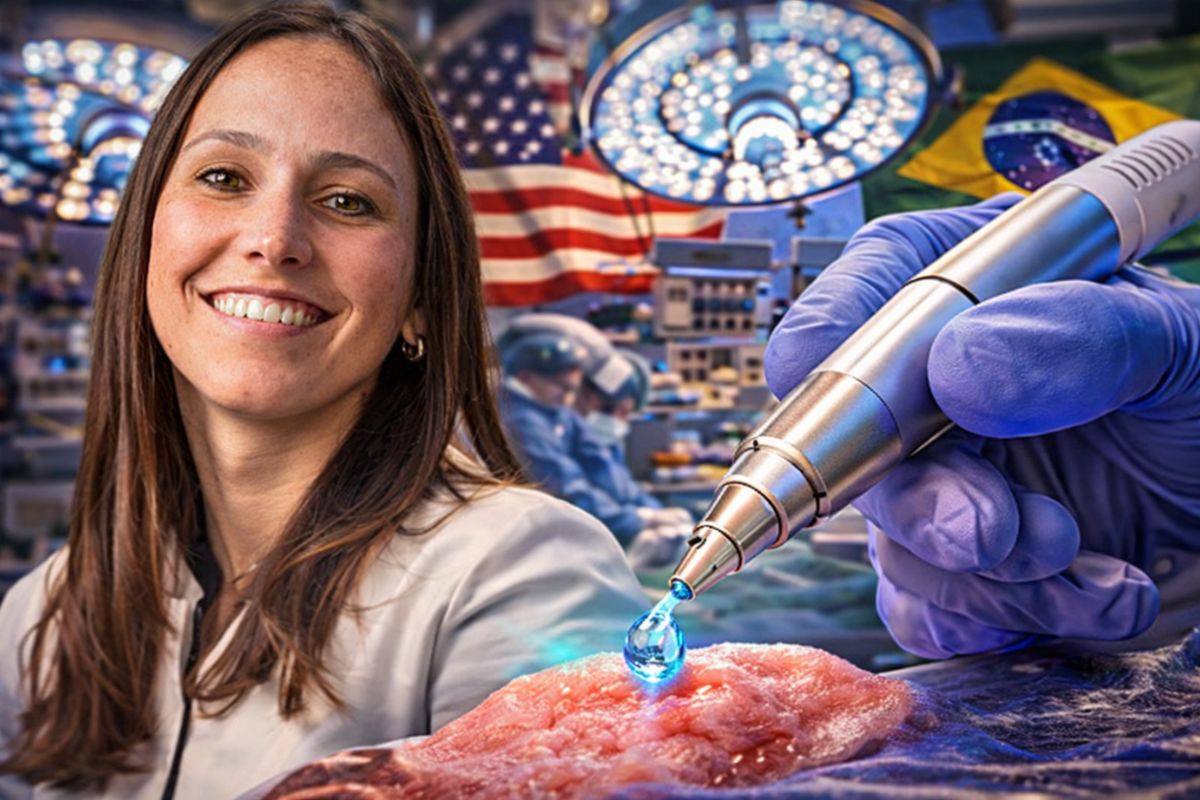
The Brazilian scientist Lívia Eberlin developed a pen that detects cancer cells in real time during surgeries, using just a drop of water and artificial intelligence to analyze the molecular profile of tissue in seconds. The technology has already been tested in more than 400 surgeries in six hospitals in the United States, including MD Anderson, and is now being tested at Einstein and Unicamp in Brazil.
A Brazilian scientist created something that oncology has been seeking for decades: a portable device capable of identifying cancer cells in seconds, during the surgery itself, without needing to remove tissue and send it to a lab. The pen developed by Lívia Eberlin touches human tissue, releases a drop of water that extracts molecules from the surface, and, with the help of artificial intelligence, informs the surgeon in real time whether what is in front is healthy or tumor tissue. The invention has already been used in more than 400 surgeries in the United States and is now being tested in Brazilian hospitals.
The path to this point has not been easy. Lívia faced years of underestimation for being a woman, Brazilian, and Latina in a male-dominated environment. She worked in windowless labs, heard that her idea was too simple to work, and went through exhaustion raising three children while developing the technology. But the pen worked. And today, the largest cancer research and treatment center in the world, the MD Anderson Cancer Center in Houston, is already using it in real surgeries, along with five other American hospitals.
How the pen that detects cancer in seconds works
The device looks like a regular ballpoint pen. Lívia Eberlin often jokes: “It’s not a pen that writes, it’s a pen that reads.” The surgeon holds the pen, touches the tip to the tissue that needs to be evaluated, and activates the mechanism with a pedal. A drop of water is released at the tip, comes into contact with the tissue, and extracts the molecules present on the surface.
-
An inventor in China creates flying drones shaped like swords that respond to hand gestures in real time, with technology based on motion sensors transforming interaction into a scene worthy of a movie and redefining the control of machines in the air.

-
100 times less energy consumption: the innovation that could solve the huge energy crisis of AI.

-
Scientists reveal a new method using solar light that transforms plastic into vinegar and could change the game against pollution, converting waste into a sustainable solution with future global impact.
-
3,500-year-old tear discovered reveals a textile technique much more advanced than previously thought in the Bronze Age.


The analogy that the Brazilian scientist uses is straightforward: just as we use hot water to extract molecules from ground coffee, the pen uses a drop of water to extract molecules from human tissue. These molecules are instantly analyzed by a mass spectrometer attached to the system, which generates a molecular profile of the tissue in fractions of a second.
This is where artificial intelligence comes in. Algorithms trained with data from hundreds of previous surgeries compare the molecular profile obtained with known patterns of normal and tumor tissues. The result appears in real time: cancer or normal.
The entire process from touching the tissue to the response on the screen takes seconds. For the surgeon, this means making decisions during the operation with a precision that was previously only possible days later, when the pathology lab results arrived.
The Brazilian scientist who faced prejudice to revolutionize oncology

Lívia Eberlin grew up visiting her father’s lab, a professor at Unicamp. Science has always been a familiar environment for her—literally. But when she moved to the United States to pursue an academic career, she encountered a very different reality. The American winter was cold, the people were too, and being a woman, Brazilian, and Latina in male-dominated departments brought challenges that went beyond science.
At Stanford, where she taught, Lívia looked at the wall of photos of professors and saw only men. “Do I belong or do I not belong?”, she remembers thinking. At an academic dinner, a professor made jokes about Brazilian women related to appearance and body. The Brazilian scientist felt uncomfortable, but her response to prejudice was consistent: achieving the best grades, doing the best work, producing results that spoke louder than any stereotype.
Exhaustion was constant. Lívia had three children in quick succession—now aged 11, 10, and 8—while developing the pen, teaching classes, and conducting research. She would put the kids to bed and go back to work: reviewing data, answering emails, preparing lessons. Persistence was not optional; it was the only way to transform an idea that many thought was too simple into a technology that today saves lives.
From 3D-printed prototypes to more than 400 real surgeries
The development of the pen went through dozens of prototypes. The Brazilian scientist and her team used 3D printers to manufacture increasingly refined versions of the device, testing each one on frozen tissues from different types of cancer.
“Let’s go to the freezer, let’s take all the tissues we have and see if it works for breast cancer, lung cancer, ovarian cancer, thyroid cancer,” Lívia recalls about the moment they decided to test the pen comprehensively.
At first, securing funding was difficult. Many investors and reviewers thought the idea would not work or was too simple to have a real impact.
The turning point came when the data began to accumulate and prove that the pen could indeed distinguish healthy tissue from tumor tissue with high precision. Publications in major scientific journals validated the technology and opened doors.
Today, the pen has been used in more than 400 surgeries in the United States, in six hospitals. The types of cancer tested include breast, lung, brain, ovarian, and pancreatic cancers. The MD Anderson Cancer Center, considered the most important cancer research and treatment center in the world, has already used the device on more than 70 patients.
Dr. Sudhakar Reddy, from the MD Anderson team, stated that the pen represents “a significant advancement in how we plan complex and difficult surgeries.”
The pen arrives in Brazil: testing at Einstein and Unicamp
The first country to test the pen outside the United States is Brazil, the homeland of the Brazilian scientist who invented it. The Albert Einstein Israelite Hospital in São Paulo is already using the device experimentally in thyroid and lung cancer surgeries.
About 30 surgeries have already been performed with results that the medical team classifies as “very promising.”
At Unicamp, the same university where Lívia’s father worked and where she ran through the halls looking at scientific posters as a child, doctors are testing the pen for the diagnosis of mouth cancer.
The cycle closes symbolically: the technology developed in the United States by a Brazilian scientist returns to Brazil to be applied at the institution where it all began.
The expectation is that, after the completion of tests and obtaining regulatory approval, the pen can be widely adopted in Brazilian hospitals.
For cancer patients in Brazil, this would mean faster diagnoses during surgeries, less need for reoperations, and greater precision in tumor removal—advancements that can directly impact survival rates.
Why the pen could change the standard of cancer surgeries in the world
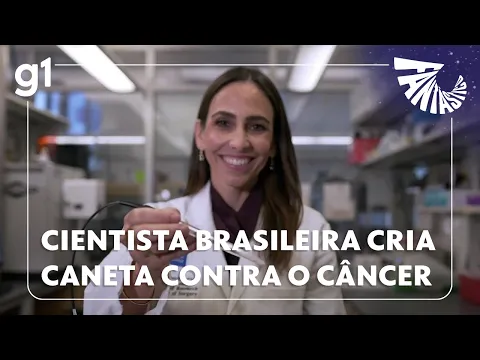

The problem that the pen solves is old and serious. During a tumor removal surgery, the surgeon needs to decide in real time how far to cut. If they remove too little tissue, cancer cells may be left behind and the cancer returns. If they remove too much, they unnecessarily destroy healthy tissue.
The traditional method of sending samples for analysis in a pathology lab can take from 20 minutes to several days, leaving the patient on the operating table or requiring a second operation.
The pen from scientist Lívia Eberlin eliminates this wait. With a response in seconds, the surgeon immediately knows whether the tissue they are touching is cancerous or normal, adjusting the procedure in real time.
This reduces the chance of positive margins when tumor cells are found at the edge of the removed tissue, indicating that the cancer has not been completely removed.
The technology is also useful after chemotherapy, helping to differentiate residual cancer cells from scars left by treatment—a distinction that traditional methods struggle to make. If the pen is adopted on a global scale, it could redefine the standard of oncological surgeries, transforming a drop of water and artificial intelligence into the difference between a cancer removed with precision and an avoidable reoperation.
With information from the G1 Channel G1.
What do you think of Lívia Eberlin’s story and the pen that detects cancer in seconds? An underestimated Brazilian scientist who created a technology used in the best hospitals in the world deserves more recognition? Leave your opinion in the comments—stories like this need to be known and celebrated.









Seja o primeiro a reagir!