





 Portuguese
  English
  Spanish
  5 min of reading
  0 comments


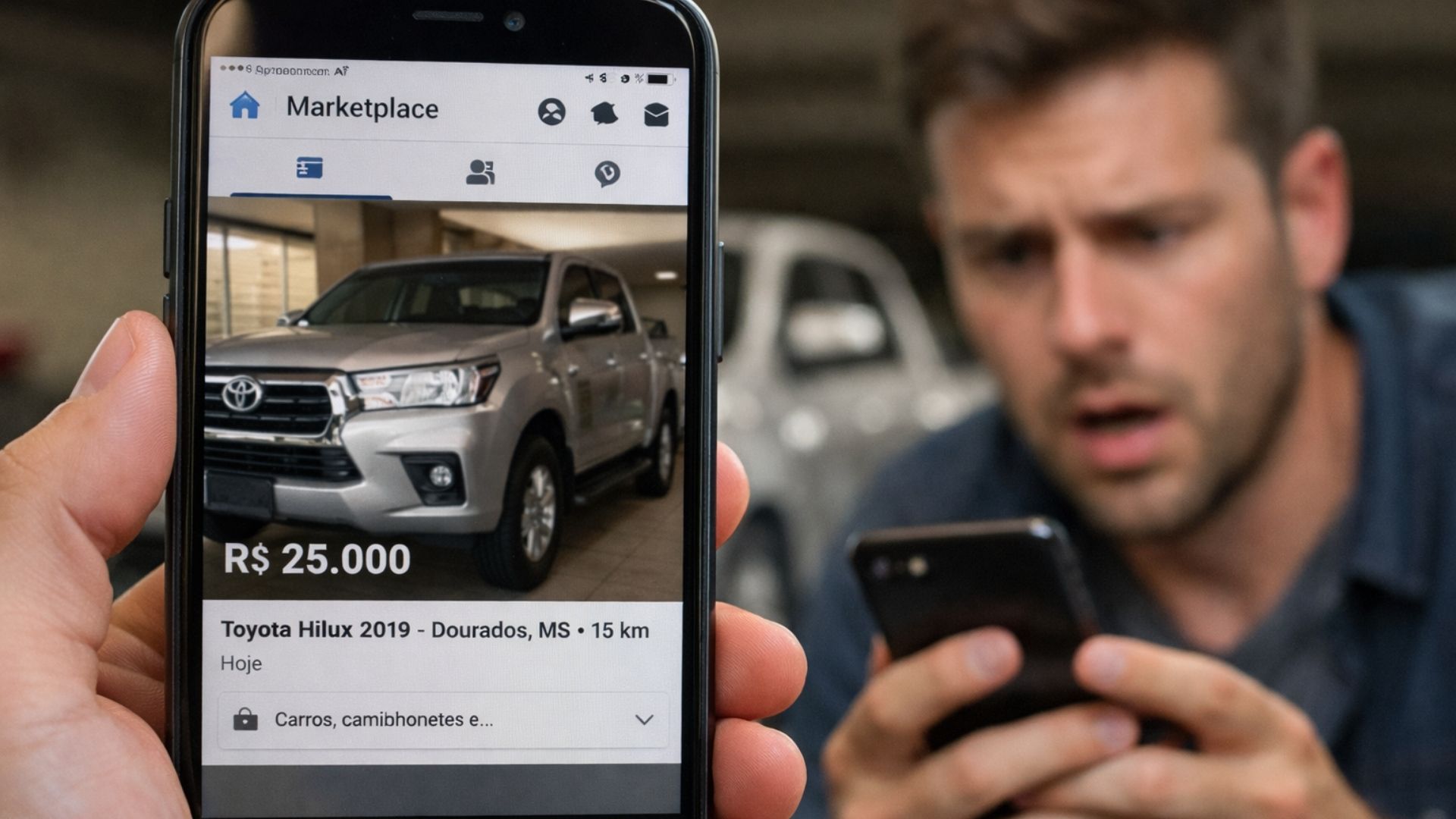
Online vehicle negotiation ends in high loss after use of fake profiles, multiple transfers via Pix, and manipulation of trust involving the identity of an acquaintance of the victim during negotiations conducted on social media.
A resident of Três Lagoas, in the east of Mato Grosso do Sul, sought authorities after losing R$ 125,000 in a fraudulent online negotiation involving a 2018 silver Toyota Hilux, advertised on Facebook for around R$ 162,000.
According to the police report, the money was sent via Pix to different accounts after the victim believed that the pickup truck had been checked by a trusted person.
The case was registered as a scam and will be investigated by the authorities.
-
With a volume of 300,000 cubic meters, an old oil depot transforms into a giant thermos, heating an entire city in Sweden and potentially changing the way energy is stored worldwide.

-
A new study suggests that the Strait of Gibraltar may disappear because the rocks beneath it are triggering a subduction process that could reshape the entire Atlantic Ocean over the next 20 million years.

-
What is it like to live inside a $13 billion aircraft carrier where 5,000 military personnel eat 17,000 meals a day and spend months sleeping in cramped bunks?

-
Without a button, sensor, or any electronic system, Harvard scientists create a solar device that decides on its own whether to generate energy or heat and could transform energy use in homes and buildings.


The victim was also advised to return to the police station with documents and to formalize the confirmation of the case, a necessary step for the continuation of the analysis in similar situations, as stated in the case record released by state media on Thursday, March 27, 2026.
Scam with Hilux sale started with an ad on Facebook
The negotiation began when the buyer found, on the social network, the ad for the pickup truck supposedly available in Dourados, a municipality in the south of the state.
After contacting the number provided in the post, he began conversing with a man who introduced himself as the seller and conducted the negotiations for the sale of the vehicle.
Then, the victim informed that he would send a friend to see the Hilux before closing the deal.
Shortly after, however, he received messages from another number, now with the photo of that friend on the profile, which reinforced the impression that the conversation was authentic and that there was someone known accompanying the in-person inspection.
Use of known identity reinforced the victim’s trust
The sudden change of contact was decisive for the scam to advance.
According to the report made to the authorities, the person using the friend’s image claimed that the pickup truck was in good condition and that the purchase could proceed, leading the resident of Três Lagoas to treat the operation as secure.
With trust already established, the supposed seller claimed that he urgently needed to receive the money to complete the purchase of a warehouse.
Convinced that the vehicle existed and that an acquaintance had validated the negotiation, the victim made several bank transfers, even using his wife’s account.
The total sent reached R$ 125,000, an amount distributed across different Pix keys indicated by the scammers.
Only after the transfers did the victim realize he had been deceived, a common situation in such cases, where those involved manipulate communication to rush payment and reduce the time for verification.
Fake intermediary scam and alerts from authorities
The plot described in the report includes frequent elements in the so-called fake intermediary scam, a type already subject to public alerts from Detran-MS.
In this type of scam, the criminal copies or repurposes information from a real ad, creates a parallel narrative, and begins to speak separately with the buyer and seller, hiding the true value of the deal and pressuring for confidentiality.
Although the case in Três Lagoas has a particular dynamic, two signs stand out in the report: the change of number during the conversation and the demand for upfront payment with a justification of urgency.
The Detran of Mato Grosso do Sul has already warned that offers below the average, urgency to transfer money, and confusing intermediation are relevant signs of scams in vehicle negotiations made online.
Another aspect that often facilitates this type of situation is the use of profiles, photos, and known names to convey credibility.
Upon receiving messages associated with the image of the friend, the victim began to believe that the inspection had occurred regularly, which weakened suspicion precisely at the most sensitive moment of the negotiation, when the money would be sent.
Furthermore, the fragmentation of the payment into several Pix keys increases the difficulty of immediate reaction.
The Central Bank advises that, in cases of scams, the guidance is to contact the financial institution as soon as possible and request a contestation of the operation, so that the Special Mechanism for Refund, known as MED, created to try to increase the chances of recovering funds in scam situations, can be activated.
Risks in purchasing vehicles through social networks
The occurrence recorded in Mato Grosso do Sul exposes an increasingly exploited pattern on digital buying and selling platforms: the criminal does not necessarily depend on a completely fabricated ad, but rather on the ability to control the conversation and introduce urgency, artificial trust, and barriers to direct verification of information between the parties involved.
In this environment, the promise of opportunity weighs as much as the price.
A 2018 Hilux advertised at a market-compatible price may not immediately raise suspicion, especially when the supposed seller maintains constant contact and presents a plausible justification for the need to receive quickly.
Still, the central point remains the breaking of basic verification procedures before any payment.
Among these precautions, authorities and traffic agencies recommend confirming the existence of the vehicle in person, checking the documentation, validating the identity of the seller, and avoiding deposits or upfront Pix transfers to third-party accounts.
When someone requests confidentiality about amounts, changes the number in the middle of the negotiation, or creates a narrative to prevent direct contact between the buyer and the owner, the risk of a scam increases significantly.
In the case brought to the authorities, the victim was precisely seeking confirmation before closing the deal by contacting a friend to see the vehicle.
The scam prospered because those involved managed to interfere in this verification step and turn a precautionary measure into a convincing tool, using the image of a known person as the central piece of the scam.
The analysis will now clarify who received the funds, how the accounts were used, and whether there was participation from other individuals in the scam chain.
Until then, the case reinforces a recurring alert from the authorities: in high-value purchases made through social networks, any pressure to advance money without direct validation of the negotiation should be treated as a sign of danger.









Seja o primeiro a reagir!