





 Portuguese
  English
  Spanish
  3 min of reading
  0 comments


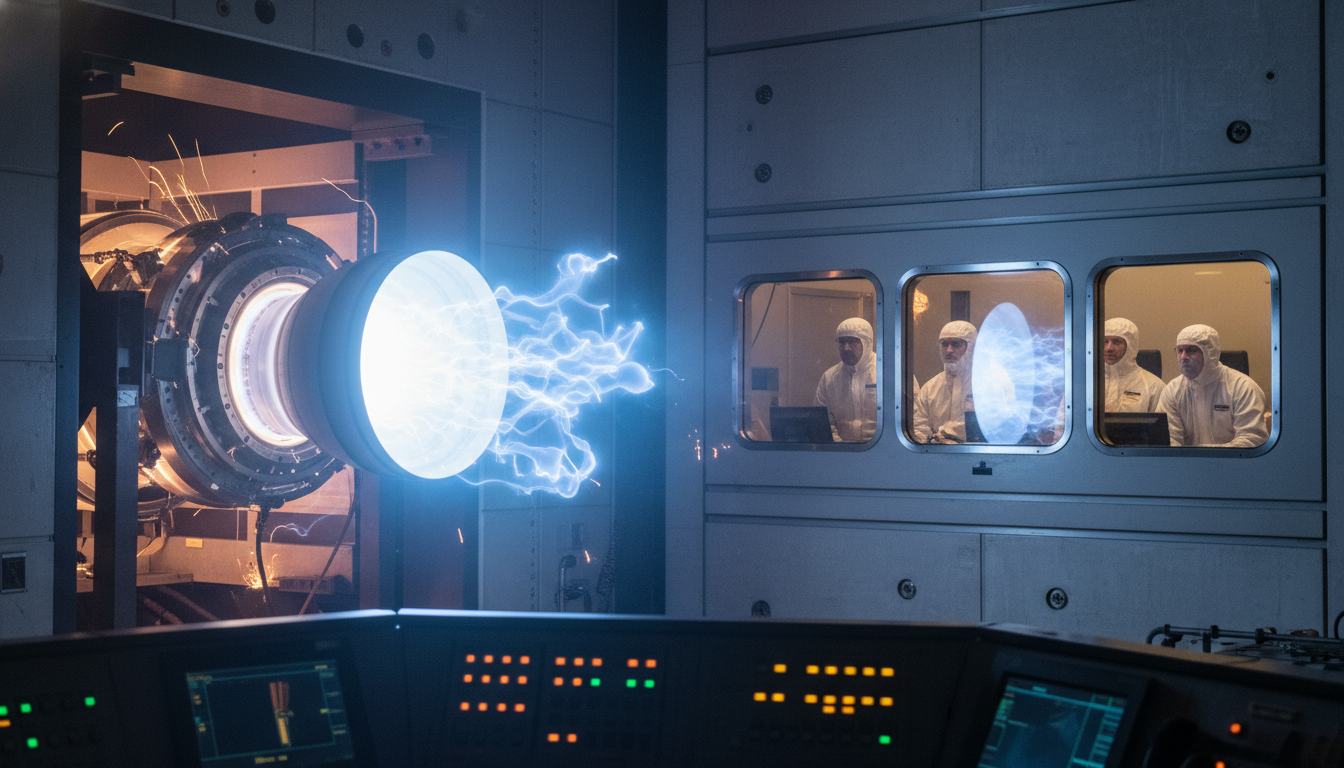
A British startup Pulsar Fusion from Bletchley achieved the first plasma ignition inside a nuclear fusion rocket engine in March 2026, using the Sunbird Mark I prototype with krypton as propellant and electromagnetic fields to confine and accelerate particles
In March 2026, at Amazon’s MARS conference organized by Jeff Bezos in California, Pulsar Fusion did what no private company had achieved before. The British startup ignited plasma — the fourth state of matter, electrically charged and extremely hot — inside a prototype nuclear fusion rocket engine called Sunbird Mark I. The test was streamed live and represented a milestone in space propulsion.
Nuclear fusion propulsion promises speeds of up to 800,000 km/h and up to 1,000 times more thrust than conventional orbital thrusters. Therefore, if the technology works at scale, trips to Mars that currently take months could be completed in a few weeks, drastically reducing the risks of space radiation and prolonged microgravity for astronauts.
How the Sunbird generates plasma and why this changes everything in space propulsion

The Sunbird Mark I operates by generating confined plasma within an exhaust architecture. Electric and magnetic fields direct and accelerate charged particles through the engine channel. In the March test, the propellant used was krypton, chosen for its high ionization efficiency at low mass flow rates.
-
Technology created by a Brazilian identifies signs of autism in babies from 4 months old using a low-cost kit that is based on the observation of gaze in response to visual stimuli.

-
Known as konjac, a root used for centuries in Asia creates foods that have virtually no calories, absorb water, form gel in the body, and are being used to replace pasta, rice, and even desserts.

-
The habit of drinking hot water in the morning is going viral on social media: experts explain how this ancient practice can influence digestion and well-being.

-
Brazil is also investing in plants for space and turning the lunar race into a real solution for producing food that grows in increasingly extreme climates.

- Propellant: krypton (high ionization efficiency)
- Confinement: electromagnetic fields guide plasma in the exhaust channel
- Theoretical speed: up to 800,000 km/h (222 km/s)
- Thrust: up to 1,000x greater than conventional orbital thrusters
- Next steps: superconducting magnets and performance testing with thrust measurement
Chemical rocket vs fusion: why the difference is 50 times

Current chemical rockets offer high thrust but have an exhaust velocity limited to about 4-5 km/s and a typical specific impulse of 450 seconds. Thus, trips to Mars take 7 to 9 months. Electric thrusters are more efficient but extremely slow. Pulsar Fusion aims to combine the best of both worlds: high thrust and high exhaust velocity.
However, it is crucial to emphasize that the March test generated plasma, but not a nuclear fusion reaction per se. As noted by experts, igniting plasma is not that difficult — the real challenge is confining plasma at sufficient densities and pressures to sustain fusion. The company plans upgrades with superconducting magnets and collaboration with the UK Atomic Energy Authority to advance.
What is needed for Pulsar Fusion to take fusion to space — and why it is still early to celebrate

Pulsar Fusion, founded in Bletchley, has a long way to go. The next steps include thrust scale testing, specialized probes, and drag potential analyzers to measure actual exhaust velocity. Furthermore, the company has not yet disclosed funding amounts raised.
Still, the milestone is historic. Since the 1960s, with the Orion Project and NASA’s NERVA, no one had demonstrated plasma confinement in fusion exhaust architecture. The global race for disruptive energy technologies finds in Pulsar Fusion one of the boldest candidates — even if functional fusion is still years away.






Seja o primeiro a reagir!