






 Portuguese
  Spanish


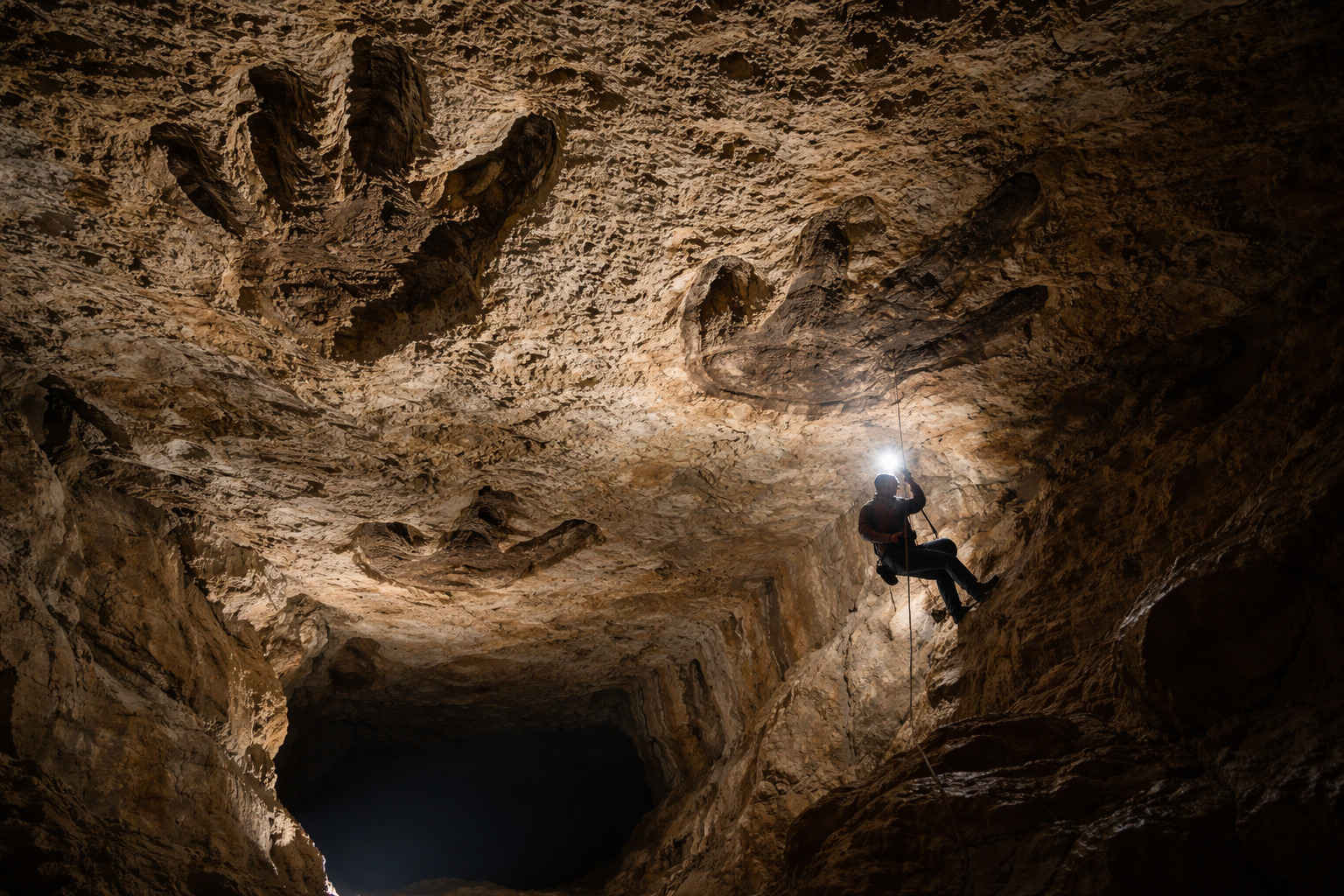


Dinosaur footprints found on cave ceiling in France reveal rare traces, anatomical details, and a new prehistoric ichnotaxon
Fossilized dinosaur footprints were found on the ceiling of a cave in southern France, about 500 meters deep, after a difficult journey. The discovery is significant as it reveals rare, detailed, and unusually preserved traces underground.
Discovery inside the cave
The footprints were identified in 2015 in the Castelbouc cave, in the Causse Méjean region. Access to the site required crossing a narrow, winding, and often flooded passage, leading to the end of a route over 100 meters long.
The location immediately drew attention because the traces were not on the ground or on side walls.
-
China Develops Custom 140-Ton Electric Mining Truck with 770 kWh Swappable Battery, Deploys 290 Units in Xinjiang’s Largest Zinc Mine

-
Meta to Launch Arena, a New Prediction App Targeting 3.56 Billion Users, Competing with Polymarket and Kalshi

-
Scientist Challenges Famous Human Evolution Theory, Argues Homo Sapiens Evolved Gradually Over Thousands of Years
-
15-Year-Old American Builds Ocean Generator with PVC Pipe and 3D-Printed Propeller for $12, Wins National Prize, Presents at White House, and Makes Forbes 30 Under 30 List




The marks appear on the ceiling of the cavity and need to be observed from below by researchers, in a rare configuration for this type of record.

How the traces were preserved
The marks are not common surface impressions. They correspond to three-dimensional counter-impressions, formed when the original footprints were filled with sediments and later exposed inside the cave.
The study published in the Journal of Vertebrate Paleontology documented three distinct trails.
The team highlighted that deep galleries of natural underground cavities, although difficult to access and sometimes dangerous, can preserve ichnofossils of great scientific value.
Anatomical details and dimension
Some footprints measure up to 1.25 meters in length. The researchers attributed the traces to titanosaurs, giant herbivorous dinosaurs known for individuals over 30 meters long and weighing up to 50 tons.
Dating back 166 to 168 million years, the footprints indicate that these animals moved through a coastal environment.
Several marks preserved impressions of toes, plantar pads, and claw marks with rare clarity.
This degree of preservation allows for examination not only of the size of the footprints but also aspects of the structure and movement of the foot.
One of the marks shows five well-defined toes on the right foot, an unusual detail in these fossils.

New ichnotaxon identified
One of the three trails presented a combination of characteristics never before recorded in sauropod traces from the Jurassic and Cretaceous periods.
From this, the researchers identified a new ichnotaxon, named Occitanopodus.
The name refers to the region of the discovery and the distinct morphology of the footprints.
For the team, the finding reinforces the potential for prospecting in deep karst caves and also highlights gaps in current classifications regarding the evolution of sauropods.
With information from Daily Galaxy.






That footprint in the first image looks like a hand than an actual dinosaur footprint.
Thats an AI image.
Sooo…how did they get on the ceiling??
The cave was washed out by underground water and exposed the bottom of the footprints. If you read the passage properly you will see that is what they said. Also you can see that the prints are not indented they are proud (pushing out of the ceiling like when you take a plaster cast of your kids hand and your left with a 3d hand made if plaster.
Australian dinosaur