





 Portuguese
  English
  Spanish
  7 min of reading
  1 comment


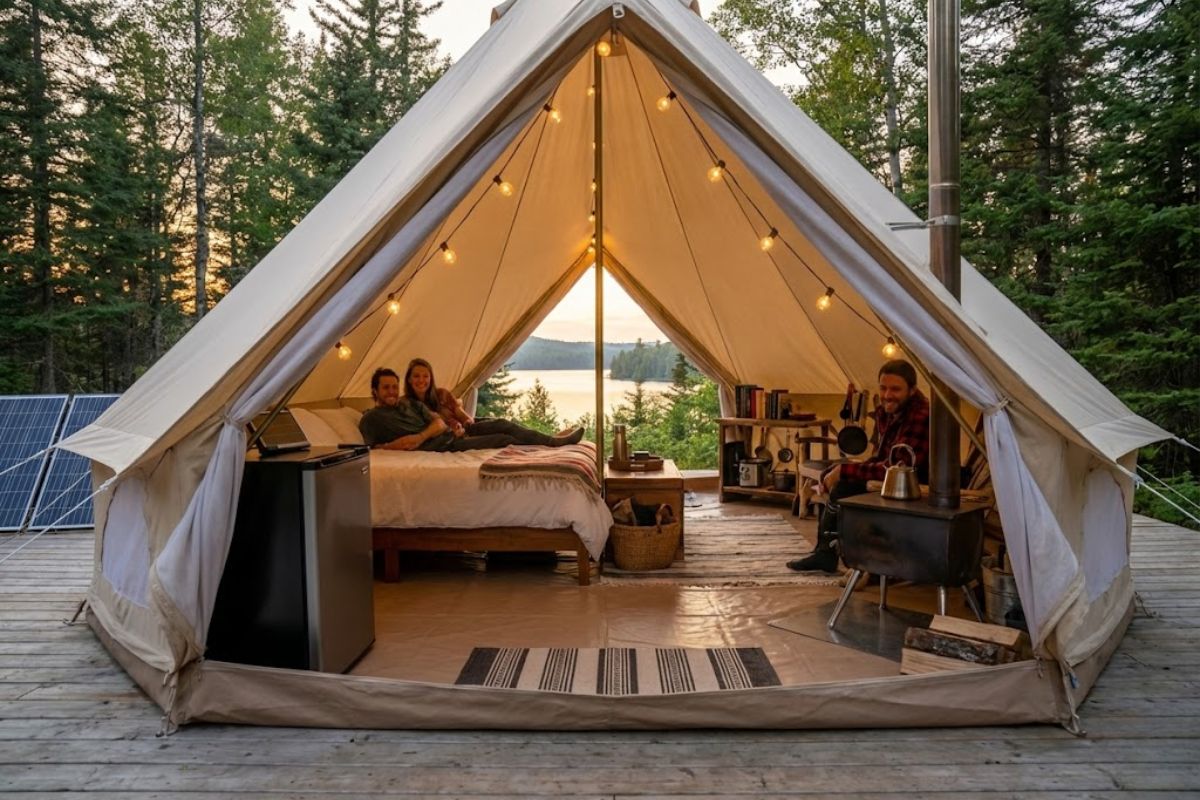

Without Raising Walls, They Searched for a Functional Cabin for the Lakefront Lot That Already Has Sauna, Hot Tub, Kitchen, and Bathroom, but Lacked a Dry Bedroom. The Solution Was a Thick Fabric Bell Tent, Double Door, Set Up on the Deck, with a Ready Bed and Basic Solar Energy.
The idea of a “cabin” here comes from a practical absence: there was almost everything on the lot, except for a permanent place to sleep. After nearly three years of improvising with common tents, the rain, the damp ground, and the routine of setting up and taking down began to weigh, and the need became a project: to create a fixed refuge without yet embarking on a permanent construction.
The “who” appears in everyday life: a couple who frequently uses the area located in Canada and prepares the space for their son as well, thinking about real comfort and repeated use. The “how much” is at the level they themselves set as a goal and limit: transforming a tent into a cabin for just a few thousand dollars, choosing simple solutions, reusing wood from their own lot, and prioritizing what enhances the experience of staying there.
Why a Tent Ended Up Turning into a Permanent Cabin

The decision starts with what already existed: sauna, hot tub, kitchen, and a place to go to the bathroom. Still, the experience was not complete because it lacked a basic point for any cabin: a dry and ready space to sleep, without depending on the whims of the weather and the soaked ground.
-
Italian researchers have detected what appears to be a second Sphinx buried under the sands of Egypt, and satellite scans reveal a gigantic underground megastructure hidden beneath the Giza Plateau for over 3,000 years.

-
There are 4,223 drums and 1,343 metal boxes concreted with 50-centimeter walls that store the radioactive waste from Cesium-137 in the worst radiological accident in Brazil, just 23 kilometers from Goiânia, with environmental monitoring every three months.

-
Giant Roman treasure found at the bottom of Lake Neuchâtel in Switzerland reveals an advanced trade system, circulation of goods, and armed escort in the Roman Empire about two thousand years ago.

-
He buried 1,200 old tires in the walls to build his own self-sufficient house in the mountains with glass bottles, rainwater, and an integrated greenhouse.
They even looked at more traditional options, like yurt-type structures, as well as other tents and shapes, but arrived at an intermediate path: a circular canvas tent designed to stay set up. The reason is straightforward: they were not ready to build a wooden cabin, but wanted a “room” that was already there every time they arrived.
What Is a Bell Tent and Why Does It Act Like a “Home”
The chosen tent follows the classic logic of a “bell tent”: circular shape, a central pole, sloped roof, and support cables to keep everything tight. This creates an internal volume where you can stand, move around, and organize real furniture, something that brings the feeling of a cabin, not just camping.
Another point is the fabric itself, described by them as thick and made for this type of use, with signs of care in design and construction. When the material and zippers make a difference, you feel less of the improvisation: the structure seals better, keeps the interior drier, and reduces the typical frustration of simple tents in damp weather.
Quick Setup, but with a Detail That Changes Everything: The Deck

In theory, the setup can be quick, within minutes, but the real scenario changes when there are more hands helping and when the goal is not “camping today,” but rather setting up to last. They unpack the tent in parts, secure the base, and then raise the whole assembly with the central pole before installing the door elements and adjusting the ropes.
The deck enters as a key piece of the “where”: it is there that the improvised cabin gains permanence. Instead of stakes in the ground, they secure the structure to the floor with stainless steel screws and washers, which makes sense for repeated use. It’s the platform that transforms a tent into an address, because it provides a solid base, avoids direct contact with the wet ground, and makes it easy to keep everything level.
Support Cables and the “Smart Hack” to Save Space

On an elevated deck, a technical problem arises: the support cables would need to extend a lot to keep the fabric taut. When the surrounding space does not help, you either accept the tent being less tensioned, or create a solution to shorten the path of the ropes.
They took the practical route and created something akin to short posts using treated wood strips (2×2), bringing the tent’s anchoring point closer. This is not aesthetics, it’s physics: keeping the fabric well stretched improves stability, reduces “belly” where water can accumulate, and helps the entire setup withstand better against wind and constant use.
Two Doors, Cross Ventilation, and a Cabin That Does Not Turn into a Greenhouse

The choice of two doors is not just a convenience for entry and exit. It creates different perspectives from the outside and allows for rearranging the interior according to the view and the wind. One access can be the “social” one, with chairs and the lake view; the other serves as a practical route, avoiding clutter and unnecessary foot traffic on rainy days.
In practice, doors on different sides help create cross breezes, which is valuable in a canvas cabin. There is also mention of a zipper and mesh closure system around the perimeter, reinforcing the idea of a more “fixed” use, with better pest control.
Comfort here is not fighting against the environment: less mosquitoes, less stuffiness, more time enjoying the place.
Real Furniture: Bed, Coffee Table, and Reuse of Land

The most time-consuming part was not raising the fabric, but furnishing it. This says a lot about the proposal: instead of a sleeping mat and makeshift setup, they put in a real bed, with bedding already left there. This choice changes the mental standard of use, as the cabin stops being “set up and taken down” and becomes “arrive and use.”

They also adapted an old desk, cutting the legs to turn it into a coffee table, and made side tables from wood of a fallen tree on the property, cut and transformed into simple pieces.
They even adjusted the headboard to be lower and fit better against the tent’s sloping wall. When each piece of furniture has reason, the space works, even without rigid walls.
A Cabin with Solar Energy and a Refrigerator: The Turning Point of “Staying”

The leap in experience appears when electricity and food preservation come into play. They mention the purchase of a battery bank with an inverter, solar panels, and a dual zone refrigerator that operates directly from the battery and solar energy.
This allows them to keep food for several days, charge phones, laptops, and tool batteries, and even use a projector for movies on the tent wall.
Here, the “how much” is again grounded in reality: it’s not about unlimited luxury, but rather choices that fit the concept of “a few thousand dollars” to transform a tent into a functional cabin.
Energy Changes Permanence: when you don’t depend on leaving to recharge everything or buy ice, the place turns into a base, not just an outing.
Three Seasons, Four Seasons, and the Limit They Recognize
Even with the robust structure and the possibility of additional heating, they consider the cabin to be a three-season solution at the moment: spring, summer, and fall.
There is a notion that it could be used in winter with adaptations, but there is a well-grounded warning about accumulated snow and the necessary care.
This caution is important to keep the proposal honest. A canvas cabin works very well within a set of limits: attention to moisture, ventilation, sealing, and maintaining tension in the fabric. The secret is not to pretend it becomes a traditional house, but rather to design the use for what it delivers best.
The “Cheat Code” That Makes Sense: Arrive and Use Without Starting from Scratch
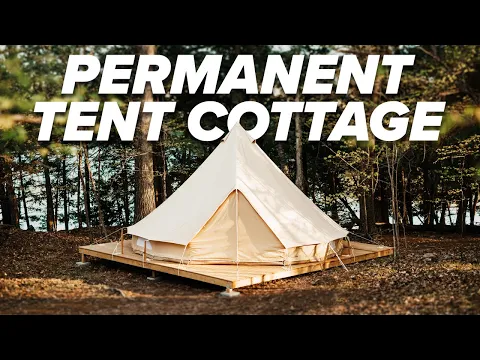

The final gain is simple to understand: instead of setting up a tent every week, rain or shine, they arrive and the space is already ready, dry, and organized. This reduces friction, increases rest time, and transforms the lot into a truly livable place, even without permanent construction.
In everyday life, the improvised cabin also becomes a social space: if it rains, they can read, the child can play, and no one needs to hunch over to enter.
When the sleeping place stops being an issue, the rest of the lot “appears”: the sauna, the lake view, and the little routines are enjoyed, not managed.
Transforming a circular canvas tent into a permanent cabin is not about “replacing” a house, but rather creating a fixed point where there was only improvisation before.
The project stands because it answers basic questions without drama: who uses it (a couple and their child), where it is (on the deck, overlooking the lake), why they made it (moisture and lack of a ready bedroom), and how much it cost in the spirit of the decision (a few thousand dollars, without exaggeration).
And you, would you have the courage to call a well-set-up tent a real cabin?
If it were on your land, would you prioritize a bed and solar energy, or would you first invest in heating, insulation, and storage to stay longer without depending on anything?










TOP. MAS QUANTO$? COMPRAONDE?