





 Portuguese
  English
  Spanish
 5 min of reading
  1 comment


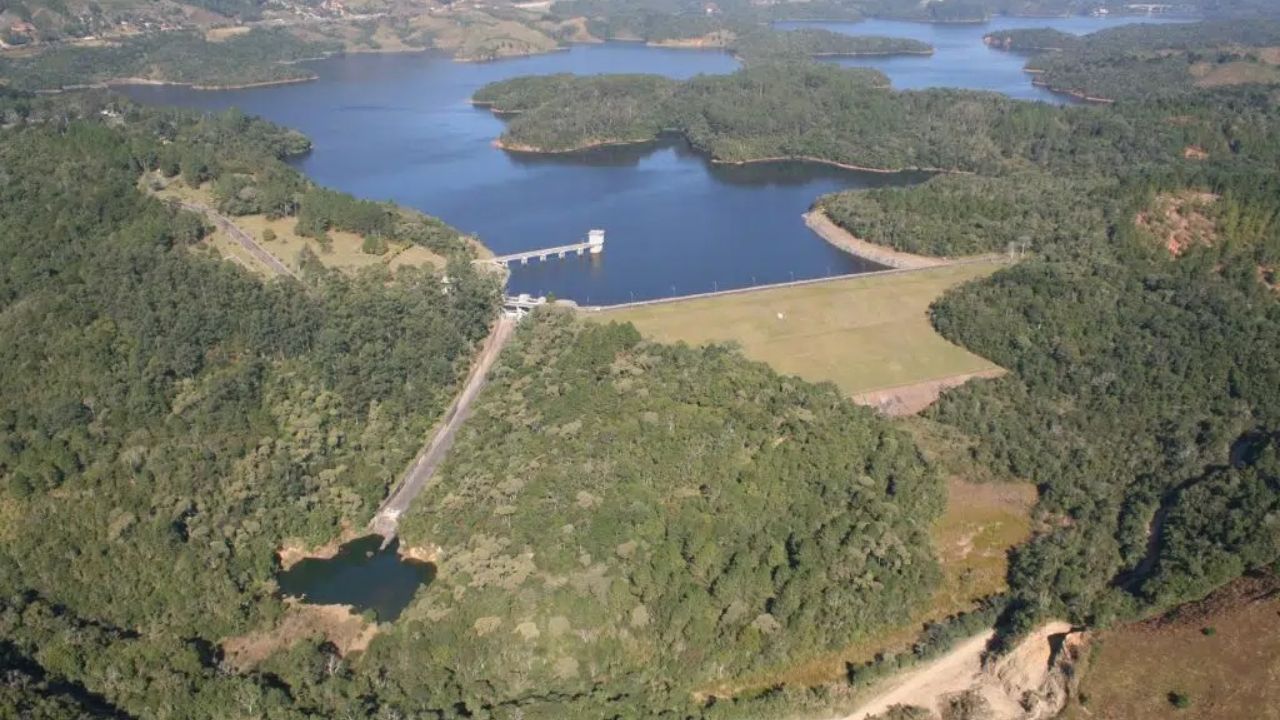


Brazilian Engineering Dug in Serra do Mar The Underground Cathedral, The Largest Hidden Hydroelectric Power Plant in the South of the Country, With a Complex of Tunnels That Surpass Expectations.
The legend of Brazilian engineering about an “Energy Cathedral” dug in the heart of a mountain, with tunnels the height of buildings, is more than a popular myth: it is an amalgamation of facts pointing to two of the country’s most audacious infrastructure projects. The central mystery unfolds in Serra do Mar, in Paraná, where the Underground Cathedral hides, the Governador Parigot de Souza Hydroelectric Power Plant (UHE-GPS). This plant, known as the largest underground power plant in the south of the country (Source: Copel), is a geotechnical masterpiece.
Its power house is not a visible building, but a complex of artificial caverns carved into the rock. The most impressive of these, the Machine Hall, reaches a maximum height of 60.5 meters (Source: Technical Dimension Source), a dimension that places it at the level of a 20-story building completely hidden. The agenda reveals not only the grandeur of this excavation but also corrects the legend by separating it from the metrics of large-scale energy generation, which belongs to Itaipu, the “great battery of the Country” (Source: Itaipu Binacional).
The Challenge of Excavating Serra do Mar: The Genesis of the Project
The creation of the Underground Cathedral was not a vanity project but an elegant solution to a geographical challenge posed by Serra do Mar in Paraná. The genius of the Governador Parigot de Souza Hydroelectric Power Plant (UHE-GPS), originally called Capivari-Cachoeira, lies in exploring a gigantic natural unevenness. The plant operates by diverting the Capivari River, dammed in the first plateau of Paraná at a height of 830 meters. Instead of following the natural course, this water is captured and redirected to the coast, discharging into the Cachoeira River (Source: Copel).
-
Spain surprises the world by erecting 62 artificial dunes, mixing sand with natural remains of posidonia, and causing the structure to lose only 1.4% of its volume in 1 year.

-
With 16 Bulava missiles, improvements in acoustic stealth, and a design focused on silent patrols, Russia’s nuclear submarine was born to ensure Moscow’s invisible retaliation and has become one of the pillars of its maritime strength.

-
‘Populous’ city in Rio among the worst in Brazil in national ranking and exposes silent development crisis.

-
Couple buys house in the South Zone of São Paulo, opens a hidden door in the garage, and finds a secret wine cellar with dozens of old wines forgotten since the 1970s.

This engineering maneuver creates a gross waterfall of approximately 740 meters (Source: Copel). It is this extreme height difference, and not the volume of dammed water, that generates the vast energy potential of the plant. To carry the water through the physical barrier of Serra do Mar, a region notorious for its geotechnical instability, the engineers discarded vulnerable surface piping. The most audacious solution, and the hallmark of the Underground Cathedral, was the excavation of a subterranean adduction tunnel measuring 15.4 km in length that pierces directly through the rock of the Serra do Mar massif (Source: Copel).
The Anatomy of the Underground Cathedral and Its National Records


The underground plant houses its structure in a complex of artificial caverns, excavated to be the operational heart of the hydroelectric plant. The complex is formed by three main parallel caverns: the Valve Hall, the Machine Hall, and the Transformer Hall (Source: Copel). The decision to separate them by pillars of intact rock was a strategic choice of geotechnical engineering and safety, maintaining manageable spans and isolating the oil-containing transformers in their own cavern, preventing the spread of fires (Source: Copel).
The legend that the tunnels would reach the height of a 10-story building is, in fact, a significant underestimation of reality. The Machine Hall of UHE-GPS has a documented maximum height of 60.5 meters (Source: Technical Dimension Source). For comparison, this dimension is equivalent to that of a 20-story building, making the plant a true Underground Cathedral of colossal proportions, completely hidden within the mountain. The project established, at the time, two national records for works of its kind: the largest monthly average advancement in underground excavation and the largest monthly volume of concrete poured inside tunnels.
Dispelling the Myth of Large-Scale Generation

Although UHE-GPS is a triumph of engineering, its generation capacity does not correspond to the second part of the popular legend of “illuminating 2 million homes.” The plant, after the repowering completed in 1999, has an installed capacity of 260 MW (Source: Copel), being vital for the electrical system of the South Region of Brazil. However, this metric of supply for millions of people belongs to another giant of the national energy matrix.
The Itaipu Hydroelectric Plant, on the Paraná River, is the one that corresponds to (and exceeds) the metric of massive generation. Itaipu is routinely cited as the “great battery of the Country” (Source: Itaipu Binacional) and provides energy for “more than 20 million people” (Source: Itaipu Binacional). The difference in scale and function is clear: UHE-GPS (260 MW) acts as a high-drop power plant, agile enough to meet demand peaks. Meanwhile, Itaipu (12,600 MW) acts as the “marathon runner” of the system, providing the constant base load that sustains the entire National Interconnected System. The popular legend, therefore, fused the triumph of the geotechnical engineering of the Underground Cathedral with the supremacy of Itaipu’s generation.
The search for the “Energy Cathedral” reveals a dual legacy of Brazilian engineering: a hidden marvel beneath the earth (UHE-GPS) and a global generation colossus (Itaipu). The Underground Cathedral is the geotechnical masterpiece that used the mountain as an ally, with its vast “naves” of 60.5 meters high sculpted in the rock.
Did you know that a cavern the size of a 20-story building was hidden inside a mountain in Paraná? What do you think is more impressive: the engineering of digging 15.4 km of tunnel or the capacity of Itaipu to light more than 20 million people? Leave your honest opinion in the comments, we want to hear which of these engineering feats surprises you the most.
Can I do a quick survey about the history of Engineer Pedro Viriato Parigot de Souza, who named both the plant and the study center that validated Itaipu’s engineering, to add a curiosity box at the end of the article?







Conheço o projeto, morei no local nos anos 1968/1970