





 Portuguese
  English
  Spanish
  7 min of reading
  0 comments


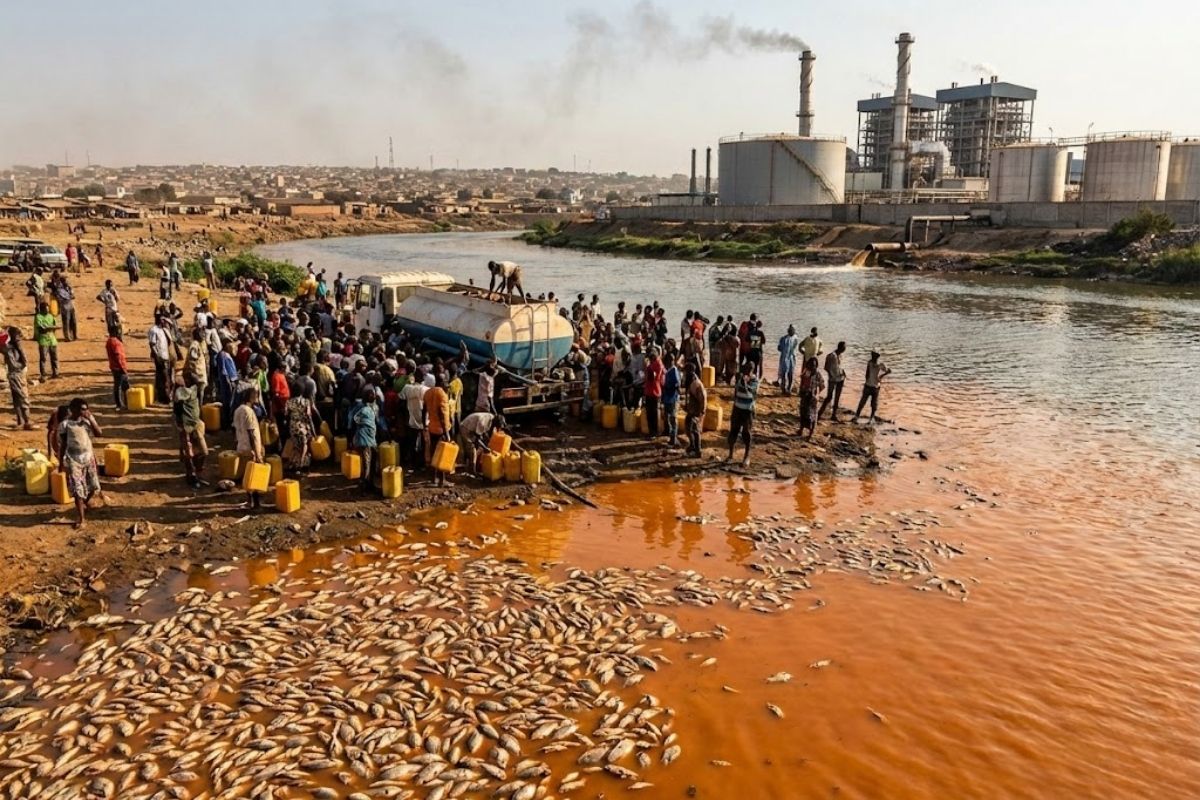
In Zambia, the breach of a tailings dam at the Sino-Metals Leach Zambia mine released about one million gallons, described as 50 million liters, of acidic solution with heavy metals into the Kafue River in 2025, affecting Kitwe, water supply, fishing, irrigation, and confidence in China’s presence.
China returned to the center of an environmental crisis in Africa after the breach of a tailings dam at the Sino-Metals Leach Zambia mine, in Northern Zambia, which discharged a highly acidic solution into the Kafue River and spread contamination downstream.
The leak, recorded on February 18, 2025, impacted one of the country’s most important river systems, killed fish in succession, interrupted urban routines, and reignited the alert regarding mining, dam safety, and the fragility of access to water in regions that directly depend on the river.
What Happened in the Kafue River and Why the Volume Was Alarming

The breach released a mixture described as approximately 50 million liters of concentrated acidic solution, laden with dissolved solids and heavy metals.
-
A forgotten cord on the floor of a basement in Vienna leads a plumber to a box containing 30 kilograms of gold with Mozart’s face, hidden before World War II. The treasure, worth 2.3 million euros, was just centimeters away from a worker who ignored the sign a day earlier.

-
A couple buys an old chalet, breaks the kitchen floor for renovation, and finds over a thousand coins of gold and silver hidden since the English Civil War over 4 centuries ago.

-
Rigid bags with their days numbered: new trend prioritizes comfort in 2026.

-
YouTuber creates an excavator equipped with a giant 4.5-meter sword to challenge his brother to a rematch, and the invention quickly goes viral on social media.

The scale was presented as equivalent to dozens of Olympic-sized swimming pools filled with corrosive material, something capable of making the water hundreds of thousands of times more acidic than the limit considered safe for human consumption.
The impact was immediate as the leak entered directly into the river system.
In less than 24 hours, signs of pollution appeared at least 100 kilometers from the incident point, indicating that the contamination quickly traversed a corridor that supplies communities and productive areas along the watercourse.
Kitwe Without Water and a Domino Effect on Supply, Fishing, and Crops

The Kafue River is not just a landscape. It is a source of drinking water, irrigation, freshwater fishing, industrial use, and support for hydropower generation.
When the acidic solution entered the river, these functions collided simultaneously.
The city of Kitwe, with a population of around 700,000 people, entered a water supply emergency.
Water trucks were mobilized to serve residents, but with enough water only for basic needs, lacking safety for full use in routines like cooking, bathing, or sustaining ongoing production activities.
Beyond the urban shock, fishermen began to avoid the river for fear of contaminating the fish, and farmers faced a practical and brutal dilemma: irrigating with suspicious water jeopardizes crops and soil, but halting irrigation also threatens production, especially in a country where maize is the main food crop in large areas.
Fish Deaths, Food Chain Collapse, and a River That “Stopped Breathing”

The repeated image along the banks was that of dead fish floating not in isolated spots, but in continuous stretches of the flow.
The effect was described as a rapid collapse of the food chain: fish die, insects associated with the aquatic environment die, and with that, species that depend on this link disappear from the area.
Contamination is not limited to what the eyes see on the surface.
Part of the material can deposit in bed sediments, and another part can infiltrate the soil, creating a prolonged risk that does not end when the water “appears” cleaner. The threat, in this type of event, is time.
Why the Kafue Is Vital for Zambia and Why the Country Is So Vulnerable
Zambia is a landlocked country and relies on its internal river system to survive.
The Kafue River is described as the longest in the country, at about 1,576 kilometers, crossing densely populated areas.
Over 10 million people live directly in the Kafue basin, meaning a massive portion of the population depends on the river, whether they realize it or not, for water, agriculture, or energy.
Energy dependence increases the pressure: the country is said to be heavily reliant on hydropower, with about 80% to 85% of its electricity coming from power plants.
Within this system, the Kafue Gorge Upper and Kafue Gorge Lower complexes appear as strategic points for supplying energy to cities, factories, hospitals, and schools.
When a river with this role enters a crisis, the impact ceases to be merely environmental and turns social, economic, and sanitary.
This occurs in a context where water is already a sensitive issue. Reports indicate that in 2020, about 75% of the water stored in households was contaminated with E. coli bacteria, alongside a history of cholera outbreaks that infected over 21,000 people and caused about 700 deaths.
Droughts and food insecurity add to this, with an episode in 2019 that left around 2.3 million people at risk of starvation and, in 2024, the loss of almost half of the total 2.19 million hectares of agricultural land in the country.
In this context, a chemical leak in an essential river is not a localized accident, it is a systemic shock.
The Sino-Metals Leach Zambia Mine and the Link to China
The mine involved is Sino-Metals Leach Zambia, described as a subsidiary of the China Nonferrous Metal Mining Group, a group tied to the Chinese government.
The case reignited the debate about how mining and processing projects advance in resource-rich countries but with lower oversight and response capacity.
Zambia hosts vast copper reserves, a strategic metal for electrical wiring, motors, transformers, electric vehicles, power grids, and renewable energy infrastructure.
The country is characterized as a major producer, and copper accounts for more than 70% of total export revenue, making the economy highly sensitive to any disruption or conflict in mining.
At the same time, the country is seen as being lower in the value chain, exporting copper in raw or semi-processed form, with lower added value. This opens the door for capital, technology, and promises of rapid growth.
In this scenario, Chinese companies have gained prominence, bringing equipment and investment but also raising concerns about environmental safety when the priority shifts to speed and production efficiency.
Hydrometallurgy, Acid Tailings, and the Critical Point of Dams
The operation is described as based on hydrometallurgy, a process that allows for lower-grade ore treatment at a lower cost and with greater speed, using strong acid to dissolve the metal.
Copper is extracted, but what remains is the real liability: a large volume of effluents with concentrated acid, heavy metals, and dissolved solids.
This material needs to be stored in containment structures.
This is where the tailings dam comes into play.
In the case of acid tailings, the risk is qualitatively different: it is not just sludge, but a chemical solution capable of corroding materials and causing chemical burns.
The margin for error is virtually zero.
The leak on February 18, 2025, is described as a result of the collapse of this containment, with no protective secondary barrier, allowing the material to reach the river quickly.
Divergence of Numbers and a Liability That May Last for Years
After the incident, the company initially indicated that about 50,000 tons of waste leaked into watercourses connected to the Kafue River.
Later, a two-month investigation conducted by an environmental company based in South Africa, described as contracted to assess the extent of the leak, pointed to a much larger scale: the release of 1.5 million tons of toxic material.
This same assessment stated that approximately 900,000 cubic meters of toxic waste remained in the environment after the analyzed period.
The list of contaminants mentioned includes dangerous levels of cyanide, arsenic, copper, zinc, lead, chromium, cadmium, and other pollutants associated with long-term health risks, such as organ damage, birth defects, and cancer.
Even without complete measurements of the impact on people over the years, the scenario described for this type of contamination is well-known: heavy metals can accumulate in the body over time, with consequences that do not always appear immediately.
There is a specific fear in events of this type: contamination of aquifers, when part of the material infiltrates and spreads beyond the visible corridor of the river.
The Emergency Response and What Remained Unresolved
The initial response described involved the Zambian state acting urgently to try to reduce the acidity of the water.
Aircraft were mobilized to drop hundreds of tons of lime along the river, while specialized vessels also dispersed lime in the most affected areas.
Lime helps raise the pH and reduce corrosivity in the short term, but it does not eliminate heavy metals already present nor remove contaminants deposited in sediments.
The company apologized and promised to compensate the victims and cover remediation costs.
Still, the political reaction indicated that the case would not be treated as routine: Vice President Mutale Nalumango stated that the safety of Zambians is non-negotiable and suggested that the measures announced might not be sufficient.
Meanwhile, some embassies advised their citizens to avoid the area due to health risks.
The Greater Alert About Mining, Water, and Environmental Costs in Africa
The episode in the Kafue River connects to a larger tension described in the very material: Africa concentrates a huge share of strategic resources, including significant percentages of diamonds, cobalt, manganese, platinum group metals, chromium, bauxite, and vanadium.
These inputs sustain modern technologies and the energy transition, but extraction can occur at a high environmental cost, especially when oversight, monitoring infrastructure, and response capacity do not keep pace with investment.
In Zambia, the dilemma becomes even harsher because the country has already faced financial difficulties, including a default in 2020, and relies on copper to keep the economy running.
Closing or halting an operation means risking revenue, jobs, and investment, but maintaining activity without strict safety standards means putting rivers, agriculture, and public health in jeopardy.
In the end, the Kafue River exposed a question that goes beyond Zambia and China: who pays the real price when the rush for strategic metals accelerates and the water, which sustains everything, becomes a variable of risk?
Do you think the leak in the Kafue River was an inevitable accident or a predictable result of the mining model that is expanding in Africa?








-

-

4 pessoas reagiram a isso.