





 Português
  Inglês
  Espanhol
  4 min de leitura
  25 comentários


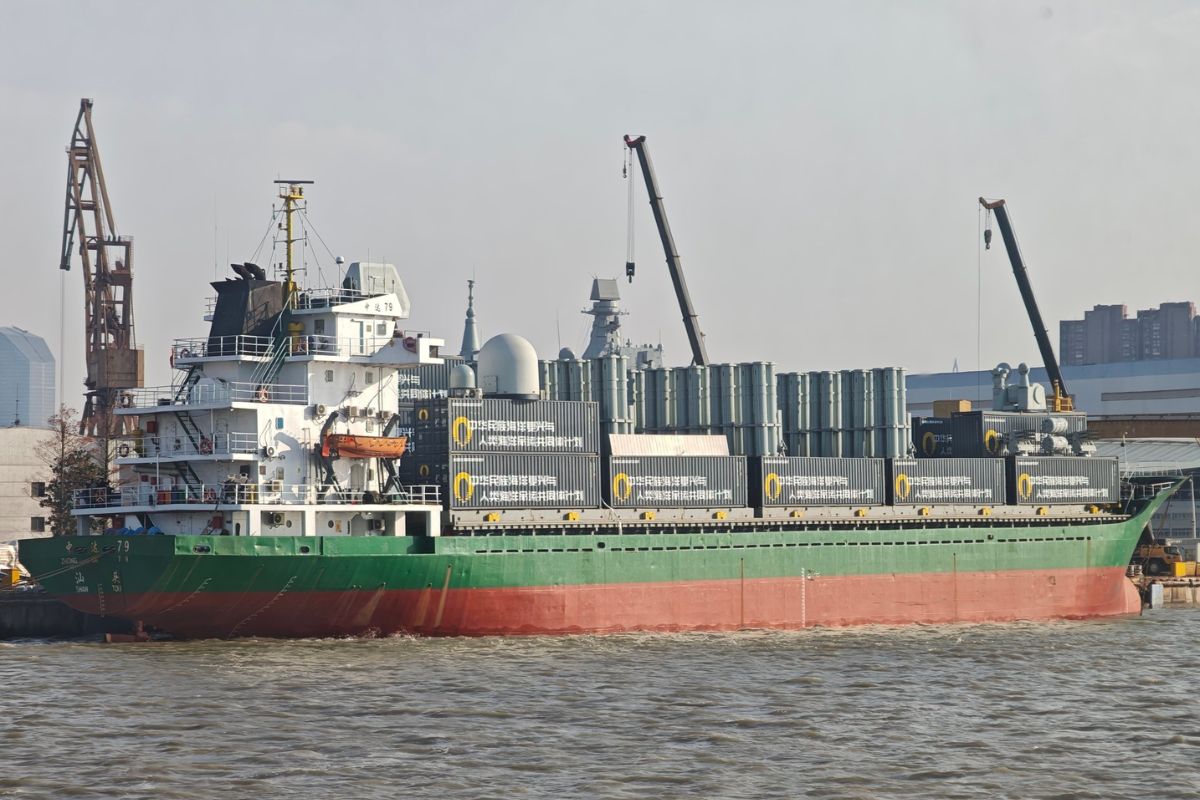


China Showed A Container Ship With About 60 VLS Cells In Containers, Radars, And Self-Defense, In Shanghai. The Aim Indicates Modularity, Quick Conversion, And First Strike At A Lower Cost, Using Merchant Fleet As Auxiliary Military Force To Multiply Presence
China showcased a container ship equipped with vertical missile launchers in containers, radars, and self-defense systems, making it clear that the boundary between civilian vessel and military platform can be modular.
The ship appears to be the Zong Da 79, with exposed armament on deck, suggesting a low-cost and rapid mobilization strategy that uses the merchant navy as a base to expand presence, surveillance, and strike capability.
The Armed Container Ship That Caught Attention

The case revolves around the Zong Da 79, seen on the Shanghai waterfront, with military modules installed on deck and no attempt at concealment.
-
With more than 635,000 doctors, Brazil sees competition increasing in large cities, and recent graduates are competing for shifts at an accelerated pace while the countryside still faces shortages.

-
The world’s first octopus farm wants to open in the Canary Islands and is already provoking an international reaction: the plan aims to produce 3,000 tons per year.

-
Drought may be creating stronger superbugs in the soil and helping antibiotic resistance reach hospitals, warns a study highlighting a problem that could grow alongside extreme weather.

-
The biggest scam in history: Napoleon’s France deceived the United States by selling them a territory that was Spanish.


The ship is described as small for the container ship standard, measuring about 97 meters in length and intended for coastal operations.
The presented configuration includes a row of containers on deck and, in the middle of the vessel, three sets of containers that function as vertical launch cells.
The displayed count points to about 60 VLS cells, spread across containers with four-tube launchers.
Additionally, there are sensors and close-in defense. There are surveillance radars and an electronic scanning radar, in addition to systems designed to intercept approaching threats, with chaff launchers and other self-defense elements.
How VLS Cells In Containers Work
What makes the design relevant is the idea of modularity. Instead of a warship built from scratch, the model shown uses containers as ready blocks for installation, connecting launchers, sensors, and a control center.
According to the description, the conversion boils down to placing the containers on deck, performing the wiring, integrating the systems, and boarding crew, quickly creating an armed platform.
This reduces the time between idea and operation, compared to traditional combat ship programs.
Why China Bets On Civilian Ships As Military Platforms
The explanation provided is straightforward: merchant ships bring advantages of range, endurance, and versatility, and China has a vast merchant navy to exploit.
China is described as the largest commercial shipbuilder in the world, with massive participation in global shipbuilding and a strong order book.
In this context, a container ship with military modules becomes a piece of a larger concept. It can operate as an armed merchant cruiser, for patrol and presence, or as a tool for deterrence and attack, without requiring the same investment as a dedicated destroyer or cruiser.
The Historical Component Behind The “Armed Merchant Cruiser”
Precedents. In World War I, navies equipped merchant ships with weapons and replaced civilian crews with military personnel to patrol and protect maritime routes.
In World War II, the “commerce raiders” appeared, vessels aimed at intercepting traffic on global routes, leveraging endurance and autonomy.
The difference now is that the concept appears with modular technology and vertical launchers, combining the range of a merchant ship with concentrated firing capability.
First Strike, Surveillance, And The Cost-Benefit Logic
The central argument is that this type of ship was not made to face a modern destroyer directly, but to create operational dilemmas.
Several similar ships can remain positioned and quickly amplify strike power, offering a first strike capability based on the volume of available missiles.
The comparison made is of time and cost. Large warship programs take years and cost billions, while an armed merchant ship could be adapted quickly, generating volume and presence at a lower cost.
There is also the “disposable” aspect: losing the platform is different from losing a capital ship, and the equation centers on crew and tactical employment.
Camouflage, Decoys, And Confusion In Maritime Traffic
Another point is the operational environment. The oceans are full of vessels, and ships with commercial looks can increase the complexity of identification.
Even when armed, they can blend into traffic, use decoys, and create more targets to analyze, requiring visual tracking, sensors, and constant monitoring.
The idea of “multiplying targets” creates cost and friction for any force attempting to neutralize the threat, as identification and prioritization become part of the problem.
What The Demonstration Signals About Rapid Mobilization
By publicly exposing the vessel and with visible armament, the reading presented is one of signaling.
China would be showing the ability to quickly integrate military modules into civilian platforms, expanding presence and strike potential through conversions and employing the merchant fleet as an auxiliary force.
Overall, the demonstration indicates a strategy of modularity, speed, and scale, where the value lies less in the individual sophistication of the ship and more in the ability to produce and mobilize many.
What is your take: does this type of armed container ship shift the balance at sea, or is it more of a deterrent and propaganda piece to test reactions?







😆😂🤣😄
Capa The Economist 2026, coincidência? Hahah
pensei a mesma coisa
EU AQUI OLHANDO COMO MÃE QUE SOU, ESSAS DEMONSTRAÇÕES DE PODER ME LEMBRA DAS CRIANÇAS EXIBINDO SEUS CARRINHOS E UM DIZIA O MEU É MAIOR EVO OUTRO DIZIA MAS O MEU CORRE MAIS. ME PARECE QUE ALGUNS DESSAS AUTORIDADES FORAM DRUSTRADAS NA INFÂNCIA, NÃO FIZERAM TERAPIA E FICAM ATE HOJE MEDINDO FORÇAS. NÃO SUPERARAM! MUITO TRISTE, PORQUE POR TRÁS DELES TEM FILHOS DE ALGUÉM SOFRENDO!