





 Portuguese
  English
  Spanish
  7 min of reading
  4 comments


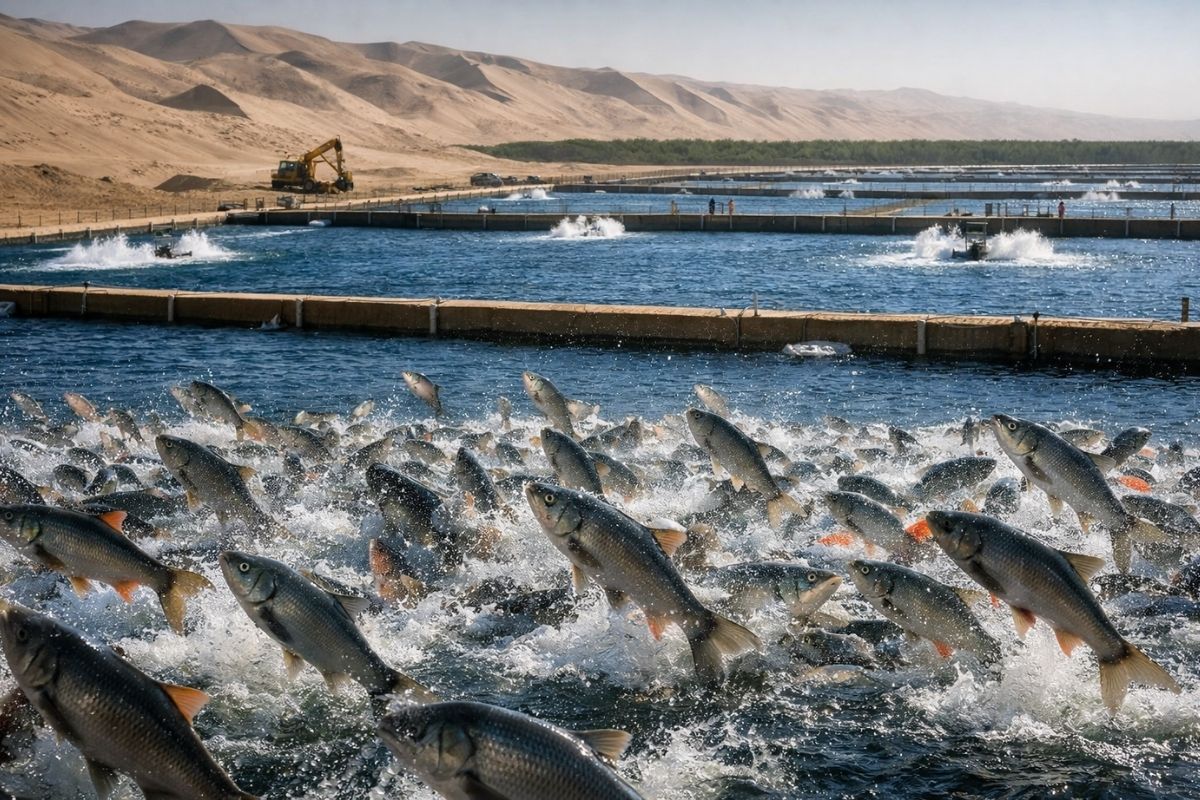


In Northwest China, the Taklamakan Desert Stopped Being a Symbol of Vacuum. In Xinjiang, Coated Tanks, Sensors and Biofilters Use Salty Alkaline Water and Meltwater from the Tianhan Mountains. The Project Has Already Harvested 196,500 Tons in 2024 and Spread the Label Desert Seafood to Markets in Asia.
China decided to take fish and shrimp production to a place where the idea seemed impossible: the Taklamakan Desert, in Xinjiang, in the heart of the Asian continent, far from any coast and marked by extreme heat and scarce rainfall.
Instead of trying to “tame” the desert, China set up an aquaculture operation based on engineering, geology, and environmental control, creating giant tanks, simulating seawater with microorganisms, and converting a landscape of dunes into a productive hub that now supplies internal markets and even destinations like Singapore.
Where It All Happens and Why the Scenario Was Hostile
The project focuses on Xinjiang, in northwest China, using the area of the Taklamakan Desert as a showcase, described as the “Dead Sea of Central Asia” due to its historical association with sand, severe winds, and saline soil.
-
A rural producer from Urubici cries as he shows 50 tons of plums thrown on the ground because no one wanted to buy them, and in desperation, he records a video asking anyone to come to the property to pick the fruits before they rot.

-
Unable to pass through Hormuz, Brazil activated a plan B that uses Turkey as a gateway to the Middle East: the route through Gibraltar and the Mediterranean is longer and more expensive but ensures that chicken, beef, and corn continue to reach Arab markets.

-
You grew up hearing that the good coffee from Brazil goes all abroad and the bad coffee stays for Brazilians, but this story has completely changed, and the numbers show that in the 1980s, thirty percent of the coffee sold here was adulterated with corn and barley.
-
Engineer creates reforestation method that transforms small plots into dense forests in a few years using local biomass and can reduce environmental recovery costs.

The Taklamakan is presented with 337,000 km² of area and about 1,000 km long, with a name that, in the Uyghur language, carries the idea that entering is easy and exiting can be almost impossible.
During the day, temperatures can exceed 50°C routinely; at night, there is a sharp drop to near-freezing levels. The average annual rainfall is below 100 mm, with areas that go years without seeing a drop.
Moreover, the soil is saline-alkaline, extremely alkaline, and described as devoid of essential nutrients, which for decades sustained the classification of the territory as “technically dead” for agriculture.
The Geological Turn That Opened the Way for China
China began to see an advantage in what seemed like a condemnation. Beneath the scorching dunes, layers of saline-alkaline groundwater with salinity levels close to those of the ocean were identified.
From then on, the logic changed: if the soil is already saline, it can serve as a base to simulate seawater.
The piece that completed the puzzle was the combination of this groundwater with the meltwater from the Tianhan Mountains, forming a mixture that, when thermally and chemically stabilized, allows for the recreation of a functional marine ecosystem in the interior of Xinjiang.
The “artificial ocean” does not arise from a climatic miracle, but from engineering that precisely controls variables.
Giant Tanks in the Taklamakan and the Barrier Against the Soil

One of the symbols of China’s operation in Xinjiang is the physical scale: each artificial tank can reach 10,000 m² in the Taklamakan Desert.
These tanks do not function like conventional reservoirs dug into the ground. They are described as closed biological units, lined with thick impermeable membranes to prevent water from seeping into the sandy, saline soil.
Surrounding this base, pipelines and systems continually operate: pumping, aeration, and biological filtration run 24 hours a day, with automated sensors monitoring critical parameters, especially salinity and environmental stability.
Any miscalculation, even small, could lead to system collapse, because the combination of heat, dust, thermal variation, and salinity requires continuous control.
How China Keeps the Water Stable Between 20°C and 30°C
The contrast between outside and inside the tanks is one of the central points. While the air reaches 50°C during the day and drops drastically at night, the water is maintained between 20°C and 30°C with thermal sensors and automated regulation that compensate for external fluctuations.
Water management is also treated as the pivot of viability. In a territory where water is presented as the most scarce resource, more than 90% of the water in the cycle is continuously recycled through integrated purification processes.
Solid waste and uneaten feed are directed to sedimentation tanks and biological filters before being returned to the main system.
The operation only sustains itself because the water circulates, is treated, and returns to the tank without stopping.
Microorganisms, Biofilters, and the “Invisible Biodiversity” of the Project
The system does not rely solely on pumps and sensors.
China also bets on biotechnology as the engine of the ecosystem: within the biological filtration units, microorganisms act in the decomposition of waste and the transformation of potentially toxic compounds into neutral substances.
The reference is to 500 species of microorganisms that can develop simultaneously in the aquatic ecosystem.
Instead of being seen as contamination, they are part of the continuous water treatment, creating natural supplementary nutrients for the fish and reducing the need for external industrial feed.
The operation, thus, ceases to be a sequence of isolated tanks and begins to function as an integrated and self-regulating artificial ecosystem.
Species Introduction, 99% Survival Rate, and the Start of the Leap
The first experimental tanks received hundreds of thousands of juvenile specimens of fish and shrimp, with introductions established in 2022.
The metric that stands out the most is the survival rate above 99% reported in the aquaculture tanks in the Taklamakan Desert.
This performance is described as superior even to references from open-sea farming, where environmental variations and diseases can limit survival to a range between 60% and 80%.
The difference here lies in the controlled environment and constant monitoring, which reduces fluctuations and provides predictability for growth to market size in just a few months.
Production in Xinjiang, Revenue in Dollars, and China’s Industrial Scale
The volume numbers position Xinjiang as a real hub in China, not just experimental.
The annual aquaculture production of the region is quoted at around 200,000 tons, with detailed data by year:
- 184,000 tons of aquatic products harvested in Xinjiang in 2023, with revenue exceeding 530 million dollars
- In 2024, production advanced to 196,500 tons, an increase of 6.8% over the previous year
The territory of the Taklamakan, previously described as “without economic value,” now holds the title of largest aquaculture center in northwest China, with automated systems attempting to extract the maximum from every cubic meter of water.
The Billion-Dollar Investment and the Transition to Market
To sustain the operation, the total investment cited is 5 billion dollars, applied over more than a decade to transform the desert into a productive hub.
Of that total, about 1.6 billion dollars were concentrated in the last two years, marking the transition to large-scale commercialization, when efficiency needs to survive in real market conditions.
The central argument of the project is not rhetorical; it is operational: without massive technological input, extreme salinity and temperatures would make commercial production unfeasible.
With the system in operation, China begins to operate with predictability and volume, including supply for large urban centers and international markets.
Qiemo, the 20 Mu Farm, and the Acceleration in 2024
In the county of Qiemo, in Xinjiang, expansion gained momentum and characters. Gong Yonghong, who worked in the textile sector in Guangdong and arrived in Xinjiang in 2023, decided to start a venture upon seeing marine fish thriving in the desert and processed products being exported.
In the spring of 2024, he and his team established a 20 mu farm, about 1.3 hectares, built in less than three months, with two fish tanks, a breeding tank, and a standardized workshop.
In June of 2024, 100,000 marine fish were brought from coastal areas to the farm.
Among the organisms mentioned are mullet, groupers, silver snappers, and also mentions of freshwater mussels in the transported batch. Technicians monitored growth and adjusted strategies, and the survival rate of the first batch exceeded 99%.
Continuing the effort, the company introduced 60,000 striped catfish fry, marking the third batch of “ocean inhabitants” in the desert.
The Domino Effect: Oysters, Lobsters, and Other Areas of Xinjiang
In addition to fish, Gong also experimentally released 2 million larval and pearl oysters, signaling a movement that spreads to other areas of Xinjiang.
The county of Makit built a farm for Australian lobsters, producing lobsters weighing 130 grams each. In Hotan, a breeding base forecasts an annual production of 280 tons.
In Atux, a facility cultivates six aquatic species, including groupers and shrimp.
This set reinforces the label “desert seafood,” which has become popular with the increasing use of desert saline water for aquaculture.
Local Employment, Monthly Income, and the Traceability Plan
The growing sector is also described as a generator of income and opportunities for local farmers.
Jurat Imin, a farmer from the municipality of Tatirang, joined the company in May and reported a salary of 5,000 yuan per month, about 704 dollars, highlighting the proximity of work and income stability, in addition to plans to open his own business after mastering the skills.
Looking to the future, clear goals emerge: to introduce more species, establish a comprehensive quality control and traceability system, form a complete industrial chain, and operate with a “company plus farmers” model, expanding operations and allowing more residents to “share the benefits.”
When Tank Water Becomes Input for “Sea Rice”
China’s ambition in Xinjiang is not limited to fish and shrimp.
The treated water that exits the tanks, instead of being discarded, is channeled to support agricultural experiments in highly saline soils.
The focus is on cultivating rice in saline-alkaline soils, known as sea rice, which uses this recovered water to test plant resistance.
Tests with salt-tolerant varieties in Xinjiang have been described as uninterrupted since 2018, in lands previously classified as impossible to cultivate by traditional methods.
Reference is made to soil salinity levels above 1.7%, and the transformation of these areas is attributed to the constant flow of nutrients and the partial desalination promoted by aquaculture water.
The complete strategy closes like a circuit: China creates aquatic life in the desert, recycles water, enhances biological treatment, and reuses the water resource to push the limits of cultivation in saline soil.
Do you think China should further expand this aquaculture model in the desert in Xinjiang, even with the billion-dollar costs and the extreme environment of the Taklamakan Desert?








The Chinese government all along cared for the people in rural areas more than ROI which is possible only in a single party socialist state like China.
Another example is building bridges between rural farms and cities to improve the lives of farmers bringing their fresh produce to city narkets in good much shortened time.
The country should continue to look after rural regions while showcasing creativity and ingenuity of the Chinese government and people.
Hats off to China! 中国加油!
Si, manden más información por Whatsapp al respecto estoy interesado+52 4925448664
I wish they would do the same with Pollock! That would crush the Trawlers industry destroying the sea floor and valuable fish are just wasted caught up in those nets pulled over crushed by the weight of the net and thrown overboard bed for an 8-cent a pound fish. They’ve decimated the halibut and salmon population in Alaska. It really wish they would make some Pollock Farms to get those trawlers out of the water.