





 Português
  Inglês
  Espanhol
 5 min de leitura
  2 comentários


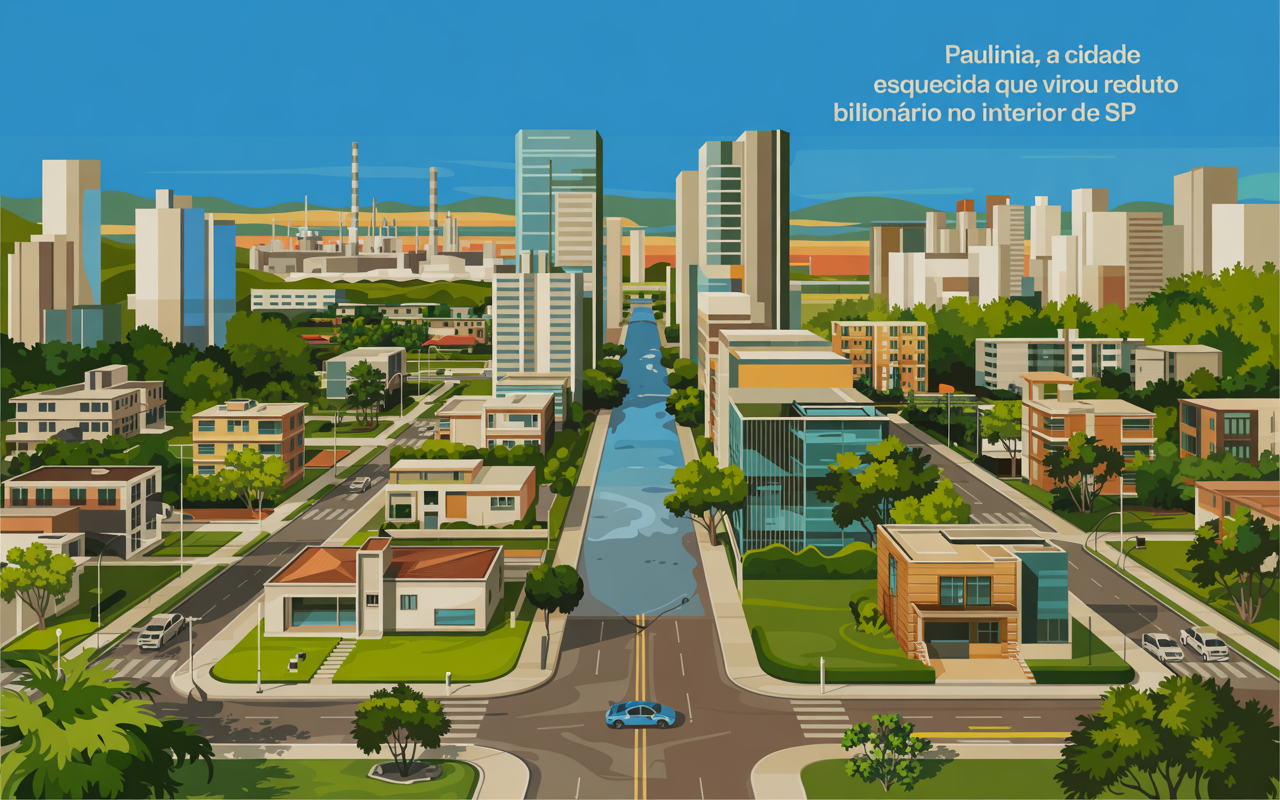


Paulínia (SP), Once Forgotten in the Countryside, Became a Haven for Millionaires with Luxury Condos, Bilingual Schools, and a Booming Billion-Dollar Economy.
For many years, few people knew where Paulínia was. It was just another small town nestled in the interior of São Paulo, known for some farms, quiet streets, and a routine that didn’t attract anyone’s attention. But today, just walking around there makes it clear that something has changed — and changed a lot. Paulínia has silently become one of the most sought-after square meters in the state. While large cities struggle with chaotic traffic, violence, and absurd prices, Paulínia offers a rare combination: safety, luxury, bilingual schools, green areas, and an economy that continues spinning billions.
But what happened there? How did a town that hardly anyone mentioned 50 years ago become this new high-end haven? The answer involves a mix of luck, strategy, and the kind of opportunity that few cities have.
Everything Changed When Oil Arrived
The turning point began in the 1970s. While Brazil was still crawling in the development of its heavy industry, Paulínia was chosen to host one of Petrobras’s most ambitious projects: the construction of the largest oil refinery in the country.
-
The world’s first octopus farm wants to open in the Canary Islands and is already provoking an international reaction: the plan aims to produce 3,000 tons per year.

-
Drought may be creating stronger superbugs in the soil and helping antibiotic resistance reach hospitals, warns a study highlighting a problem that could grow alongside extreme weather.

-
The biggest scam in history: Napoleon’s France deceived the United States by selling them a territory that was Spanish.

-
Why is the Danakil Desert so dangerous? It has unstable terrain and how extreme temperatures and toxic gases turn the region into one of the most hostile environments on Earth.

From then on, what was once peaceful countryside became the stage for one of the largest petrochemical complexes in Latin America. It wasn’t just Petrobras that arrived. Chemical companies, multinationals, cutting-edge industries came along — and with them, a wave of highly qualified professionals, earning well above the Brazilian average.
It was the first step to completely change the city’s profile.
From Quiet Town to Destination for Executives and Entrepreneurs


With the new money circulating, commerce flourished, schools improved, and infrastructure modernized. Paulínia ceased to be just another point in the countryside and became a real option for those seeking quality of life without giving up proximity to Campinas and São Paulo.
At this time, large gated communities also began to appear. High-end houses, tree-lined streets, private security, exclusive clubs.
Today, those who pass through neighborhoods like Campos do Conde, Santa Isabel, and GreenVille see mansions worthy of soap operas, with values that easily exceed millions.
There, many people who previously lived in the capital or Campinas opted to move in search of tranquility — but without losing quick access to major cities and airports.
Bilingual Schools and the New Profile of People Living in Paulínia
With this new population came bilingual and international schools as well. Today, it’s not hard to find children attending schools where classes are already half in English and half in Portuguese, with educational programs imported from abroad.
Furthermore, the city transformed into a hub for technical training. Centers like SENAI, ETEC, and units linked to Unicamp offer training specifically aimed at the type of heavy industry and technology that dominates the region.
Paulínia literally became a city tailored for a new type of resident: people with high purchasing power, qualified professionals, executives from multinationals, and families seeking quality of life — but without sacrificing infrastructure and job opportunities.
An Economy That Continues to Grow
Those who think Paulínia stopped growing after the refinery are mistaken. The city continues to diversify its sources of revenue.
With its privileged location between some of the state’s main highways, it has also become a logistical hub. More recently, it has started to attract data centers and technology companies, which see the region as a strategic location for their businesses.
Result: A soaring GDP, per capita income among the highest in Brazil, and a small city that, financially, competes with many major centers in the country.
The Countryside That Feels Like a Capital
At first glance, one can’t believe that Paulínia is a city of just over 100,000 inhabitants.
It has its own shopping center, modern hospitals, a municipal theater, a network of cultural events, well-preserved parks, and one of the best infrastructures for mobility in the region.
Around the city, the condominiums continue to multiply. The land is becoming increasingly valuable, and demand, even with high prices, keeps growing.
Paulínia has practically become what many people today define as the “luxury countryside” of the state.
Not Everything Is Perfect — But the Balance Remains Positive
Of course, rapid growth has brought some problems. Local traffic has increased, urban expansion areas need to be carefully planned to avoid flooding, and some regions still suffer from the effects of pollution caused by industrial activity.
But overall, Paulínia continues to stand out as one of the biggest success stories when it comes to urban and economic transformation in Brazil.
Few cities have managed to emerge from a faded past and build, in just a few decades, an image of a safe, modern, and highly desired city.
The Silent Power of a Refinery That Changed Everything
Imagine a place where, overnight, a power plant of jobs and opportunities emerges — quietly, but with a gigantic impact. That’s what happened in 1972 when Petrobras inaugurated Replan, the largest oil refinery in Brazil.
It was not merely a massive industrial installation; it was the trigger for an urban mutation. The structure attracted engineers, technicians, suppliers, service providers, and partner companies — and the Paulínia of the 1970s was quickly replaced by a bustling city, connected, under construction, and filled with people holding contracts and future plans.
From Petrochemical Presence to Everlasting Wealth
With Replan established, Paulínia became a magnet for major names in the chemical sector, such as Rhodia, Shell, ExxonMobil, Syngenta, Purina, and other giants. The result was an avalanche of income and extremely high per capita GDP, with figures that rank Paulínia among the highest per capita incomes in the country.
For many, Paulínia is now a rare case of a rural area generating wealth as if it were an industrial capital.
The Immediate Future
Paulínia has already taken off. But it is far from stagnating. What lies ahead?
- Bigger data centers, technology networks with doubled value.
- Real estate market remains strong – modern developments with architectural design.
- Urban infrastructure updated – drainage, mobility, sanitation.
- Enhanced environmental preservation – mini wetlands and green areas under technical oversight.
- Education increasingly specialized – focus on technology, sustainability, and global fluency.
Paulínia is not just a city: it is a case study. One of those experiences that one learns about when observing closely. It took what was best (geographic location and refinery), added intelligence, prospecting, and planning. The result: it became the face of the new countryside, where capital and land coexist advantageously.
If someone asks, “Who still lives in this forgotten city?” today the answer is simple: a little piece of Brazil that found a formula for urban success — and is just beginning to show its value now.








Que interessante essa matéria que acabei de ler, até compartilhei no meu Facebook. Telefone do Balanço Geral
Orgulho em nascer em Paulínia e ter sido empregado na empresa Rhodia, a grande responsável pelo seu desenvolvimento. Sou empreendedor nela, de proprietário de cinema à Imobiliária na cidade. Seu grande trunfo é o de receber bem a todos que aqui comparecem, a partir de seu Hino. Minha gratidão,
Walter Costa
Wcosta.lopes.com.br
http://www.waltercostaimoveis.com.br