





 Portuguese
  English
  Spanish
  4 min of reading
  51 comments


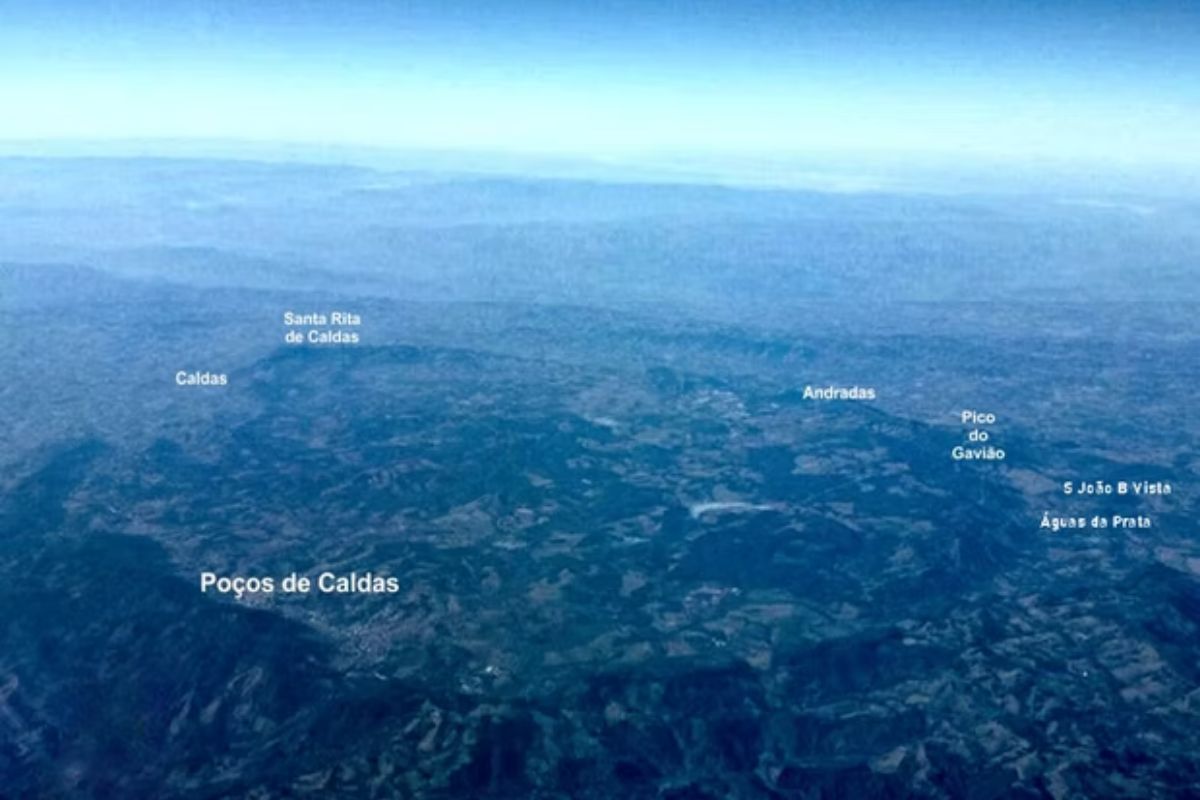


Poços de Caldas, in Minas Gerais, is a famous hydromineral resort and, for many, a surprising Brazilian city on top of an ancestral volcano. Discover its geological secrets!
The idea of a Brazilian city on top of a dormant volcano sparks curiosity and, for some, even a certain fear. And what if we tell you that this city not only exists but is the renowned Poços de Caldas, in Minas Gerais, famous for its therapeutic waters? Many visitors and even residents may be unaware of the geological grandeur beneath their feet.
Science reveals to us that this Brazilian city on top of a volcano rests over an enormous volcanic caldera that was formed tens of millions of years ago. Let’s unveil the fascinating history and characteristics of this unique formation.
Poços de Caldas: Geological Wonder and a Unique Brazilian City on Top of a Volcano
Located in the southwest of Minas Gerais, Poços de Caldas is nestled in a mountainous plateau, but its most striking geological feature is a vast circular depression – the volcanic caldera. This caldera is the geological heart of the region, a ring of mountains known as Serra de São Domingos. The Poços de Caldas Alkaline Complex is one of the largest intrusions of alkaline rocks on the planet, with a diameter ranging from 30 to 35 kilometers and an area of approximately 800 km², being the second largest alkaline massif in the world.
-
With more than 635,000 doctors, Brazil sees competition increasing in large cities, and recent graduates are competing for shifts at an accelerated pace while the countryside still faces shortages.

-
The world’s first octopus farm wants to open in the Canary Islands and is already provoking an international reaction: the plan aims to produce 3,000 tons per year.

-
Drought may be creating stronger superbugs in the soil and helping antibiotic resistance reach hospitals, warns a study highlighting a problem that could grow alongside extreme weather.

-
The biggest scam in history: Napoleon’s France deceived the United States by selling them a territory that was Spanish.


It is essential to understand that this Brazilian city on top of a volcano does not occupy a conical structure like Mount Fuji. It is a caldera, a much larger depression formed by the collapse of an ancestral supervolcano following colossal eruptions or the emptying of a large subterranean magma chamber.
Journey to the Deep Past: The Origins of the Brazilian City on Top of a Volcano

The formation of the Poços de Caldas Volcanic Complex occurred a considerable time ago, between 72 and 90 million years ago, at the transition between the Cretaceous and Cenozoic periods. It was a complex and lengthy geological process involving the ascent of a large volume of alkaline magma from the Earth’s mantle. This generated intense volcanic activity, with lava flows (mainly phonolites) and explosive eruptions. The climax was the collapse of the structure, forming the vast caldera we see today.
Crucially, the volcano beneath this Brazilian city on top of a volcano is classified by scientists as extinct, not merely dormant. This means it has not erupted for tens of millions of years, and there is no scientific expectation that it will return to activity. This long inactivity is a determining factor for the safety and type of development that has occurred in the region.
Treasures of the Caldera: The Rich Heritage of Volcanic Activity in Poços de Caldas
The volcanic heritage of Poços de Caldas is vast and valuable. The famous thermal waters are undoubtedly the most emblematic natural resource. These waters originate from meteoric (rain) sources that infiltrate deeply into the ground through fractures. During their long journey, they are heated by the Earth’s natural heat and chemically interact with the alkaline rocks, emerging with unique characteristics: hyperthermal (between 40°C and 44°C), alkaline pH, and rich in sodium bicarbonate, sulfur, fluorides, and a slight natural radioactivity (radon), known for their therapeutic properties.
In addition to the waters, this Brazilian city on top of a volcano has a remarkable concentration of minerals. The region hosts extensive deposits of bauxite, exploited by Alcoa; it was home to the country’s first uranium mine (Mina Osamu Utsumi); and features occurrences of thorium, zirconium (including caldasite, named after the region), and important Rare Earth Elements (REE).
Development and Challenges of a Brazilian City on Top of a Volcano
The development of Poços de Caldas was initially driven by its thermal waters, with the arrival of the railway in 1886 catalyzing its growth as a renowned hydromineral resort. The city has shown great resilience throughout its history, diversifying its economy with the exploration of its mineral riches and industrial development, especially after the prohibition of gambling in the 1940s, while never abandoning its thermal tourism vocation.
However, urban planning within a volcanic caldera presents unique challenges for this Brazilian city on top of a volcano. It is crucial to reconcile growth with the protection of water resources, particularly the recharge zones of thermal aquifers, and to mitigate geological risks such as landslides and flooding, especially on steep slopes.
Embracing the Volcano: Tourism, Culture, and the Unique Identity of Poços de Caldas
Poços de Caldas has managed to transform its extraordinary geological heritage into a pillar of its tourism and cultural identity. The “Volcanic Route” is an initiative that promotes tourism in the region, exploring rock formations, viewpoints with panoramic views of the caldera, and, of course, the thermal water springs, all under the fascinating narrative of being a Brazilian city on top of a volcano.
The local culture is inseparable from its waters. The architecture of the spas, such as the Thermas Antônio Carlos, and the tradition of therapeutic baths are central. While popular perception may simplify the geology to a “dormant volcano”, institutions like the Historical and Geographic Museum of Poços de Caldas seek to educate the public about the formation of the extinct caldera. This rich geological context offers immense potential for geotourism and geoscientific education.






Essa caldeira vulcânica é meu torrão natal. Embora viva desde os sete anos em São Paulo capital, raramente deixei de voltar à cidade grande parte da família vive lá. Poços de Caldas é um dos maiores fornecedores de mão-de-obra barata prós estados unidos. Uma pena que poços não valorize seus cidadão , fazendo-os migrar pra terras distantes em busca de uma vida digna que não encontram nela. Meus concidadaos, São doutrinados pela elite da cidade a se jactar da de um bem estar que não existe. Lamento por mim e todos que não conseguiram se manter dignamente na cidade . Perguntem aos que tiveram que partir e hoje estão sustentando seus filhos, país e irmãos.
Amo esse tipo de conteúdo, sobre a geologia, vulcanismo e tudo mais a ver com o assunto.
No centro de poços de caldas tem uma fonte de água quente que tem cheiro de enxofre,dizem ser água do vulcão