





 Portuguese
  English
  Spanish
  3 min of reading
  3 comments


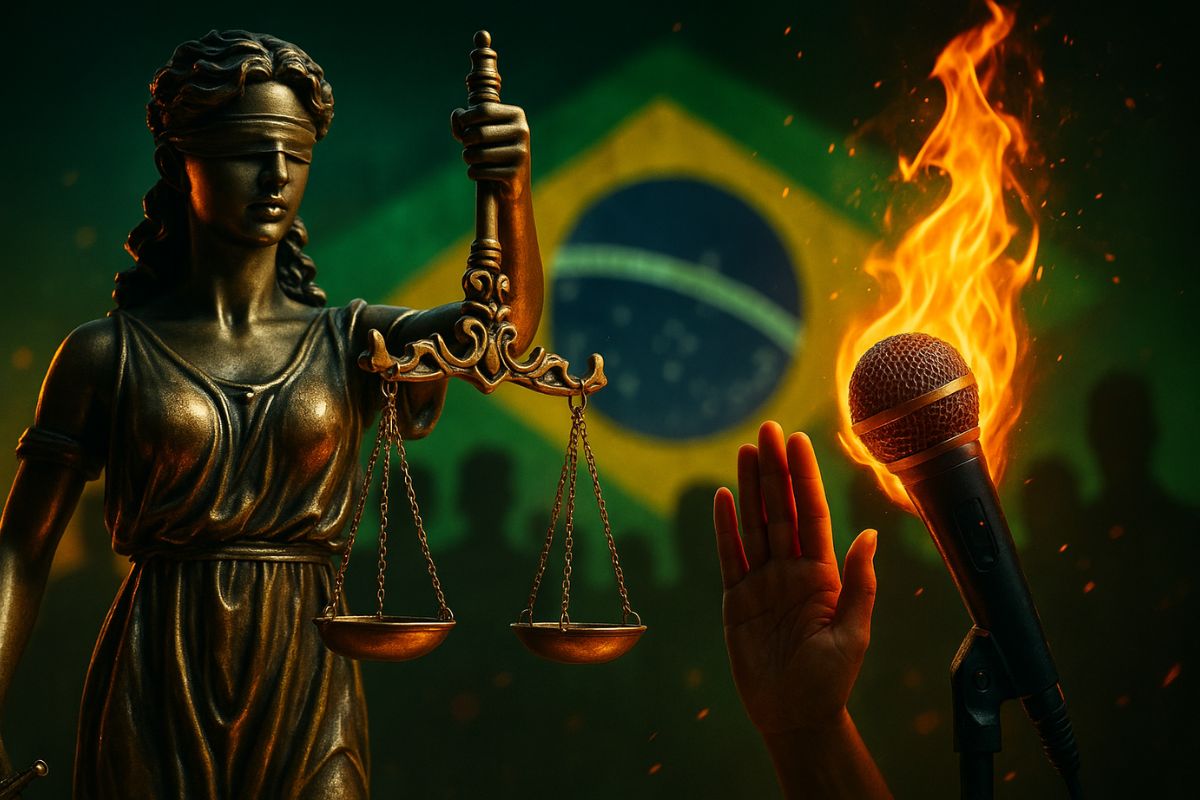

Freedom of Expression Is Not Unlimited: The Constitution Prohibits Defamation, Libel, and Hate Speech, Even on Social Networks.
The Federal Constitution of 1988 guarantees freedom of expression as a fundamental right of all Brazilian citizens. This means that anyone can freely express ideas and opinions without requiring prior authorization from the State. Article 5 states: “the manifestation of thought is free, and anonymity is prohibited.”
However, as lawyer Cíntia Brunelli explains, freedom of expression is not absolute.
It can conflict with other constitutional rights, such as honor, dignity, privacy, and equality.
-
A new Brazilian shopping center worth R$ 400 million will be built in an area equivalent to more than 4 football fields, featuring 90 stores, 5 cinemas, a supermarket, a college, and parking for 1,700 cars, potentially generating 3,000 jobs.

-
Larger than entire cities in Brazil: BYD is building a 4.6 km² complex in Bahia with a capacity for 600,000 vehicles per year, but the discovery of 163 workers in conditions analogous to slavery has shaken the entire project.

-
With an investment of R$ 612 million, a capacity to process 1.2 million liters of milk per day, Piracanjuba inaugurates a mega cheese factory that increases national production, reduces dependence on imports, and repositions Brazil on the global dairy map.

-
Brazilian city gains industrial hub for 85 companies that is equivalent to 55 football fields.


In these cases, it is up to the Judiciary to define the limits, ensuring that an individual’s expression does not violate the rights of others.
Where Are the Limits of Freedom of Expression
According to the Constitution, the exercise of freedom of expression must respect certain boundaries:
- Anonymity Prohibited: citizens have the right to express themselves but must take responsibility for their words.
- Right to Reply: those who feel offended can demand proportional reparation and seek compensation for moral or material damages.
- Protection of Honor and Image: any violation of these rights can lead to legal actions, both in civil and criminal courts.
For Cíntia Brunelli, these mechanisms reinforce that there is no absolute right: freedom of expression cannot be used as a shield for verbal aggression or false accusations.
Crimes Against Honor
The Penal Code defines three actions that are often confused with the exercise of freedom of expression but, in practice, constitute crimes:
- Defamation: falsely attributing to someone the practice of a crime.
- Libel: imputing an offensive fact to another person’s reputation.
- Insult: offending someone’s dignity or decorum.
These crimes can result in convictions that include detention and fines, demonstrating that civil and criminal responsibility accompanies the use of speech.
Discriminatory and Hate Speech


The Constitution classifies racism as a crime non-bailable and imprescriptible.
Furthermore, expressions that convey homophobia, misogyny, or religious intolerance are also not protected by freedom of expression.
In these cases, speech ceases to be opinion and becomes characterized as discrimination, subject to severe legal penalties.
According to Cíntia Brunelli, this is one of the points that generates the most debate today, especially on social networks, where the reach of statements is amplified.
Responsibility of the Speaker
Another important aspect is that the reach of speech increases responsibility.
An offense made in a private circle does not carry the same weight as a statement made by politicians, influencers, or celebrities in mass communication media.
The larger the audience reached, the greater the legal and social responsibility of the speaker.
This reinforces the idea that freedom of expression does not mean impunity.
What is said in digital environments can result in serious legal consequences.
Freedom of Expression Is Not Censorship
It is essential to differentiate censorship from accountability.
- Censorship: occurs when the State prevents a manifestation from being made, which is prohibited by the Constitution.
- Accountability: happens after the speech, when it crosses the limits of legality and harms the rights of others.
According to Cíntia Brunelli, this distinction is central: guaranteeing freedom of expression does not mean allowing abuses, but rather balancing the right to express oneself with the protection of the honor and dignity of others.
While freedom of expression is a pillar of democracy, it is not unlimited.
Citizens can criticize, express opinions, and manifest themselves, but they do not have legal backing to defame, libel, incite hatred, or discriminate.
The principle is clear: one person’s right ends where another’s begins.
What about you? Do you believe that the limits of freedom of expression are being applied fairly in Brazil? Or do you think there are exaggerations in the interpretation of the law?
Leave your opinion in the comments — we want to hear from those living this reality.










Justiça no Brasil visa arruinar a vida do réu, visando manter a **** de advogados, juízes, promotores e toda essa bandidagem por trás da lei brasileira de ****.
Honra e diguinidade e conquistada. E na maioria dos casos quem está sendo chingado é uma **** ainda viva, que só **** os outros…
Uma pessoa… FD os outros