





 Português
  Inglês
  Espanhol
  3 min de leitura
  6 comentários




With 2,177 km, the Gulf Railway (GCC Railway) Aims to Unite Saudi Arabia, Bahrain, Qatar, UAE, Kuwait, and Oman, Transforming the Logistics and Economy of the Region with a New Mega Railway
The Gulf Railway project, or GCC Railway, represents one of the most ambitious transnational infrastructure initiatives of the 21st century. With an estimated cost of US$ 250 billion, this mega railway of approximately 2,177 kilometers aims to interconnect the six member states of the Gulf Cooperation Council (GCC): Saudi Arabia, Bahrain, Qatar, United Arab Emirates (UAE), Kuwait, and Oman.
Conceived in 2009, the project faced several delays but recently gained new momentum, with a completion target set for the early 2030s. The railway is seen as crucial for economic integration and the diversification of Gulf economies.
What Is the Gulf Railway and Its Strategic Vision for the Gulf Cooperation Council (GCC)?
The GCC Railway seeks to promote greater economic integration, optimize supply chains, and offer sustainable mobility for passengers and freight. It is considered the backbone of a future customs union for the GCC, aiming to increase intraregional trade, currently at about 10%.
-
With more than 635,000 doctors, Brazil sees competition increasing in large cities, and recent graduates are competing for shifts at an accelerated pace while the countryside still faces shortages.

-
The world’s first octopus farm wants to open in the Canary Islands and is already provoking an international reaction: the plan aims to produce 3,000 tons per year.

-
Drought may be creating stronger superbugs in the soil and helping antibiotic resistance reach hospitals, warns a study highlighting a problem that could grow alongside extreme weather.

-
The biggest scam in history: Napoleon’s France deceived the United States by selling them a territory that was Spanish.


The main route of this mega railway will extend from Kuwait City to Muscat (Oman), passing through Saudi Arabia and the UAE, with branches to Bahrain and Qatar. The original 2018 schedule has been revised to the early 2030s, reflecting the complexity of the undertaking.
Advances and Challenges in Each Gulf Country by 2025
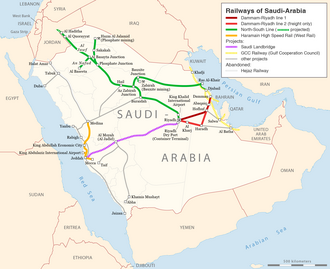
The implementation of the Gulf Railway progresses unevenly. The United Arab Emirates, with its Etihad Rail network of 900 km already completed for freight, and Saudi Arabia, with the Saudi Land Bridge Project, show the most progress. The Hafeet Rail project, connecting the UAE to Oman (Sohar Port), began implementation in April 2024 and serves as a model.
Kuwait recently awarded the study contract for its connection with Saudi Arabia. Bahrain has approved the development of its internal network connected to the GCC. Qatar reaffirmed its completion target for 2030, despite previous delays due to the diplomatic crisis (2017-2021).
Technical Specifications and the Quest for Interoperability of the Mega Railway of the GCC
To ensure smooth cross-border operations, the Gulf Railway will adopt the international standard gauge of 1,435 mm. The design speeds are up to 220 km/h for passenger trains and between 80-120 km/h for freight trains. The axle load is designed for 32.5 tons, and the profile will allow for double-stack containers.
The standard signaling system will be the ETCS Level 2 (European Train Control System), as already implemented in Hafeet Rail. Despite common guidelines established in 2012, complete technical and regulatory harmonization among the six countries remains a significant challenge for this mega railway.
Financing, Governance, and the Challenges of Such an Ambitious Multinational Mega Railway
The cost of US$ 250 billion is financed individually by each GCC country for its respective section, without an initial unified fund. This has led to uneven development, with wealthier states advancing more rapidly. Public-Private Partnerships (PPPs) are being considered, as seen in the successful US$ 1.5 billion financing for Hafeet Rail.
The GCC Railway Authority (GCCRA), established in 2021, coordinates the project, but there are calls for its role to evolve to include oversight powers, similar to the EU Railway Agency. Political obstacles, such as the crisis with Qatar, and the need to harmonize customs and regulations remain persistent challenges.
The Transformative Potential of the Gulf Railway for the Region and the World
The Gulf Railway has the potential to boost intra-GCC trade, reduce logistical costs, and support economic diversification beyond oil. Environmentally, it promises to reduce CO2 emissions compared to road transport. It is estimated that it will transport 8 million passengers and 95 million tons of cargo annually by 2045.
This mega railway could also connect to larger transnational corridors, such as the India-Middle East-Europe Economic Corridor (IMEC), elevating the GCC to a global logistics hub. The success of the project will depend on overcoming the challenges of coordination, financing, and sustained political will from all member states.








Jo
Pretendo adqueri um corola yuris como fazer, sou. Aposentado tenho 80 anos de idade e quero me beneficiar de impostos. Como devo agir?
Viva a China.
Mudem para china, já que vocês gostam tanto dela.