





 Portuguese
  English
  Spanish
  6 min of reading
  0 comments


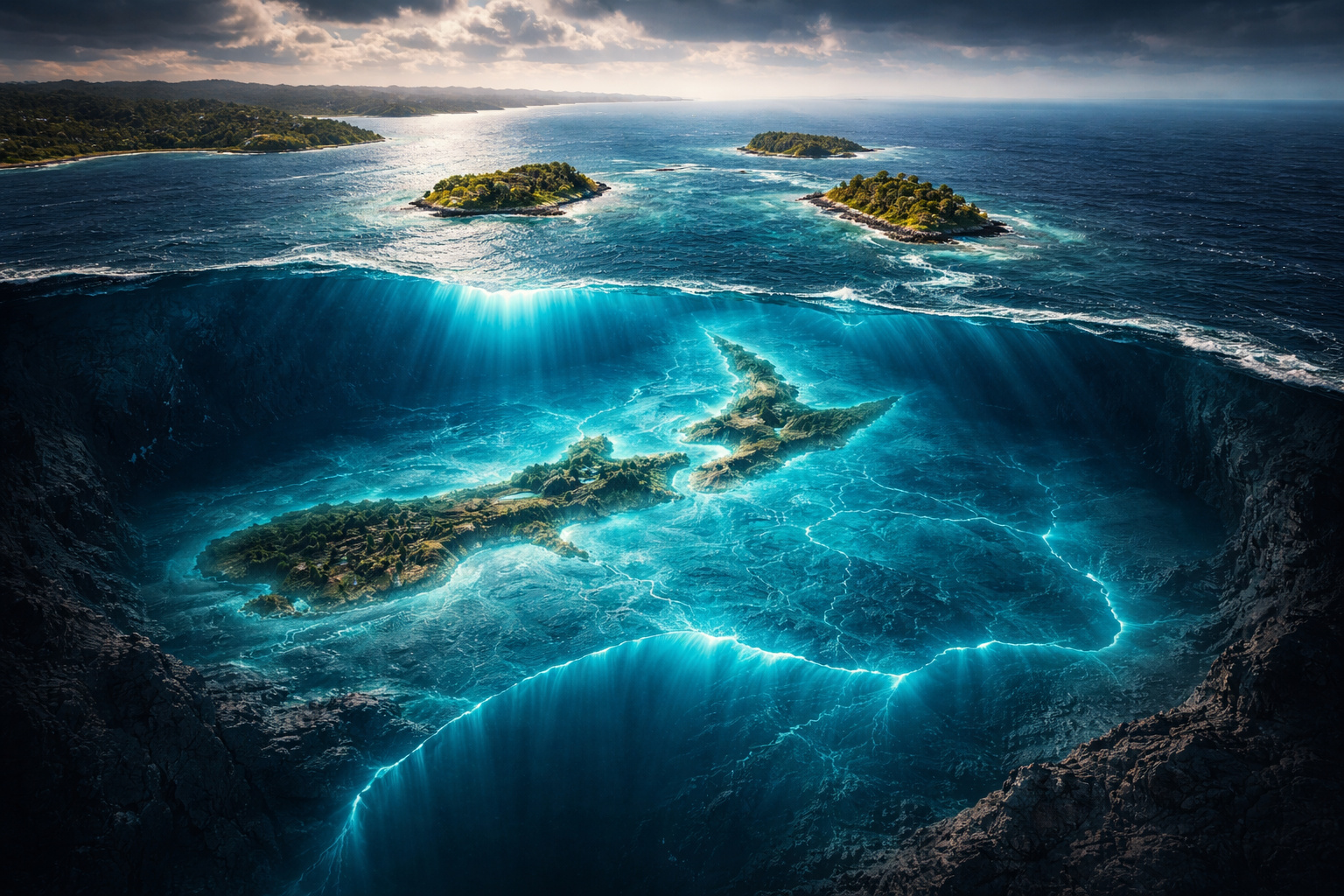
Zealandia is a submerged continent with 4.9 million km², recognized in 2017 after centuries of study and that redefines the geological map of the Earth.
For centuries, the map of the planet seemed complete. The continents were defined, studied, and classified. But, beneath the Pacific Ocean, an entire continental mass remained invisible to modern science until recently. Zealandia, now recognized as an almost entirely submerged continent, took about 375 years from the first suspicions to its formal recognition in 2017, when a group of geologists presented consolidated evidence in the study “Zealandia: Earth’s Hidden Continent”, published in the journal GSA Today of the Geological Society of America.
With approximately 4.9 million km², Zealandia is not a small geological anomaly. It is a complete continental structure, comparable in scale to large known land masses, but with about 94% of its area below sea level, a characteristic that explains why it remained outside the traditional classification of continents for so long. Its confirmation profoundly altered the way geologists understand the physical division of the planet, demonstrating that continental masses can exist almost entirely submerged and still meet the geological criteria of a continent.
Zealandia is fully mapped for the first time and ceases to be a hypothesis to become a defined geological structure
In recent years, Zealandia has ceased to be merely a scientific curiosity to become a precisely mapped geological object. Recently completed research combined seismic data, satellite images, and high-resolution bathymetric surveys to produce the first complete map of the submerged continent.
-
Italian researchers have detected what appears to be a second Sphinx buried under the sands of Egypt, and satellite scans reveal a gigantic underground megastructure hidden beneath the Giza Plateau for over 3,000 years.
-
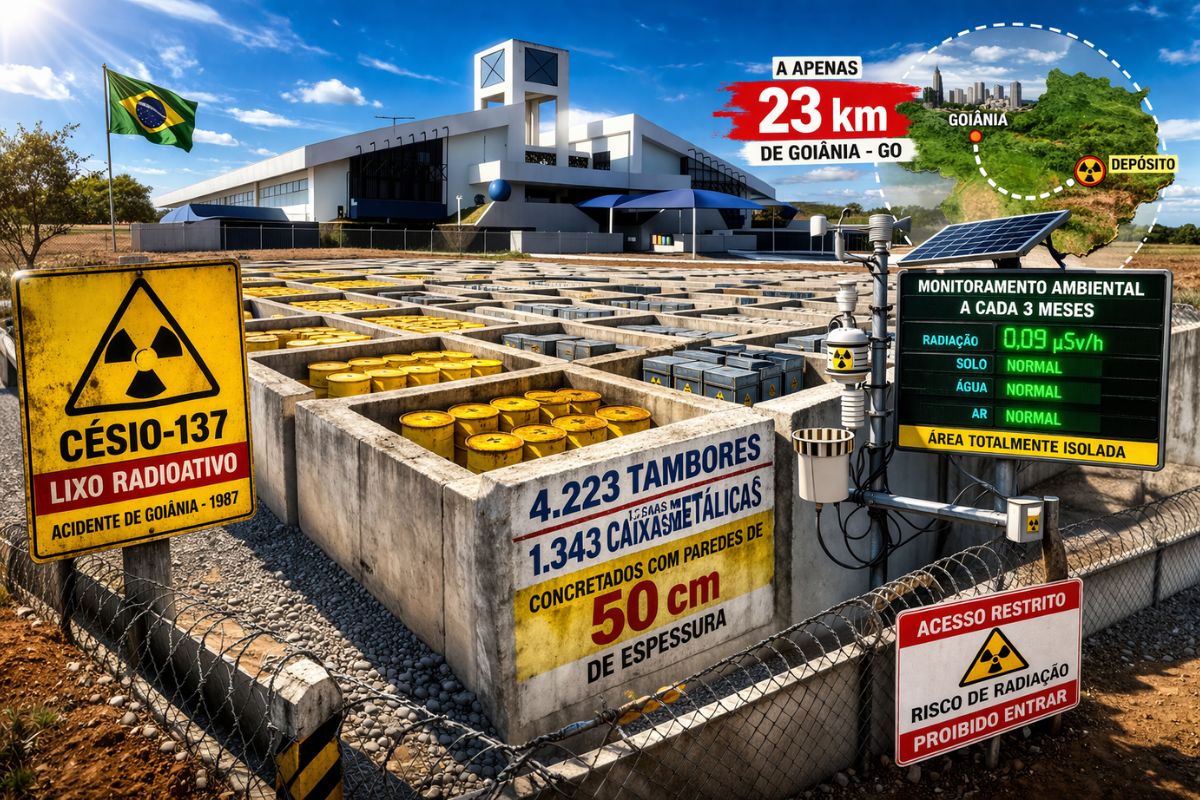
There are 4,223 drums and 1,343 metal boxes concreted with 50-centimeter walls that store the radioactive waste from Cesium-137 in the worst radiological accident in Brazil, just 23 kilometers from Goiânia, with environmental monitoring every three months.
-
Giant Roman treasure found at the bottom of Lake Neuchâtel in Switzerland reveals an advanced trade system, circulation of goods, and armed escort in the Roman Empire about two thousand years ago.
-
He buried 1,200 old tires in the walls to build his own self-sufficient house in the mountains with glass bottles, rainwater, and an integrated greenhouse.

This advancement allowed for a clear identification of its boundaries, internal structure, and territorial extent, estimated at about 4.9 million km². What was once described as a fragmented mass of continental crust is now treated as a cohesive block, with geological continuity and characteristics of a continent.
Studies confirm that Zealandia has continental crust and 95% of its area is submerged in the Pacific
The main doubt that still surrounded Zealandia — whether it was indeed a continent or just an oceanic elevation — has been practically resolved. Recent studies confirmed that its composition is continental crust, thicker and less dense than oceanic crust, which clearly differentiates it from the surrounding seabed.
Still, about 94% to 95% of its area remains submerged beneath the Pacific Ocean, making it the only continent on the planet that is almost entirely invisible. Only small portions, such as New Zealand and New Caledonia, remain above sea level, functioning as the “exposed tips” of a much larger continental structure.
New geological interpretation indicates that Zealandia formed over 1 billion years ago and sank after separating from Gondwana
The latest research has also revised the age and formation of Zealandia. Evidence indicates that parts of the continent may be over 1 billion years old, placing it among the oldest geological structures on Earth.

It separated from the supercontinent Gondwana between 80 and 100 million years ago, but, unlike other continental blocks, underwent an extreme process of crust thinning. This thinning reduced its buoyancy, causing much of the continent to gradually sink without becoming oceanic crust.
The result is a unique geological anomaly: a complete continent that did not disappear — it just became almost entirely submerged.
What is Zealandia and why is it considered a submerged continent
Zealandia is composed of continental crust, which is thicker, less dense, and geologically distinct from oceanic crust. This point is fundamental, as it differentiates continents from volcanic chains or simple archipelagos formed by tectonic activity.
Although it is mostly submerged, parts of Zealandia emerge above the ocean, such as New Zealand and New Caledonia. These regions represent only the highest points of a much larger continent that remains hidden beneath the waters. The fact that it has been submerged for millions of years explains why its identification was so late and complex.
Why Zealandia took 375 years to be recognized by science
The first observations about the existence of a continental mass in the region date back to the 17th century when European explorers noted unusual geological features on the islands of New Zealand. However, there was a lack of concrete data to confirm the existence of a complete continent.

For centuries, technological limitations hindered the detailed mapping of the ocean floor. It was only with the advancement of modern tools, such as high-resolution bathymetry, seismic studies, and rock composition analysis, that Zealandia began to be understood as a continuous continental structure.
In 2017, scientists from GNS Science published a study consolidating this evidence, leading the scientific community to recognize Zealandia as a continent under geological criteria.
Scientific criteria that classify Zealandia as a continent
To be considered a continent, a region must meet well-defined criteria in geology. Zealandia fulfills all these requirements, reinforcing its scientific classification.
It has significant elevation relative to the ocean floor, possesses distinct continental crust, covers an extensive area, and has clearly defined geological boundaries. The fact that it is submerged does not invalidate its classification, as what defines a continent is its internal structure and not its exposure above sea level.
This conclusion led to an important revision in the way continents are defined, expanding scientific understanding of the structure of the planet.
Origin of Zealandia: fragment of the supercontinent Gondwana
The history of Zealandia dates back about 80 million years, during the fragmentation process of the supercontinent Gondwana. During this period, large continental masses began to separate, giving rise to the current continents.
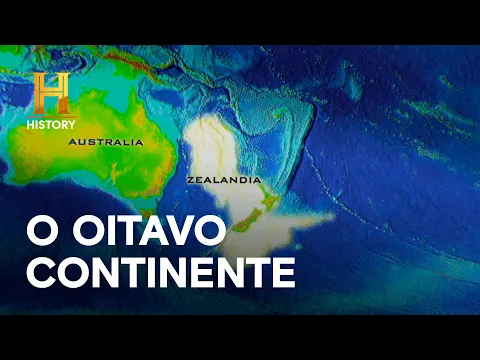

Zealandia detached from the regions that today correspond to Antarctica and Australia. After this separation, the continental crust underwent a process of progressive thinning. Over time, much of the structure lost support and sank, remaining submerged to this day.
This process explains why Zealandia is often described as a “drowned” continent, distinct from other visible continents.
Why Zealandia is submerged and remains invisible
The submersion of Zealandia did not occur due to a single catastrophic event, but rather through a gradual geological process over millions of years. During this period, the continental crust stretched, became thinner, and increased its relative density.
This set of structural changes reduced the supporting capacity of the continental mass, causing much of it to sink below sea level. Currently, about 94% of Zealandia remains submerged, making it the only practically invisible continent on Earth.
The confirmation of Zealandia as a continent had profound implications for geology. It demonstrated that continents can exist almost entirely submerged and that the mapping of the planet is still incomplete, even after centuries of study.
This discovery also led to a revision of old models regarding the formation and evolution of tectonic plates, contributing to a more precise understanding of the geological dynamics of the Earth over millions of years.
Natural resources and strategic importance of Zealandia
In addition to its scientific value, Zealandia has economic and strategic relevance. The region hosts potential mineral reserves, sedimentary basins with hydrocarbon possibilities, and unique marine biodiversity.
The presence of this continental structure also influences the definition of exclusive economic zones, especially for countries like New Zealand, which can claim rights over vast maritime areas associated with the submerged continent.
An invisible continent that reveals the limits of human knowledge
The story of Zealandia reveals a little intuitive aspect of the planet: not everything that defines the Earth is visible. For millions of years, this continent remained hidden beneath the ocean, while science did not yet have the tools capable of identifying it.

Its recent recognition demonstrates that human knowledge about the planet continues to evolve and that fundamental structures can still be discovered or reinterpreted.
The discovery of Zealandia reinforces a central idea of modern science: even on a largely explored planet, there are still fundamental structures waiting to be understood.
By revealing an entire continent hidden beneath the ocean, Zealandia has expanded the understanding of the geology of the Earth and shown that the map of the planet is more complex than it appears, both on the surface and in the invisible depths.









Seja o primeiro a reagir!