





 Portuguese
  English
  Spanish
  5 min of reading
  0 comments


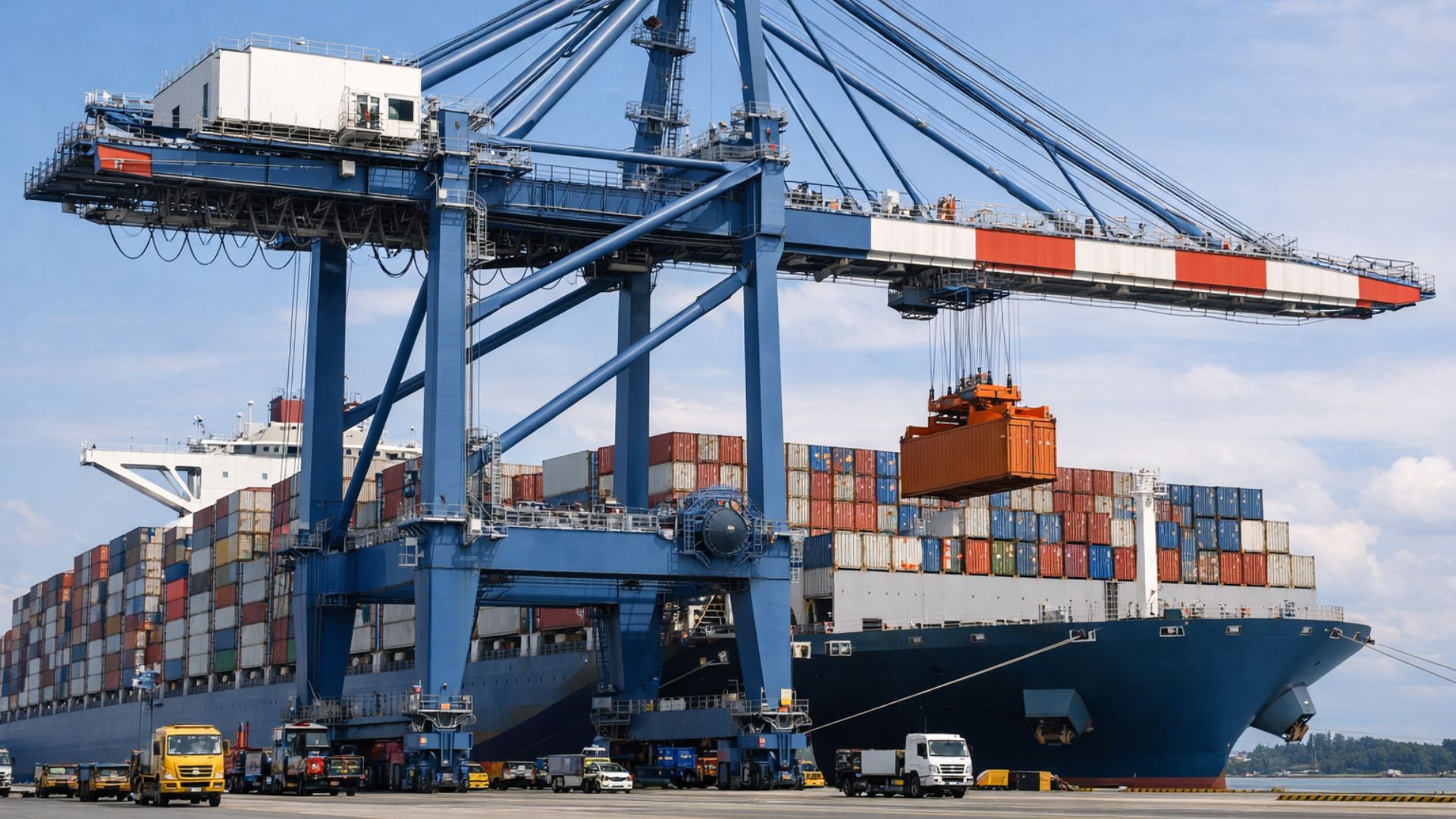
Giant structures at the dock make it possible to operate the largest ships in the world, connecting maritime scale, port automation, and logistical efficiency in a silent gear that sustains the continuous flow of contemporary international trade.
The largest container ships in the world can only maintain the promise of scale when they find, at the dock, an infrastructure capable of keeping up with the size of the vessel, the height of the cargo stacks, and the speed required by contemporary logistics.
This is the role of ship-to-shore cranes, the STS, equipment that transforms naval gigantism into practical operation and supports a chain on which more than 80% of the volume of international goods trade transported by sea depends.
STS Cranes and Their Role in Global Trade
At the Port of New York and New Jersey, one of the clearest examples of this adaptation appears in the Megamax cranes supplied by Liebherr to Maher Terminals, designed with 69.5 meters of outreach and 53.34 meters of lift height over rail.
-
Diapers are being turned into solid fuel in Japan: an ambitious project could forever change the way cities deal with one of the most difficult types of sanitary waste to process.

-
Hyundai presents a luxury electric SUV with up to 7 seats, a range of up to 620 km, and futuristic technologies that redefine comfort and interior space.

-
Orenburg has rivers, roads, and industrial areas covered in snow in a geometric pattern visible from space, and a NASA image reveals how the winter lasting up to 5 months and temperatures below −30 °C transform the city of over 500,000 inhabitants into an almost continuous white map.

-
They have orbited the Moon and are now returning home: the astronauts of Artemis II are making final preparations for a descent at 38,000 kilometers per hour, with a landing in the ocean scheduled for this Friday at 9 PM Brasília time.

Operationally, this means that the machine was designed to reach over the deck of the largest container ships in service and lift units to heights compatible with state-of-the-art vessels.
The logic behind these dimensions becomes more evident in the face of vessels like the MSC Irina, presented as the largest container ship in the world by nominal capacity, with 24,346 TEUs, 399.9 meters in length, and 61.3 meters in width.

According to data released by the port operator, the ship was designed to stack containers in up to 26 tiers, a fact that helps explain why the cranes needed to grow not only upwards but also to accommodate the ever-increasing width of the hulls.
How the Unloading Operation at the Dock Works
From a distance, the operation seems almost simple: the spreader descends, locks the container, lifts the unit, moves the load to the side of the dock, and deposits it onto trucks, chassis, or internal terminal systems.
In practice, however, each step requires millimeter precision, sway control, position reading, and integration with the rest of the yard so that the productivity of the berth is not compromised by slow movements, misalignments, or unnecessary pauses.
This challenge grows when the ship becomes wider, because the rows installed near the center of the vessel are farther from the dock and require a longer arm for safe access.
In South Carolina, the port authority reports that the five STS cranes at the Hugh K. Leatherman terminal reach 69.49 meters, have 51.51 meters in height, and were designed to accommodate ships with 26 containers in width on deck, a level associated with the largest long-haul services.
The Scale of Ships Redefines Port Infrastructure
The difference between accommodating 22, 24, or 26 rows may seem modest in a technical table, but it redefines the competitive map of an entire port.
The same set of data shows that Wando Welch operates with cranes capable of working with ships of 22 to 24 containers in width, while Leatherman was already designed for 26, which expands the capacity to receive megaships without relying on operational restrictions at the dock.
That is why the STS is not treated as mere handling equipment, but as the machine that determines the rhythm of the entire port facility.

These cranes are pointed out as responsible for defining the terminal’s performance, as any loss of productivity at the dock spreads to the rest of the logistics operation.
Automation and Productivity in Modern Terminals
In the most advanced terminals, part of this cycle can already occur with a high degree of automation.
Technological solutions allow for a fully automatic cycle between ship and dock, with functions such as load sway control, ship profiling, optical container recognition, vehicle position measurement, and automatic unit landing.
The pressure for performance also explains why manufacturers directly associate these cranes with the time a ship stays in port.
The central objective of the modern terminal is to reduce the interval between docking, operation, and departure, especially when each call involves thousands of movements and high costs per hour of downtime.
On a container ship over 20,000 TEUs, a few minutes lost in each lifting sequence quickly translates into additional hours of operation.
Moreover, delays at the dock can affect rail connections, road distribution, yard availability, and the rotation of subsequent vessels.
Capacity, Reliability, and Energy Efficiency
Productivity without reliability does little to resolve an operation that depends on narrow windows and concentrated volumes.
STS cranes can be configured with safe working loads between 40 and 120 metric tons, in single, twin, and tandem lift modes.
This flexibility allows for adjusting the equipment to the fleet profile, the type of cargo, and the level of intensity required by each terminal.

These machines also achieve up to 99.6% availability, a decisive factor for maintaining continuous operations in ports with high vessel traffic.
There is also a less visible layer of this transformation: the energy consumption of the equipment itself.
High-strength steel structures and lattice design help reduce weight and energy consumption.
The design also incorporates systems capable of returning electricity to the grid and high-efficiency LED lighting, responsible for a 70% reduction in energy expenditure compared to conventional fixtures.
Integration with the Yard and Land Logistics
This type of equipment does not operate in isolation within the terminal.
At the Hugh K. Leatherman Terminal, the five STS operate alongside 25 hybrid RTGs, in a long berth.
The first phase of the installation added 700,000 TEUs of annual capacity to the port market, connecting docks, yards, and logistical accesses.
This integration shows that the STS has become the most visible link in a much broader infrastructure.
When the crane grows to accommodate larger ships, it requires simultaneous investments in energy, automation, internal traffic organization, and connection with land modalities.
At the center of this transformation is the change in scale of container navigation itself.
The advancement of mega-carriers has ceased to be merely a matter of size and has come to directly depend on the port’s capacity to absorb ever-increasing volumes without compromising operational efficiency.
Thus, a crane with 69.5 meters of outreach and 53.34 meters of lift consolidates itself as a key piece to transform maritime scale into effective logistical flow.







Seja o primeiro a reagir!