





 Portuguese
  English
  Spanish
  4 min of reading
  1 comment


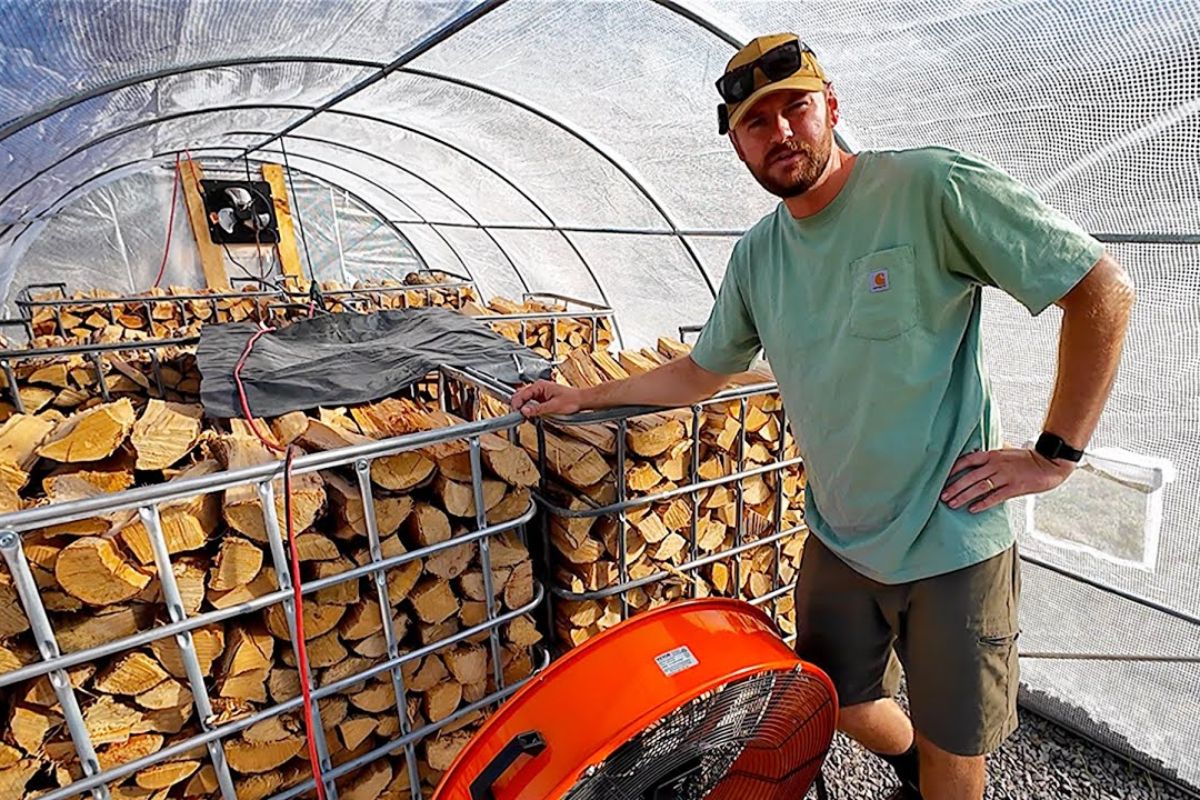


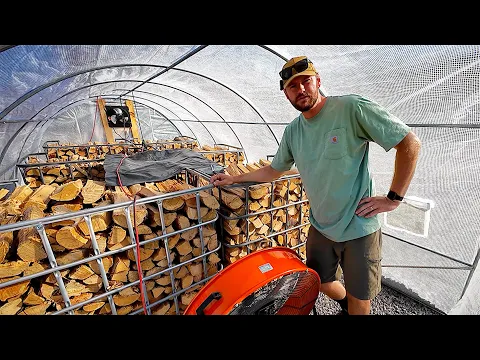
The 3 m by 6 m Greenhouse Powered by Solar Panels Maintained Constant Ventilation and Timed Exhaust to Accelerate the Drying of Recently Cut Firewood. The Internal Monitor Recorded a Peak of 51.4 °C, but Rain Increased Humidity and Required Double Vapor Barrier with Geomat on the Floor.
The greenhouse set up as a solar oven was tested with recently cut maple firewood, stacked in six containers and subjected to forced airflow from three fans. In 41 days, the reading went from 37% humidity to 19% inside the unit, a level associated with firewood ready for use in many markets.
The same batch, left outdoors with sun and breeze, lagged behind in the indicator: the internal part registered 27%, even under conditions described as “ideal,” with dry weather and almost no cloudy days. The contrast turned a practical experience into a technical alert about humidity control, floor sealing, and operational stability.
The Architecture of the Greenhouse and What Was Prioritized in the Design

The greenhouse was sized to fit a relevant load without depending on the electrical grid: about 3 meters wide by 6 meters long, with sufficient height for internal circulation, but still limited for higher stacking.
-
Curitiba is shrinking and is expected to lose 97,000 residents by 2050, while inland cities in Paraná such as Sarandi, Araucária, and Toledo are experiencing accelerated growth that is changing the entire state’s map.

-
Tourists were poisoned on Everest in a million-dollar fraud scheme involving helicopters that diverted over $19 million and shocked international authorities.

-
Hidden beneath the dense forest of the Sierra Nevada, Betoma emerges in a neighbor of Brazil as the greatest archaeological discovery of the century, revealing a colossal ancestral city covering over 18 km², with 8,334 stone structures and the potential to rewrite the history of South American civilizations.

-
Goodbye iron: new technology from Xiaomi promises to revolutionize the way we iron clothes with 500 kPa steam, continuous flow of 120 g/min, heating in 65 seconds, and six smart modes for different fabrics.


The option for solar panels and a battery bank kept the operation off-grid and imposed a design focused on efficiency, with activations aligned to sunlight periods.
The core of the method was circulation. Three fans distributed along the rows pushed air through the stacks, while a rear exhaust fan with shutters made way for internal volume renewal.
The greenhouse effectively became a convection chamber, with thermal gain from solar radiation and vapor removal through ventilation.
What the Numbers Showed in Temperature, Power, and Humidity

The instrumentation was simple yet sufficient to reveal patterns. A sensor recorded a maximum temperature of 51.4 °C inside the greenhouse, with daily curves following sunlight exposure.
At one point during operation, generation was around 520 W and consumption close to 505 W, maintaining a positive balance and stable battery, a typical scenario for off-grid greenhouses that need to match load and supply.
The central data, however, was the humidity in the wood. The external reading from the test piece dropped to the range of 9% to 10%, while the internal reading, after splitting the piece, remained at 18% to 19%.
In comparison, the outdoor control showed 15% on the outside and 27% inside.
The difference in the core was the “time gained” by the greenhouse, precisely the slowest stage of drying.
When the Rain Exposed the Weak Point: Humidity from the Ground
The system seemed stable until the day it rained. The rain rehydrated the ground under the greenhouse and, together with the daily heating, created an additional source of vapor rising from the floor.
Instead of continuing to drop, internal humidity measured by the sensor increased, contrary to the logic that, with the wood drying, the air should become progressively drier.
The physical signal was direct: condensation on the inside of the roof at dawn. In a greenhouse, condensation can come from wood and air, but when it coincides with rain and wet soil, the diagnosis points to the floor as a reservoir.
The greenhouse was drying the wood while simultaneously “feeding” the air with moisture from the ground, reducing efficiency at the end of the cycle.
The Correction: Double Vapor Barrier and Protection with Geomat

The chosen solution was to isolate the greenhouse from the ground. The structure was moved, gravel was removed, and a two-layer plastic tarp was placed, forming a double vapor barrier to increase resistance to moisture passage.
Over the tarp, geomat was applied as mechanical protection, reducing the risk of punctures caused by stones and equipment traffic.
The operational detail was the edge of the floor. To manage the water flowing down from the higher ground, the tarp was positioned so that rainwater would flow beneath the barrier, not over it.
The greenhouse now had a controlled floor, where the main source of internal humidity returned to be the wood itself, stabilizing the process.
What This Greenhouse Teaches About Quick Drying Off-Grid
The experiment reinforced a principle: temperature helps, but humidity control determines the outcome. In a solar oven, heat accelerates water evaporation from the wood, but without vapor removal, the process loses momentum.
Therefore, fans and the exhaust were not accessories, but rather the engine of the system, maintaining humidity gradient and air renewal.
It also became clear that the advantage of the greenhouse appears more at the end of the cycle. Dropping from 37% to 26% outdoors can happen in weeks; dropping from 26% to less than 20% is usually the slow stage.
When the greenhouse delivered 19% while the control remained at 27%, it demonstrated value where physics becomes an obstacle. Without a vapor barrier, rain can work against and steal efficiency precisely when it seems everything is resolved.
The 3 m by 6 m greenhouse, equipped with solar panels, fans, and timed exhaust, demonstrated that accelerated drying is possible off-grid, provided humidity is treated as an engineering variable.
The peak of 51.4 °C drew attention, but the episode of rain and the demand for double vapor barrier with geomat delivered the toughest message: the floor can be the invisible “infiltrator” that undermines performance.
In your experience, what mostly hinders when you try to dry wood quickly in a greenhouse: insufficient ventilation, rain and soil moisture, or sealing failures? Share a specific case and say which adjustment truly resolved it.







Fantástica combinação de estufa, ventiladores, exaustores e isolamento.