





 Portuguese
  English
  Spanish
  5 min of reading
  0 comments


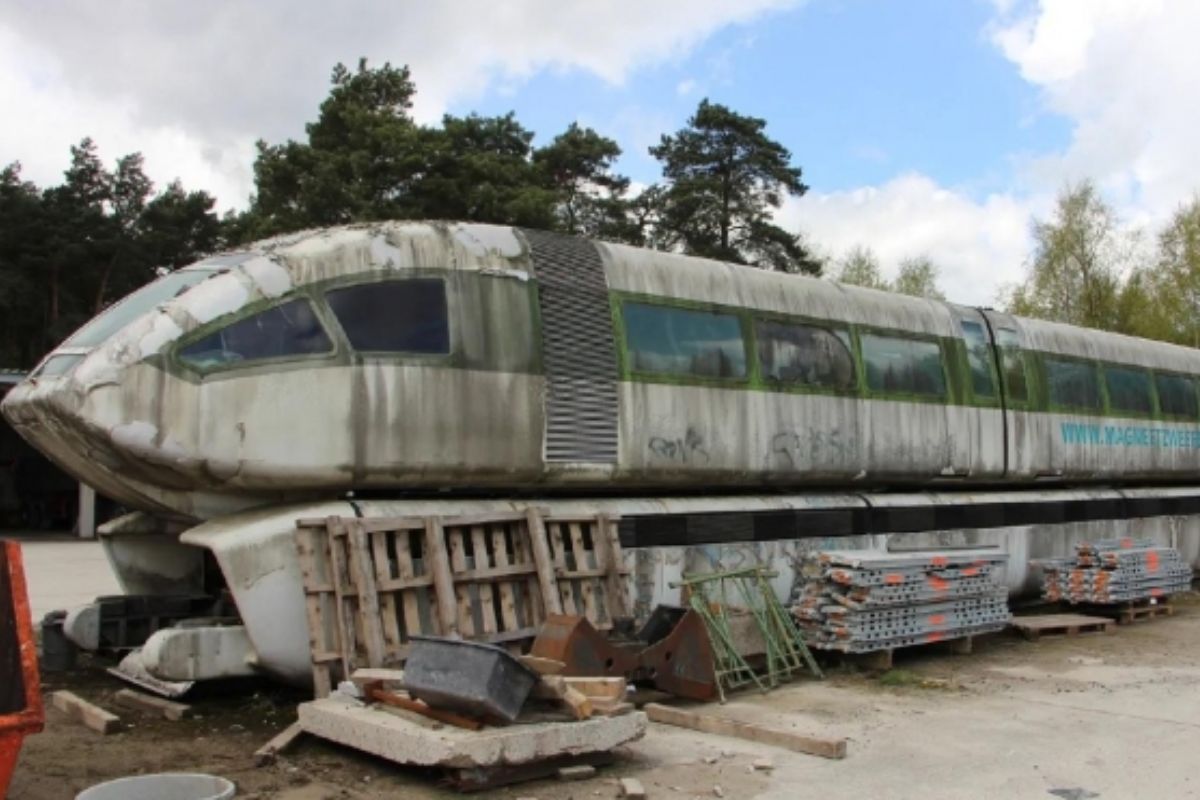
Germany developed the Transrapid, a magnetic levitation train that reached 450 km/h in tests, invested 1.25 billion euros in public funds, and never put it into commercial operation, while China implemented the same technology in Shanghai, where it has been operating with passengers since 2004.
There was a time when the Transrapid seemed ahead of its time. The magnetic levitation train developed by Germany was fast, silent, electric, and visually futuristic, capable of moving without physical contact with the tracks thanks to electromagnetic fields that suspended the vehicle above a concrete track. At the test track in Emsland, in northwestern Germany, the magnetic levitation train reached speeds of up to 450 km/h, a figure that impresses even today. The system was designed to operate at speeds of up to 550 km/h, positioning itself between conventional high-speed trains and regional aviation.
But the future never materialized in the country that created it. Germany invested around 1.25 billion euros in public funds in the development of the magnetic levitation train and failed to turn it into commercial service. According to Hibridos y Eletricos, the paradox is that the technology worked, but not in Germany: China implemented it in Shanghai, where it has been operating with passengers since 2004. What remains of the Transrapid on German soil are remnants of an industrial ambition that never left the test track, while the same engineering has been transporting people on the other side of the world for over two decades.
Why the magnetic levitation train never worked in Germany

The problem with the Transrapid was never technical. The magnetic levitation train required a completely separate infrastructure, different from the conventional railway network, which multiplied the implementation costs.
-
Xiaomi launches smart air conditioner that simulates natural wind with a range of 13 meters, runs HyperOS, identifies over 120 problems on its own, and costs the equivalent of R$ 3,448 in China.

-
Little-known Amazonian fruit contains up to 3,000 mg of vitamin C per 100 g, surpassing orange by dozens of times and also gathering phenolic compounds with strong antioxidant action, according to scientific studies; meet camu-camu.

-
A new chip created by engineers challenges the limits of computing and AI by operating at extreme temperatures of 700°C, introducing a new technology capable of reducing failures and revolutionizing applications in extreme environments.

-
JBL launches BandBox in Brazil with Stem AI capable of separating vocals and instruments in real-time and features a portable amplifier of up to 135 W, 4 simultaneous inputs, a 10-hour battery, and a starting price of R$ 1,699.

It was not enough to buy trains. It was necessary to build an entire system around them: special tracks, dedicated power supply, control electronics, and stations designed exclusively for maglev. This additional cost was the main barrier that prevented its expansion.
Germany studied several routes for the magnetic levitation train, including a connection between Munich’s central station and the airport. The federal government even allocated 550 million euros for this specific project.
But the line was never built. For years, the project oscillated between technological enthusiasm and difficulty in justifying such a large investment in a market that already had conventional high-speed trains and competitive regional aviation. The magnetic levitation train was technically superior, but economically unviable in a country that already had functional alternatives.
The 2006 accident that sealed the fate of the magnetic levitation train in Germany
The story of the Transrapid had a tragic episode that accelerated its abandonment. On September 22, 2006, at the Emsland test track, the magnetic levitation train collided with a maintenance vehicle, resulting in the loss of 23 lives.
The accident was not the only reason for the project’s failure, but it marked a turning point in public perception of the technology. The image of the system was severely damaged, and the chances of commercial deployment in Germany decreased drastically.
The Emsland test track remained operational for a few more years after the accident, but it no longer represented the same symbol of innovation. The operating license expired in 2011, officially ending the German phase of the magnetic levitation train as an active test program.
Part of the infrastructure and some vehicles remained on site as remnants. German media reports that the test track will be dismantled in 2034, finalizing any physical remnants of the project in the country that created it.
How China turned the German magnetic levitation train into commercial reality
While Germany gave up, China advanced. The construction of the magnetic levitation train line in Shanghai began on March 1, 2001, entered experimental operation on December 31, 2002, and became fully operational commercial service in 2004.
The line connects downtown Shanghai to Pudong International Airport, offering a journey that reaches commercial speeds that no other train in the world delivers in regular operation.
The Chinese experience with the magnetic levitation train is the definitive proof that the Transrapid was not an engineering fantasy. The technology worked and could transport passengers regularly. The Shanghai line operated at 431 km/h for years and has been operating at 300 km/h since 2021.
The reduction in speed does not diminish its historical importance: it remains the first and only commercial implementation of high-speed maglev in the world. The irony is that Germany financed and developed the system for decades, but it was China that profited from it.
What the failure of the magnetic levitation train in Germany teaches about innovation
The case of the Transrapid is a classic study of the difference between technological innovation and commercial success. The magnetic levitation train was technically brilliant, but Germany did not find enough economic and political support to implement it in a market that already had established conventional railway infrastructure.
The cost of building an entirely new network competed with investments in systems that were already functioning and could be improved for a fraction of the cost.
The lesson that remains is about the cost of developing revolutionary infrastructure when established alternatives already exist. Germany did not err in creating the magnetic levitation train. It erred in not finding a viable path to implement it before the investment became politically indefensible.
China, without a prior high-speed network at the time, had less to lose and more to gain from adopting a radically new technology. The context, not the engineering, decided who ended up with the train.
The legacy of the magnetic levitation train and its influence on the transport of the future
The Transrapid may have failed commercially in Germany, but its technological influence remains. The magnetic levitation train was one of the first major demonstrations that electric high-speed transport, without physical contact with the tracks, was possible.
Current discussions about new forms of rapid ground mobility, from next-generation Japanese and Chinese maglev trains to guided transport concepts, are based on principles that the Transrapid helped to validate.
The story of the Transrapid magnetic levitation train is fascinating precisely because it is not just about a machine that reached 450 km/h. It is the story of a technology that seemed destined to transform European transport, which became a symbol of lost opportunity in Germany and found its only commercial life thousands of kilometers away, in Shanghai.
The train continues to levitate over Chinese tracks. In Germany, only empty tracks and the bill of 1.25 billion euros remain.
What do you think: did Germany err in abandoning the magnetic levitation train or does the decision make sense when looking at the costs? Did China do well to take advantage of someone else’s technology? Share in the comments. Stories of innovation that do not find their market are as instructive as those of success.








Seja o primeiro a reagir!