





 Portuguese
  English
  Spanish
  5 min of reading
  0 comments


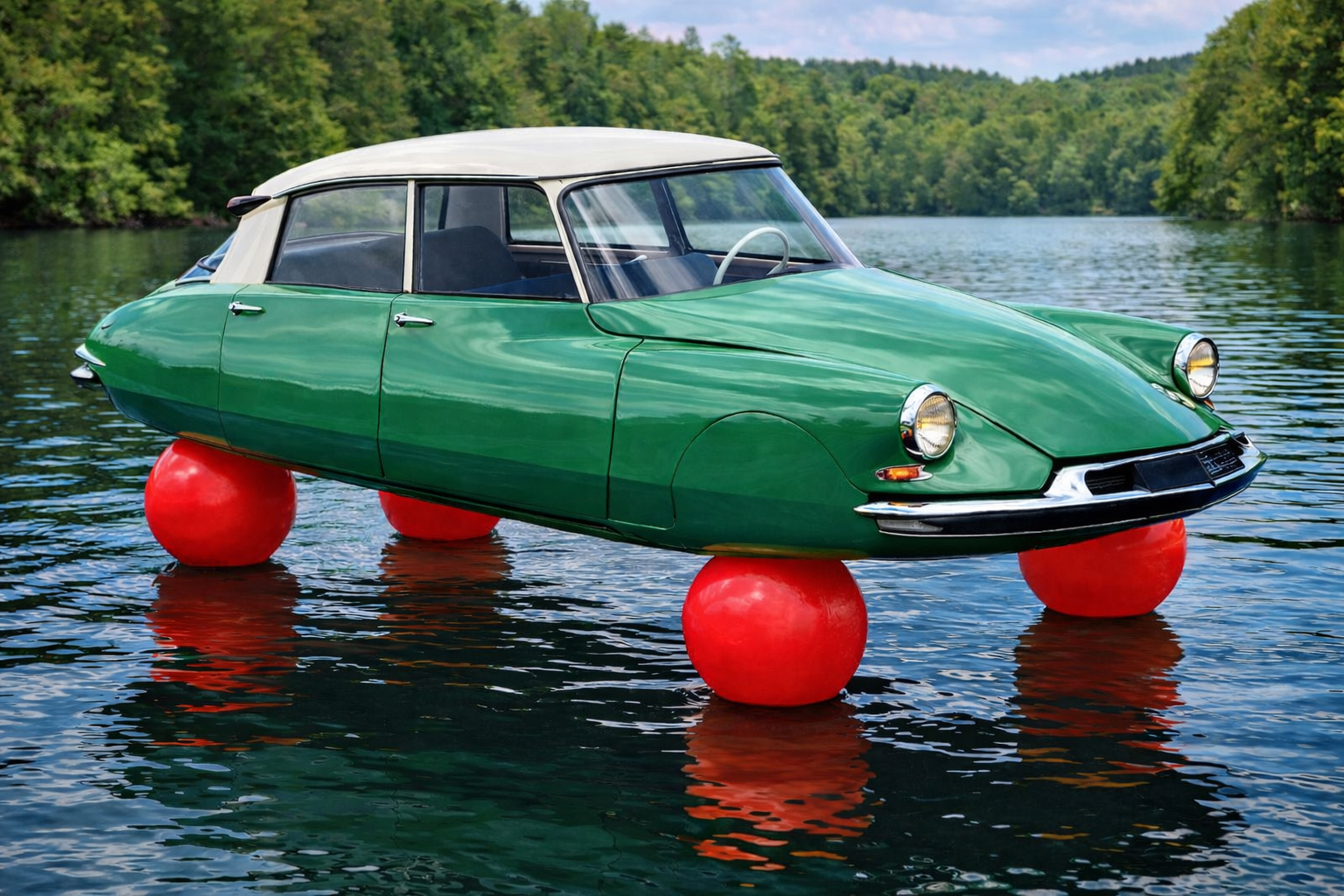
The Citroën DS was placed on balloons to prove its advanced suspension, creating one of the most iconic and curious images in automotive history.
In 1959, in France, the manufacturer Citroën conducted one of the most unusual demonstrations ever recorded in the automotive industry by positioning a Citroën DS model on four large red spheres, creating the illusion that the car was floating. According to historical records from the brand itself and archival materials preserved by automotive museums and Stellantis, the action was part of a campaign to demonstrate the efficiency of the vehicle’s hydropneumatic suspension.
The most striking fact is that the car was not just artistically posed, but visually represented a real system that allowed the vehicle to absorb ground irregularities with a level of comfort and stability far above the standards of the time. The image quickly became a global icon, crossing decades as one of the boldest representations of automotive engineering.
What seemed like a surreal advertising piece actually hid one of the most advanced technologies ever applied in a production car.
-
Jeep Avenger begins production in Brazil, debuting as the brand’s new entry-level SUV and inaugurating an unprecedented phase by becoming the first national Jeep manufactured outside of Goiana, as part of a R$ 3 billion plan.
-
Costing R$ 12,490, the new Shineray Urban Lite 150 “cheap one” arrives in Brazil with a CVT transmission, digital dashboard, and LED lights, making it more affordable than the Biz and targeting those who want to abandon the bus.
-
Ducati brings to Brazil the Superleggera V4 Centenario: 228 hp that become 247 with a track kit, carbon fiber and carbon-ceramic brakes, estimated price between R$ 1.5 and 2 million, deliveries only in 2027.
-
Used cars with electric steering for R$ 30,000: check out 5 practical and economical options for everyday use.


The Citroën DS was born as one of the most revolutionary cars of the century
Launched in 1955 at the Paris Motor Show, the Citroën DS made an immediate impact. In just one day, the model recorded tens of thousands of orders, reflecting the level of innovation embedded in the design. The vehicle featured an unprecedented combination of:
- Futuristic aerodynamic design;
- Integrated hydraulic solutions;
- Extreme focus on comfort and stability.
The DS was not just a new car, but a complete break from the automotive industry standards of the 1950s. At the time, most vehicles still used conventional mechanical suspensions, with metal springs and simple shock absorbers. The DS introduced a completely different approach.

Hydropneumatic suspension: the technology that created the sensation of floating
The great differentiator of the Citroën DS was its hydropneumatic suspension, a system that replaced traditional springs with spheres containing gas and hydraulic fluid. This system allowed the car to maintain a constant height, regardless of weight, and absorb impacts extremely efficiently, creating the sensation that the vehicle “floated” over the road.
The operation involved spheres with compressed gas, pressurized hydraulic fluid, automatic control valves, and constant leveling of the body. When passing over irregularities, the fluid was displaced within the system, compressing the gas and softening the impact, unlike conventional suspensions that transmitted more vibration to the cabin.
The image of the balloons as a visual translation of engineering
The 1959 campaign was not just a simple creative resource. It sought to visually and directly translate a complex technical concept. By replacing the wheels with spheres, Citroën created a clear analogy with the actual functioning of the suspension, which also used spherical elements to absorb impacts.
The red balloons represented the elasticity of the system, energy absorption, and the smoothness of movement. This approach transformed an engineering concept into an easily understandable image, even for those without technical knowledge.

A level of comfort that exceeded the standards of the time
The DS’s hydropneumatic suspension provided a level of comfort that surprised even experts of the time. Historical accounts indicate that the car could maintain stability on uneven surfaces, drastically reduce internal vibrations, and offer a smooth ride even at high speeds.
This performance made the model one of the most comfortable cars ever produced up to that point, solidifying its reputation as a benchmark in automotive engineering. The impact of this technology was so great that it influenced subsequent generations of vehicles.
Technology also brought safety and control advantages
In addition to comfort, the suspension offered important safety benefits. The system allowed the car to maintain control even in adverse situations, such as a loss of pressure in one of the tires, something extremely advanced for the time.
This feature became even more known after a historical episode involving then French President Charles de Gaulle, whose DS vehicle managed to maintain stability after an attack, allowing for an escape. This type of performance reinforced the image of the model as not only a comfortable machine but also highly safe.
Hydraulic integration further enhanced the model’s innovation
The hydraulic system of the DS was not limited to the suspension. It also controlled brakes, steering, and the clutch in some versions. This integration made the car one of the first examples of a vehicle with systems interconnected by a centralized hydraulic architecture. This increased the complexity of the design but also elevated the level of sophistication of the vehicle compared to its competitors.


In addition to engineering, the Citroën DS also stood out for its design. With fluid lines, aerodynamic bodywork, and innovative visual solutions, the model seemed far ahead of its time.
The combination of design and technology created a unique identity, which helped solidify the DS as one of the most iconic cars of the 20th century. The image of the car on balloons further reinforced this futuristic perception.
The campaign that crossed decades and became a cultural reference
The photograph of the DS on balloons not only fulfilled its advertising role but became a lasting symbol. Decades later, the image is still used as an example of how to communicate complex engineering in a simple and impactful way.
It also became part of exhibitions, historical materials, and cultural references within the automotive universe. Few campaigns have managed to translate a technical concept so well into a single image.
When engineering and creativity meet
The experiment of the Citroën DS on balloons goes beyond an automotive curiosity. It represents a moment when advanced engineering and creative communication came together to explain a complex innovation.

By transforming a technical system into a memorable image, Citroën managed not only to demonstrate its technology but also to permanently mark the history of the automotive industry.
More than six decades later, the episode continues to be remembered as one of the clearest examples of how technical innovation can be translated into something visually simple yet profoundly impactful.










Seja o primeiro a reagir!