





 Portuguese
  English
  Spanish
  4 min of reading
  0 comments


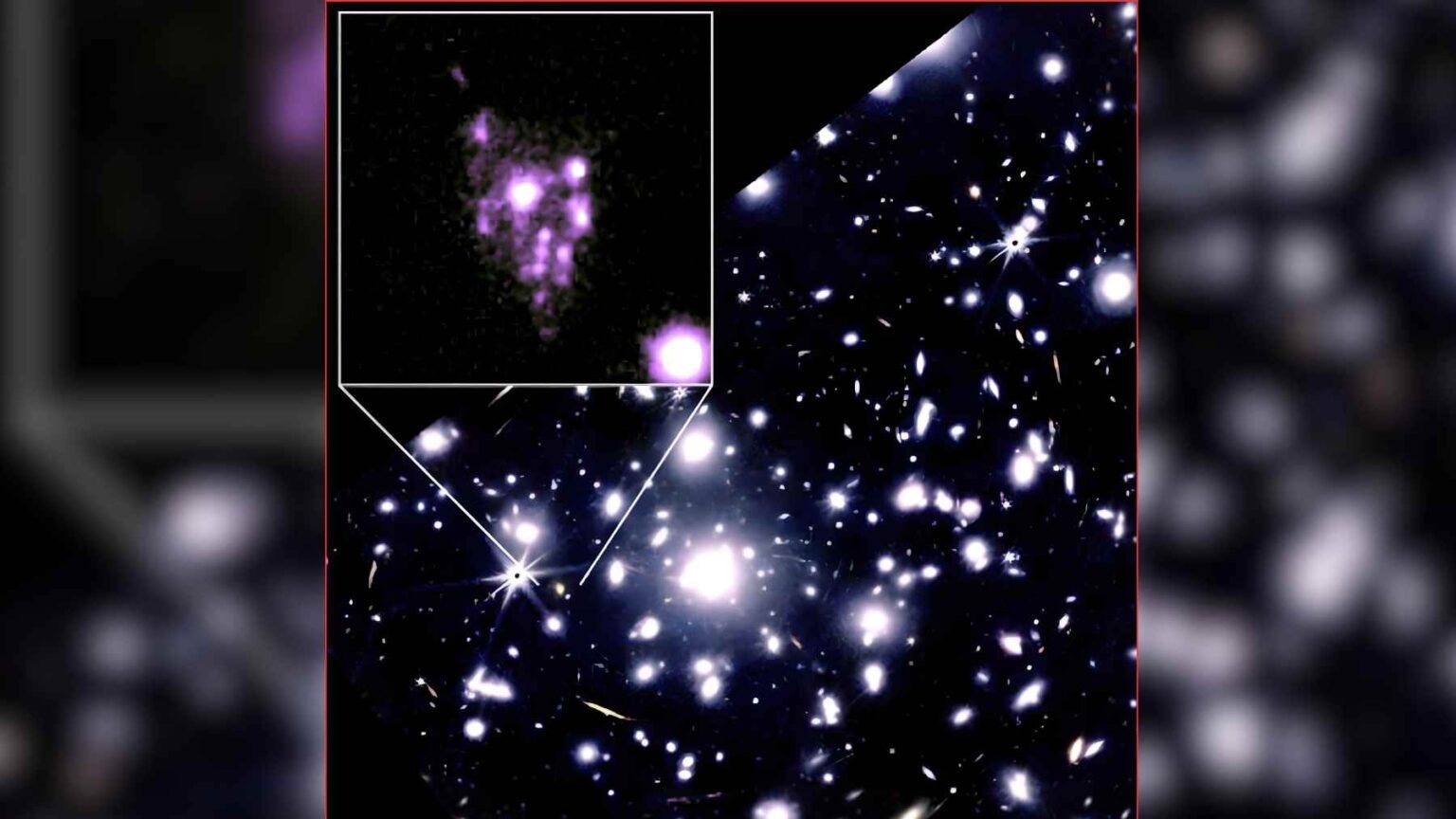
Detailed Observation Of A Galaxy Formed About 930 Million Years After The Big Bang Revealed, With The Help Of Gravitational Lensing And More Than 100 Hours Of Data From ALMA, At Least 15 Compact Clusters Of Star Formation Concentrating Two-Thirds Of Ultraviolet Light, Challenging Classical Models Of Galactic Evolution
A galaxy observed when the Universe was about 930 million years old revealed, following magnification by gravitational lensing, at least 15 compact clusters of star formation, altering the understanding of the internal structure of primitive galaxies and the models used to describe their early development.
The Galaxy That Seemed Uniform In The First Images
In the first observations, the galaxy appeared as a homogeneous and relatively calm rotating disk. Images obtained earlier by the Hubble Space Telescope did not indicate significant internal variations or regions concentrated with intense activity within the system.
With the use of more precise instruments and higher-resolution observations, this uniform appearance unraveled.
-
Motorola launched the Signature with a gold seal from DxOMark, tying with the iPhone 17 Pro in camera performance, Snapdragon 8 Gen 5 that surpassed 3 million in benchmarks, and a zoom that impresses even at night.

-
Satellites reveal beneath the Sahara a giant river buried for thousands of kilometers: study shows that the largest hot desert on the planet was once traversed by a river system comparable to the largest on Earth.

-
Scientists have captured something never seen in space: newly born stars are creating gigantic rings of light a thousand times larger than the distance between the Earth and the Sun, and this changes everything we knew about stellar birth.

-
Geologists find traces of a continent that disappeared 155 million years ago after separating from Australia and reveal that it did not sink, but broke into fragments scattered across Southeast Asia.

The galaxy turned out to be composed of multiple dense clusters of star formation, distributed within the same rotating system, forming what the researchers described as a “bunch of grapes.”
The discovery was led by Seiji Fujimoto from the University of Toronto. According to the team, the analyzed galaxy does not exhibit extreme characteristics and falls within the parameters considered typical for young galaxies of that period in the Universe.
Gravitational Lensing Allowed Observing Hidden Details
The detailed observation was only possible thanks to the effect of gravitational lensing. A foreground galaxy cluster curved and amplified the light from the distant galaxy, acting as a natural magnification that made visible structures that would normally be too small and faint.
This increase in brightness was crucial because faint primordial galaxies are often difficult to study.
The amplification allowed for the extraction of structural information that, without this gravitational effect, would remain hidden even in deep observations.
The target was initially identified through a survey of lens clusters conducted with ALMA. Subsequently, over 100 hours of observations were employed to obtain as many details as possible from the analyzed galaxy.
Clusters Concentrate Two-Thirds Of The Ultraviolet Light
The new images showed that the galaxy hosts at least 15 compact clusters of star formation. These clusters are dense regions where stars form rapidly and can dominate the total brightness of the observed system.
According to the study published in Nature Astronomy, these clusters are responsible for approximately two-thirds of the ultraviolet light emitted by the galaxy.
This indicates that most of the stellar radiation does not come from a uniform distribution but from highly concentrated points of activity.
This concentration changes the interpretation of the luminosity of primitive galaxies. Systems that appear smooth and homogeneous in low-resolution images may, in fact, hide complex and highly active internal structures.
Organized Rotating Disk Challenges Current Simulations
Another relevant aspect of the galaxy is its dynamics. Measurements of the gas indicate that the system rotates in an organized manner, with one side moving away and the other approaching the observer, a typical behavior of well-defined rotating disks.
The combination of ordered rotation with intense internal fragmentation caused astonishment among researchers. Many current computational simulations struggle to reproduce a young, faint galaxy while being so rich in compact star formation clusters.
This contrast suggests that fundamental elements used in galaxy formation models may be incomplete or underestimated, especially in the first billion years after the Big Bang, when physical conditions were different from today.
Impacts For The Models Of The Cosmic Dawn
The researchers emphasize that the galaxy is not treated as a rare or exceptional case. Considering mass, size, and star formation rate, it is described as a typical primitive galaxy, which amplifies the impact of the discovery.
If similar structures are common, many young galaxies observed so far may appear simple only due to resolution limitations. Just like a blurry photo, the lack of sharpness can hide a much more complex internal organization.
Future observations will need to test whether the so-called “Cosmic Grapes” represent a recurring pattern. If confirmed, this will require extensive revisions of the models used to describe the initial evolution of galaxies.
Stellar Feedback May Be Weaker Than Previously Thought
A central point in debate is the role of feedback, the energy released by events such as supernovae, which can disperse gas and limit the formation of new stars. Many models assume that this effect is intense in young galaxies.
The new results indicate that feedback may be weaker than anticipated, allowing gas to remain clustered and continue forming stars in compact regions. This helps explain how a galaxy can maintain so many active clusters without losing its organized rotation.
According to Fujimoto, it was indeed surprising to observe so many clusters in a galaxy that still rotates smoothly. This type of tension between observations and simulations often accelerates theoretical advances in astronomy, forcing adjustments in models to better reflect what the universe actually shows.








-

-

-

-

-

-

61 pessoas reagiram a isso.