





 Portuguese
  English
  Spanish
  5 min of reading
  0 comments


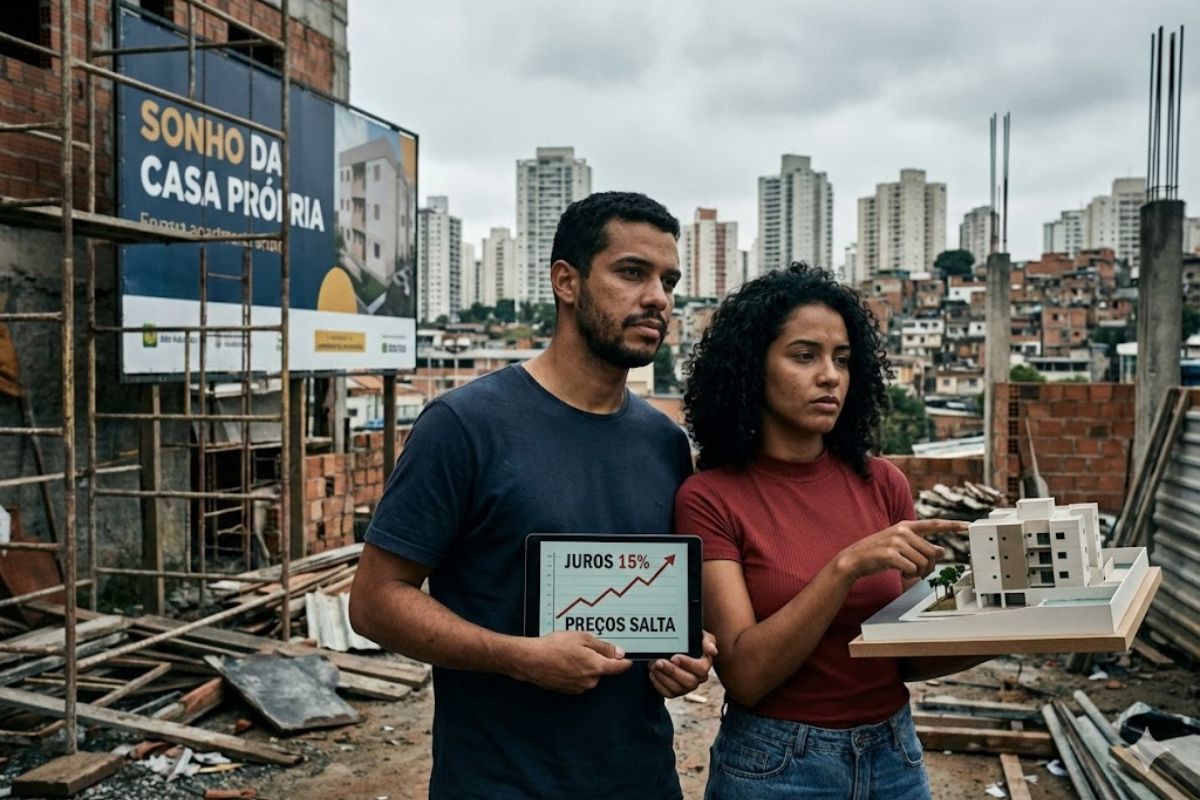
The Generation That May Never Buy a Home Grows as Real Estate Prices Rise 7.7% in Brazil in 2024, Outpacing Salaries, While Young People Cite Interest Rates Near 15% in Financing. Between Staying at Parents’ Home and Paying High Rent, the Dream of Homeownership Becomes a Survival Calculation Today.
The Generation That May Never Buy a Home has become a recurring theme in Brazil after 2024 indicators reinforced the mismatch between income and housing. A survey by the consultancy IPSUS indicates that 70% of young people dream of owning a home, but 62% state that buying a property today is more difficult than it was for their parents and grandparents.
In 2024, real estate prices rose 7.7% in Brazil, while the impact of interest rates near 15% increased the cost of financing and expanded reliance on rent. In practice, more young people are staying at their parents’ homes, there is an increased search for smaller properties, and family decisions are postponed due to lack of predictability.
Numbers That Frame the Housing Access Crisis

The starting point is the contrast between desire and viability.
-
Brazilian city bets on the business environment to generate jobs and attract investments in the energy sector — secretary reveals strategy at Macaé Energy 2026.

-
50 viaducts, 4 tunnels, 28 bridges, and 40 kilometers of bike paths: BR-262 in Espírito Santo will receive 8.6 billion reais for the largest engineering project in the state’s history, inspired by the Immigrant Highway in São Paulo.

-
Brazil produces too much clean energy and doesn’t know what to do with it: over 20% of solar and wind capacity was wasted in 2025 while investors flee and 509 renewable generation projects were abandoned in the last year.

-
Piauí will produce a new fuel that replaces diesel without needing to change anything in the truck’s engine and reduces pollutant gas emissions by half: truck drivers from all over the Northeast are already celebrating the news that will arrive later this decade.

The survey mentioned in DW Revista records 70% of young people saying they want the home and 62% saying the path is tougher than for previous generations.
The data does not prove that everyone will be out of the market, but it helps explain why the generation that may never buy a home has become a frequent expression.
The problem also appears outside the country.
In 2024, the report cites Turkey as the most extreme case, with a rise of nearly 30%. There are also adjustments between 8% and 16% in countries like Mexico, Iceland, Colombia, Croatia, Portugal, Poland, Bulgaria, and the Netherlands.
The message is that the pressure on real estate prices and rent is not just local.
Interest Rates Near 15% and Why Financing Becomes a Mathematical Barrier

For those who do not buy outright, financing is the main axis of cost.
The report indicates that the base rate rose from a level close to 2% to levels near 15%, increasing the final cost.
In contracts that can exceed 120 months, high interest rates widen the gap between the property value and the total paid over time.
This changes families’ strategies. The lower the down payment, the more the financing is exposed to the weight of interest rates.
The monthly installment, in turn, now competes with rent and essential expenses, which pushes decisions and increases the risk of default in unstable income scenarios.
Real Estate Prices Rise Above Salaries and the Numbers Don’t Add Up


The material points to two engines for the perception of blockage.
The first is that real estate prices tend to rise above inflation and, frequently, above salary adjustments.
When income does not keep up, access to homeownership shifts to a more distant horizon.
The second engine is production costs. The rise in labor costs in construction is cited as a factor that pressures the final cost, along with the difficulty in finding workers in the sector.
The result is a calculation where real estate prices rise and financing becomes more expensive, reinforcing the risk that the generation that may never buy a home may become the norm for part of the youth.
Effects on Life: Parents’ House, Smaller Apartments, and Decisions About Children
The crisis ceases to be abstract when it alters routines.
The text describes young people staying longer at their parents’ homes to save for a down payment and reduce the weight of financing.
At the same time, there are launches of apartments smaller than 30 m² as an alternative for those still pursuing homeownership in areas with jobs and infrastructure.
The consequences impact family decisions.
Couples are reassessing the decision to have children due to space limitations and financial insecurity, especially when the budget is already compromised by rent or installments sensitive to interest rates.
Where the Problem Weighs Heaviest: Metropolises, Subway, and Pressure on Rent
The dynamics tend to be more intense in large cities.
The material uses São Paulo and Rio as references for places where living close to work and transport raises real estate prices and increases rent. Neighborhoods near subway stations tend to concentrate demand and, hence, appreciation.
There are also cities outside the traditional axis.
João Pessoa is mentioned as a notable case of recent increases, associated with the arrival of remote workers seeking quality of life by the coast.
When supply does not grow at the same pace, the adjustment appears in rent and in real estate prices.
What Has Been Tried and Why Increasing Supply Is Central to the Solution
The international debate mentioned in the material points to two recurring targets: short-term rentals, like Airbnb, and property purchases by foreigners.
Barcelona is cited with measures to restrict short-term rentals, and countries like Canada and Spain show limitations on purchases by non-residents.
The assessment presented is that restricting demand has not shown consistent effects in driving down real estate prices.
The path with the highest expectations is to increase the stock of housing, invest in social housing, and redesign supply in areas with jobs and infrastructure.
In Brazil, Minha Casa, Minha Vida is cited as an example of a policy that expanded access to financing in specific income ranges, although high interest rates still pose a brake for many families.
Where This Is Headed in Brazil in 2025 and Beyond
If the generation that may never buy a home faces barriers in financing, the pressure is likely to shift to rent.
The text cites the expansion of coliving spaces as a practical response, especially in São Paulo, along with the return of models similar to shared housing, including for graduates with jobs.
The structural point is that housing becomes a recurring issue, not a short-term project.
As long as interest rates remain high and real estate prices continue to outpace salaries, homeownership ceases to be the standard trajectory and comes to depend on a rare combination of income, down payment, and credit.
If this issue impacts your planning, the most realistic step is to map your income, simulate financing, and compare it with the rent in your neighborhood before committing to long-term payments.










-

-

-

-

-

-

20 pessoas reagiram a isso.