





 Portuguese
  English
  Spanish
  4 min of reading
  2 comments


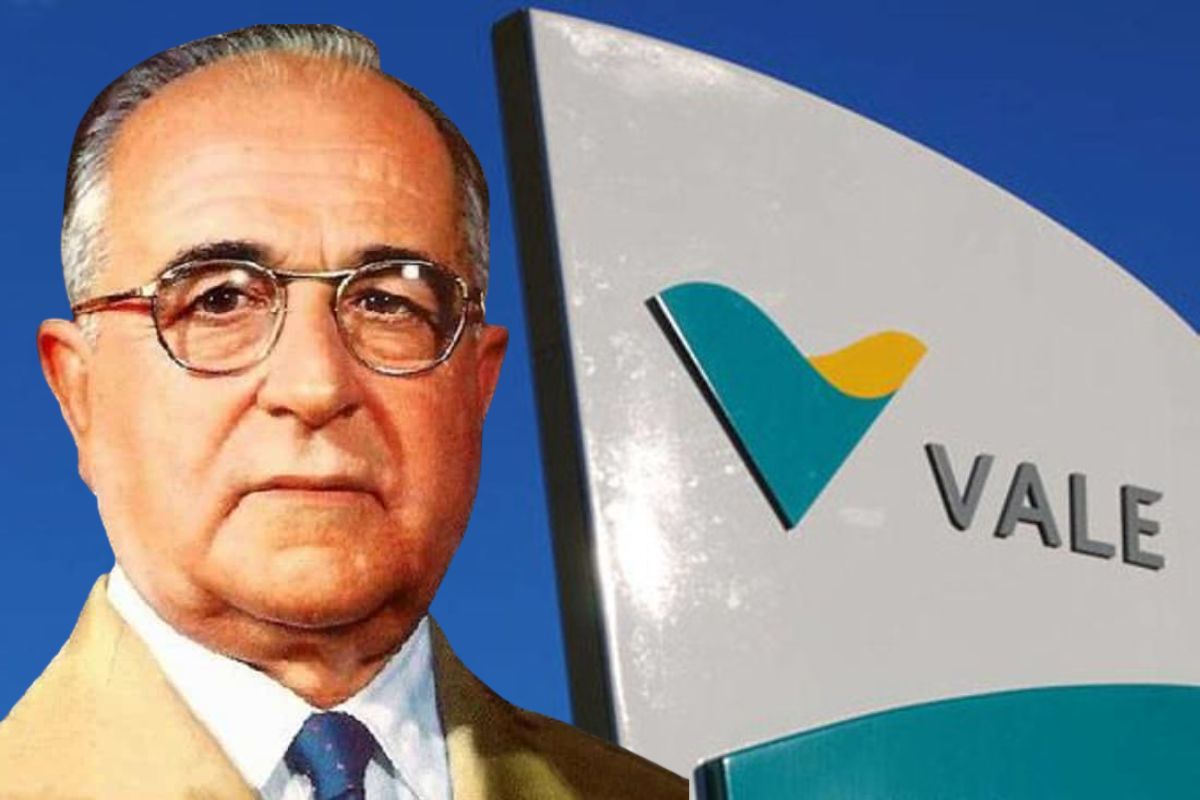

From Getúlio Vargas’ Nationalization to the Controversial Privatization in 1997, Discover the History of Companhia Vale do Rio Doce.
Vale, one of the world’s largest mining companies, has its origins linked to disputes over iron ore in Itabira (MG) and the nationalist vision of Getúlio Vargas. Established as a state-owned company in 1942, Companhia Vale do Rio Doce (CVRD) grew exponentially, became a global leader, and in 1997, its control was sold in a controversial auction, marking a pivotal moment in Brazil’s economic history.
In the early 20th century, the Vitória a Minas Railway (EFVM) began operations, transporting agricultural products and iron ore. The mining town of Itabira became a crucial point in 1908. News of the region’s mineral wealth attracted a group of Englishmen (Brasília Iron Syndicate – BIS), which established the Itabira Iron Ore Company (IIOC) in 1911. The IIOC acquired the monopoly on local deposits and control of EFVM, intending to export ore through the Port of Vitória (ES), although a stipulation required by the government – the construction of a steel mill – was never realized.
In 1919, control of the IIOC passed to American Percival Farquhar. His export plans, however, were thwarted by opposition from Arthur Bernardes, then governor of Minas Gerais and later president of Brazil (1922). Bernardes advocated for the development of a local steel industry and opposed the export of raw ore, imposing heavy fines that thwarted Farquhar’s plans.
-
Spain surprises the world by erecting 62 artificial dunes, mixing sand with natural remains of posidonia, and causing the structure to lose only 1.4% of its volume in 1 year.

-
With 16 Bulava missiles, improvements in acoustic stealth, and a design focused on silent patrols, Russia’s nuclear submarine was born to ensure Moscow’s invisible retaliation and has become one of the pillars of its maritime strength.

-
‘Populous’ city in Rio among the worst in Brazil in national ranking and exposes silent development crisis.
-
Couple buys house in the South Zone of São Paulo, opens a hidden door in the garage, and finds a secret wine cellar with dozens of old wines forgotten since the 1970s.

Getúlio Vargas: Nationalization and the Creation of CVRD in 1942

The scenario changed with Getúlio Vargas‘ rise to power following the 1930 Revolution. Vargas governed by decree and advocated for the nationalization of the country’s mineral wealth. Pressure on foreign concessions increased, especially on the IIOC, which had not fulfilled its promise regarding the steel mill. During the Estado Novo, in 1939, the IIOC lost its concessions.
With World War II ongoing, Brazilian iron ore became strategic. In 1942, through the Washington Agreements, made with the support of the United States and the United Kingdom (interested in the ore for the war industry), the Itabira deposits were transferred back to the Brazilian government. In this context, in June 1942, Getúlio Vargas, through a decree, created the Companhia Vale do Rio Doce (CVRD). Established as a mixed economy company, CVRD incorporated the assets of the former IIOC and EFVM, ensuring state control over the exploration and export of the ore.
State Expansion: CVRD on the Path to Global Leadership (Post – Getúlio Vargas to the 90s)
After its creation, CVRD began a growth trajectory. It started supplying small domestic steel mills (1947) and diversified its international clients beyond the U.S., gaining markets in Western and Eastern Europe (1954) and Japan (1955). In 1956, it went public on the Rio de Janeiro Stock Exchange.
In the 1960s, under the presidency of Eliezer Batista, CVRD implemented innovations such as the concept of “economic distance,” using large ships to transport ore to Japan and oil on the return trip, optimizing costs. Batista initiated the construction of the Tubarão Port (Vitória, inaugurated in 1966), which strengthened ties with Japanese and German clients through long-term contracts.
By the late 1960s, vast reserves of Carajás in Pará were discovered. Vale obtained the concession to build the Carajás Railway (EFC) in 1976, and by 1977, it was the world’s largest exporter of iron ore. Eliezer Batista returned in 1979 to implement the Carajás Iron Project, which, despite the challenges of the “lost decade” of the 1980s, was inaugurated in 1985, consolidating the Northern System (Mine-Railway-Port of Ponta da Madeira/MA).
The Troubled Privatization of 1997
In the 1990s, CVRD was Brazil’s main exporter and a global leader in the iron ore market. However, on May 6, 1997, amid a fierce legal battle which even had a court officer attempting to suspend the auction with a court injunction, the federal government sold its 41.7% stake in the company for R$ 3.3 billion. The auction was won by a consortium led by Companhia Siderúrgica Nacional (CSN). The privatization occurred at a time of increasing profitability for the company.
Vale Post-Privatization


Post-privatization, the company continued its expansion. It launched shares on the New York (2002) and Madrid (2003) stock exchanges, diversified its operations into copper (Sossego Mine, 2004) and nickel/base metals with the acquisition of Canadian Inco in 2006 (now Vale Canada / Metals for Energy Transition). In 2007, CVRD officially changed its name to Vale, facilitating international recognition.
However, recent history was marked by tragedies. In 2015, the dam collapse at Samarco (Vale’s joint venture with BHP) in Mariana (MG) caused a large-scale environmental and social disaster. In 2019, an even worse disaster occurred with the collapse of the dam at the Córrego do Feijão Mine, in Brumadinho (MG), resulting in the deaths of 270 people and devastating the region. Vale entered into a billion-dollar agreement (R$ 37.6 billion) for reparations related to the Brumadinho disaster and committed to decommission all its upstream dams (of the same type that collapsed) by 2030, a costly process. The Samarco case is still pending in court.
Currently (May 2025), Vale is a “corporation” with a dispersed ownership structure. The influence of the federal government is indirect, primarily exercised by the Previ pension fund (employees of Banco do Brasil), following BNDES’s exit from the shareholder framework in 2021. In 2022, the company reported a net revenue of R$ 226 billion and a net profit of R$ 96 billion, maintaining global operations and employing over 200,000 people.







Eu não conhecia essa história.
Muito interessante saber que Getúlio Vargas foi um ponto de partida para essa melhoria brasileira.
Imagino se tivesse ficado na mão do governo **** como de hj, ela já teria falido