





 Portuguese
  English
  Spanish
 4 min of reading
  1 comment


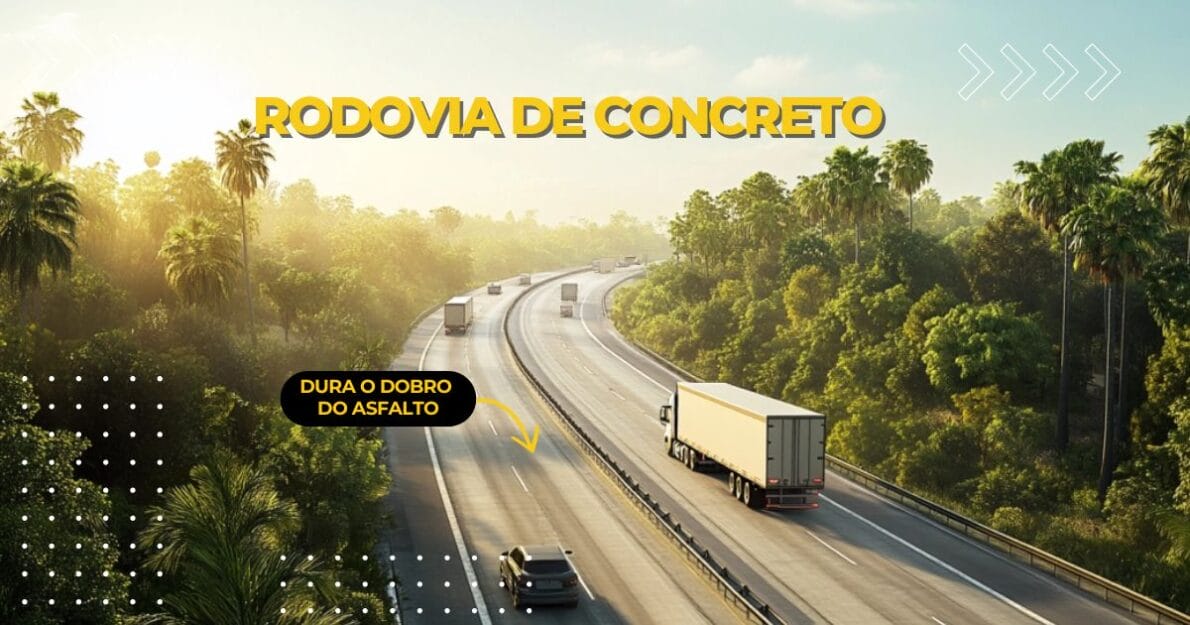

State Innovates by Implementing Concrete Highway That Promises to Last Twice as Long as Asphalt. With Costs of R$ 188 Million, the PRC-280 May Define the Future of Brazilian Roads.
Brazilian highways constantly face maintenance problems, especially in sections with high traffic of heavy vehicles, such as trucks.
With traditional asphalt requiring frequent repairs, the concrete solution has attracted attention.
In Paraná, rigid pavement is already being implemented on the PRC-280, between Palmas and Clevelândia.
-
A new Brazilian shopping center worth R$ 400 million will be built in an area equivalent to more than 4 football fields, featuring 90 stores, 5 cinemas, a supermarket, a college, and parking for 1,700 cars, potentially generating 3,000 jobs.

-
Larger than entire cities in Brazil: BYD is building a 4.6 km² complex in Bahia with a capacity for 600,000 vehicles per year, but the discovery of 163 workers in conditions analogous to slavery has shaken the entire project.

-
With an investment of R$ 612 million, a capacity to process 1.2 million liters of milk per day, Piracanjuba inaugurates a mega cheese factory that increases national production, reduces dependence on imports, and repositions Brazil on the global dairy map.

-
Brazilian city gains industrial hub for 85 companies that is equivalent to 55 football fields.


This material promises not only to double the durability of the lanes but also to improve safety.
What Is the PRC-280 and Why Did Paraná Choose Concrete?
The PRC-280 is one of the main road connections between the Southwest and the South of Paraná, with a large daily traffic volume, especially of trucks.
According to the Department of Highways of Paraná (DER/PR), the choice of concrete is not random.
This option stems from the need for a pavement that can withstand heavy loads and offer greater durability and less maintenance over the years.
According to the DER/PR, concrete is an ideal solution for locations that require extra strength.
The rigid pavement, in addition to lasting twice as long as asphalt, is also less susceptible to deformations caused by climate changes and better withstands wear from heavy traffic.
The technique used on the PRC-280 is known as whitetopping, where the existing asphalt is reused as a base for the concrete, optimizing costs and resources.
The Extension and Details of the Project
The work on the PRC-280 covers a stretch of approximately 45 kilometers, with a total investment of R$ 188 million.
The project spans from the Codapar viaduct in Palmas to the roundabout with Nossa Senhora da Luz Avenue in Clevelândia.
According to the state government, on the 9th of this month, the project, which started in April 2024, reached 75% completion, with an estimated completion in November, depending on weather conditions.
The paving process has followed a strategic schedule, paving one direction at a time to allow for vehicle circulation in the opposite direction using a stop-and-go system.
This approach minimizes traffic impact but also requires constant operations to ensure the safety of motorists and workers.
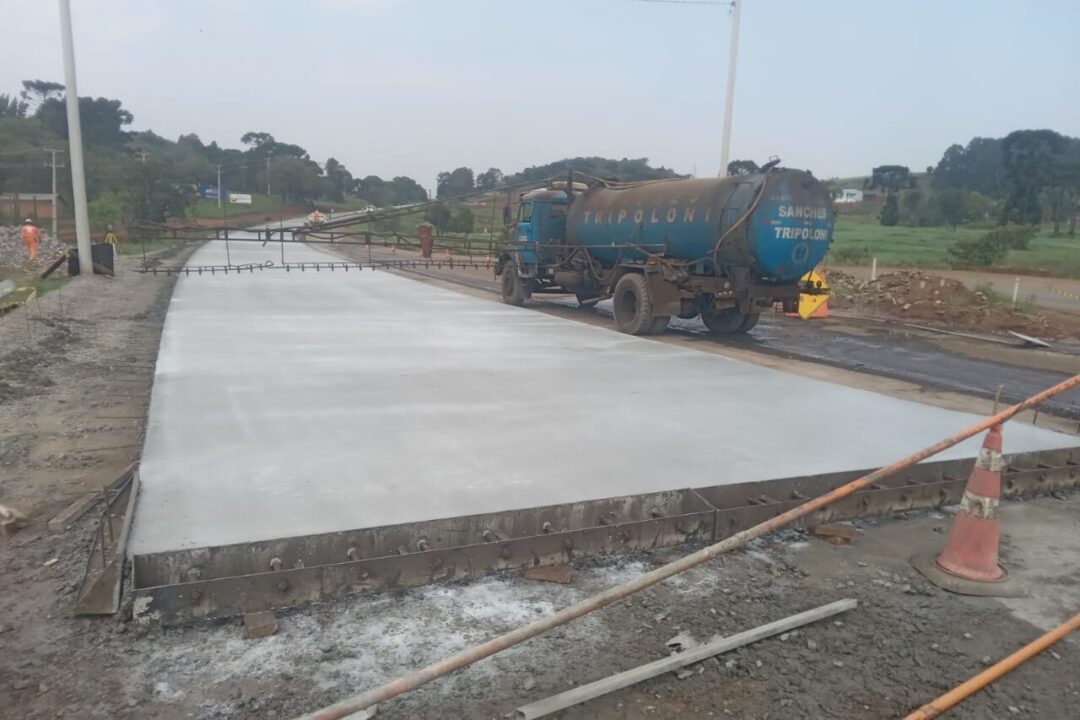
Advantages of Concrete Over Asphalt
But what makes concrete a superior choice?
The rigid pavement not only has greater durability but also offers a range of advantages in terms of safety.
It has better drainage capacity, reduces the risk of skidding, and experiences less deformation over time.
These aspects are especially important for highways like the PRC-280, where truck traffic is intense.
Furthermore, concrete requires less maintenance, which represents significant savings for public coffers in the long run.
The DER/PR emphasizes that, with concrete, the need for repairs is much lower since the material is more resistant to impacts and extreme temperatures.
Next Steps and Additional Services
After the completion of the main paving, which should occur by the end of November, the team will focus on complementary services planned for early 2025.
These services include the installation of triangular concrete gutters, grass planting, and improvements in horizontal signaling and safety devices.
These additional steps are crucial to ensure the durability and safety of the highway, as well as to address environmental issues such as proper stormwater drainage.
Signage includes reflective signs and markers, as well as metal barriers that increase protection against accidents, especially in sections with sharp curves and low visibility conditions.
Why Is Concrete Still a Rare Choice in Brazil?
Despite the advantages, concrete is still a rare choice in Brazil due to the high initial cost, which can be up to three times that of asphalt.
However, this view is changing as states like Paraná realize that savings in maintenance and safety benefits can offset the initial investment.
Experts point out that the higher initial cost of concrete is balanced by its durability.
While asphalt requires frequent repairs, concrete requires much less maintenance over the years, meaning that, in the long run, the cost-benefit can be advantageous.
However, the expansion of this model to other Brazilian highways still depends on greater financial and political support, as well as changes in the mindset of public managers.
Will Concrete Be the Future of Brazilian Highways?
If the PRC-280 proves successful, rigid concrete pavement could become a trend on Brazilian highways.
States with high truck traffic may adopt the same approach, especially in strategic stretches with high cargo circulation.
However, it is necessary to evaluate on a case-by-case basis since not all highway stretches have the same needs and logistical challenges.
Over time, the analysis of costs and benefits should guide this choice. After all, does concrete really offer the ideal answer to all the problems of Brazilian highways?
Or will the high initial investment continue to be an insurmountable barrier to large-scale implementation?
What do you think? Is concrete the way forward for the future of Brazilian roads, or is the high cost still an unmanageable obstacle? Leave your comment and join the discussion!







No Paraná Em especial em Curitiba há ruas com concreto e atualmente estradas e a boca pequena se dizia que as empreiteiras, não gostavam do material porque acabava as constantes reformas