





 Portuguese
  English
  Spanish
  5 min of reading
  0 comments


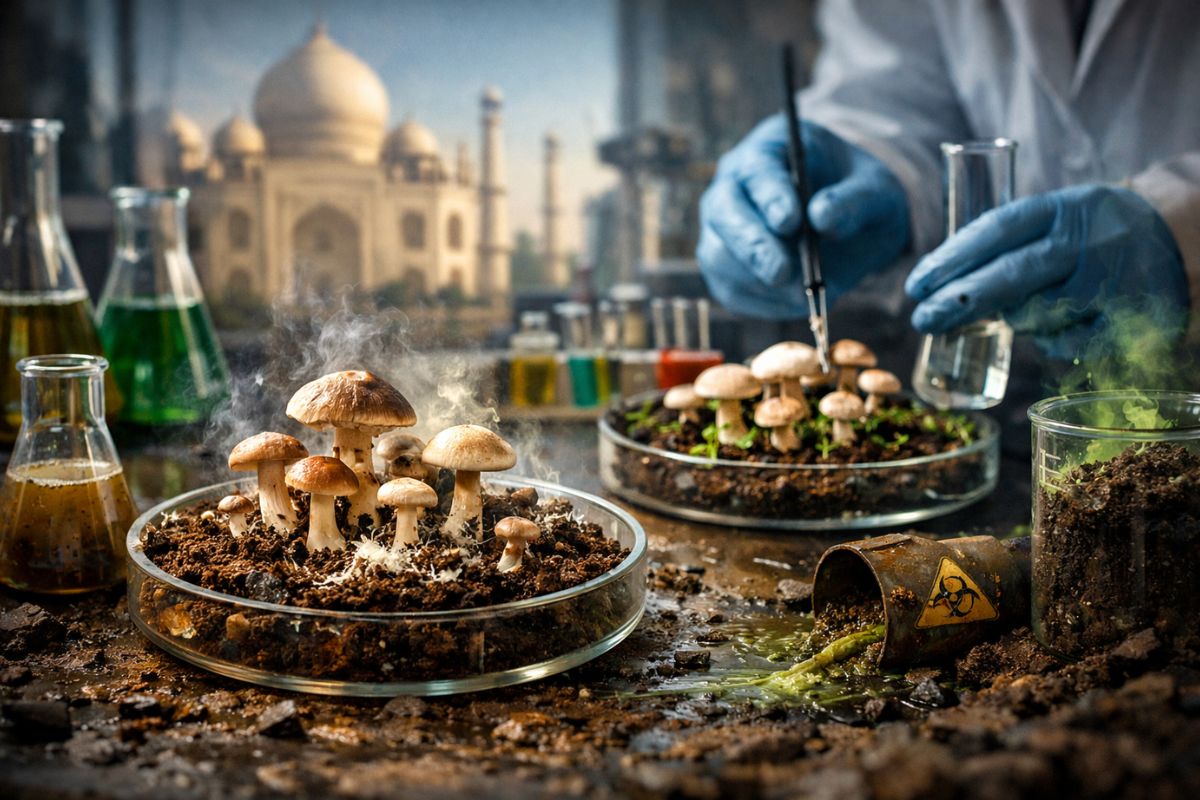
In a citizen science laboratory in southern India, mushrooms and their mycelium are studied as restoration tools: they can clean contaminated soils, degrade industrial waste, help treat polluted water, and inspire bioplastics, packaging, and construction materials, in addition to becoming a real-life meat alternative.
Mushrooms often appear in many people’s lives as food, trail curiosities, or “forest things.” In Tamil Nadu, however, they have become the subject of workshops: walking barefoot, observing the ground, and understanding why these discreet beings can sustain entire life cycles around them.
The scene blends memory and science. A family tradition of gathering, washing, and cooking mushrooms with spices meets field research and environmental education. What seems simple, in practice, opens a door to a larger theme: mycelium as a technology of nature.
Mushrooms are not plants: the first confusion that changes everything

To understand why mushrooms enter conversations about soil, water, and materials, one must start with the basics: mushrooms are not plants. They are merely the most visible part of a larger system, fungi, which has existed for over 1 billion years and includes millions of mushrooms, some poisonous, others tasty, many still unknown.
-
Maria Branyas Morera lived to be 117 years old, eating three yogurts a day without developing cancer or dementia, and when scientists analyzed her DNA, they found a secret that no one expected: her biological clocks indicated an age two decades younger than her actual age.

-
Upside Down House transforms abandoned warehouses from the 1970s, blending art with concrete and steel engineering, becoming a phenomenon in South Korea and impressing with a surreal experience that attracts tourists from around the world.

-
Brazil became 18 square kilometers smaller in the new official update from IBGE, which redrew the boundaries of 784 municipalities in 13 states and even changed the names of cities that you might know, such as Açu, which is now called Assú.
-
Stephen Hawking said that the worst enemy of knowledge is not ignorance but the illusion of knowledge, and he dedicated his entire career to proving that science dies when people act as if they already have all the answers.


A comparison helps: if an apple tree were a fungus, the “apple” would be the mushroom. What appears above ground is the fruiting body; the real organism spreads mainly beneath the surface. This detail changes the way we look at the forest because what does the heavy lifting is almost never in sight.
In India, research has already documented over 14,000 types of mushrooms. Popular fascination also plays a role: workshops and meetings attract curious people precisely because, for a long time, schools and universities have sidelined the subject. When knowledge does not circulate, potential remains trapped in “mystery.”
Mycelium, the invisible network, and the logic of decomposition that repairs the forest

Below the mushroom body lies an extensive and delicate network, like a tangle of “roots”: mycelium. It is this structure that transforms dead matter into valuable humus, recycling nutrients and returning life to the ecosystem. In the forest, decomposition is not an end: it is a beginning.
In addition to recycling leaves, plants, and dead trees, fungi can also form mycorrhizal relationships with trees. The exchange is direct: the tree provides food generated by photosynthesis, and the fungus helps with nutrients and water. This is not romanticizing nature: it is an evolutionary partnership that sustains the productivity of the forest.
This “intelligence of the underground” is what draws the attention of scientists and educators when discussing mushrooms as environmental tools. The question shifts from “what grows after the rain?” to “what can this network do with waste and contamination that humans spread?”. When the problem is systemic, the solution tends to be as well.
Cleaning contaminated soils, treating polluted water, and tackling difficult waste
The same logic of decomposition that creates humus has also inspired tests and studies with problematic waste. Scientists point out that fungi can go beyond dead wood: there is evidence that mycelium can act on plastics, petroleum waste, and even radioactive material, under specific and controlled conditions.
One cited example involves small dye factories, where waste may carry strong chemicals, such as phenols, that are difficult to break down. The mentioned investigation describes fungi of the genus Aspergillus as capable of decomposing these compounds and converting them into harmless substances. It is the idea of “dismantling” chemically what seemed too resistant for the environment to handle alone.
In the citizen science laboratory, the proposal is not limited to observation: it seeks to translate these processes into practical pathways, using local resources and agricultural waste. When it comes to treating polluted water, the ambition is clear: to harness the natural transformative capacity of fungi to reduce unwanted loads and improve the quality of what returns to the environment. The central point is the same: to transform, rather than just hide or push waste away.
From plate to “eco-plastic”: why mushrooms have also become an industry
Mushrooms did not enter this story solely from the environmental side. They have also become a desired product, appealing to different audiences: vegetarians and carnivores have begun to see them as a meat substitute, with a good supply of protein and low calories and fat content. In 2023, the global mushroom harvest was reported to be close to 50 million tons, a number that helps explain why the topic has moved out of niche.
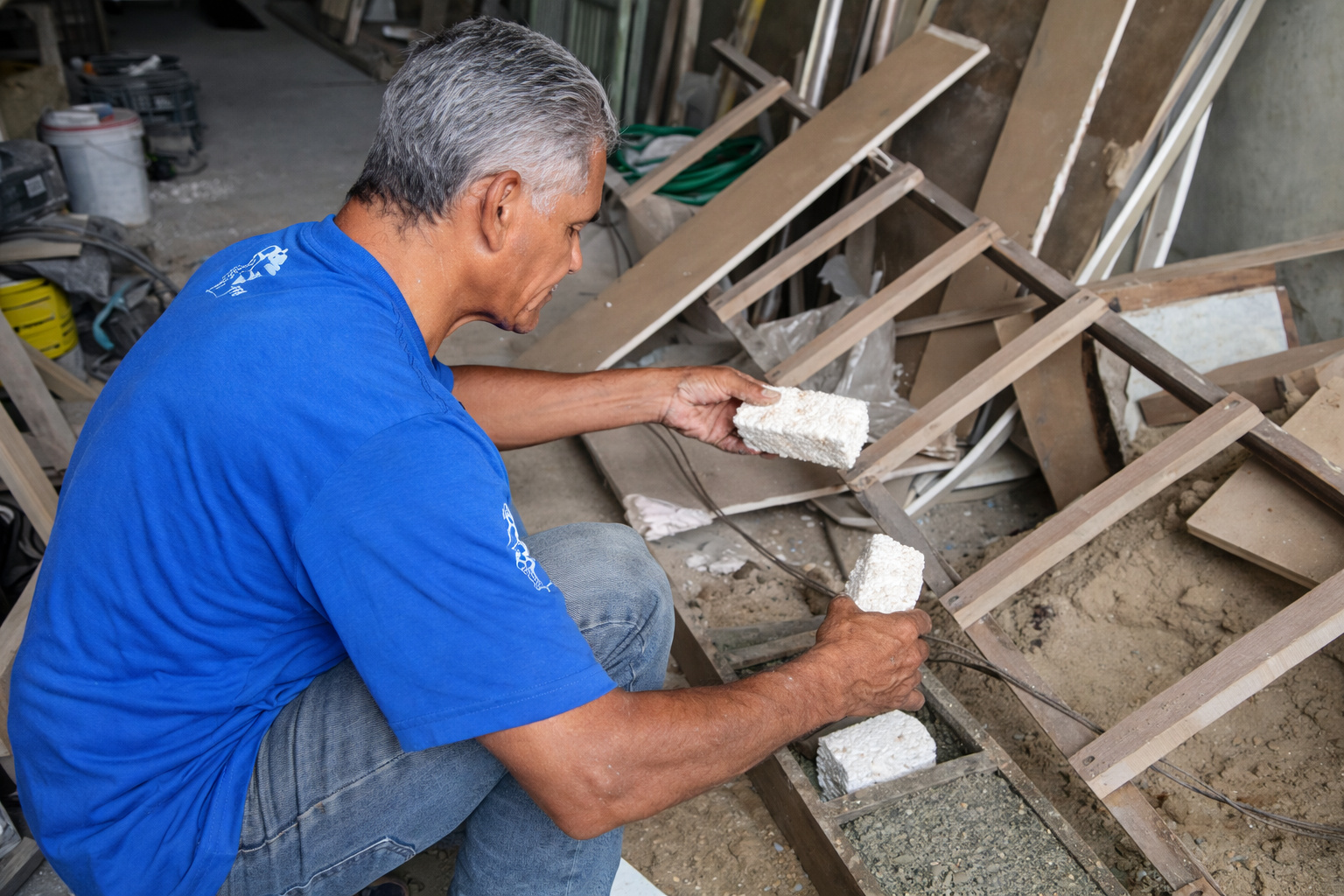
This scale fuels another shift: mushrooms and mycelium as raw materials. The unique texture of mycelium allows for thinking about packaging, “eco-plastics,” and even biodegradable construction materials, in contrast to options like concrete and traditional plastic. The change here is not aesthetic: it is about life cycle, disposal, and decomposition.
Still, the leap from the laboratory to everyday life is not automatic. There is a distance between demonstrating a capability in controlled environments and applying it on a large scale, with safety, viable cost, and standardization. Mushrooms promise a lot, but credibility depends on testing, transparency, and well-defined limits.
Why so many people still know little and what changes when they learn
Even with this range of possibilities, the topic remains little known outside specific circles. And this is directly reflected in the workshops: many people are fascinated because they have never heard, in an organized way, about the difference between fungi and mushrooms, the existence of mycelium, or the idea that decomposition can be a “tool” for restoration.
In this scenario, initiatives like the Ecology Action Lab, co-founded in 2022, bet on an approach that combines academic knowledge and community practice. The logic is to view fungi as part of an ecosystem, not as an isolated “magic solution”: understanding relationships, limits, risks, and real applications. When nature becomes just a backdrop, we lose the manual for how it works.
The most concrete impact may be cultural: by learning how mushrooms act in soil, water, and the waste cycle, the public begins to think about the balance between humans and the environment in a less abstract way. And this opens a difficult but necessary conversation: how much of the environmental crisis is also a crisis of knowledge applied in daily life.
If mushrooms can help clean contaminated soils, treat polluted water, decompose certain waste, and inspire biodegradable foods and materials, then the question shifts from “if” to “how”—with what rules, what tests, what limits, and what acceptable social uses.
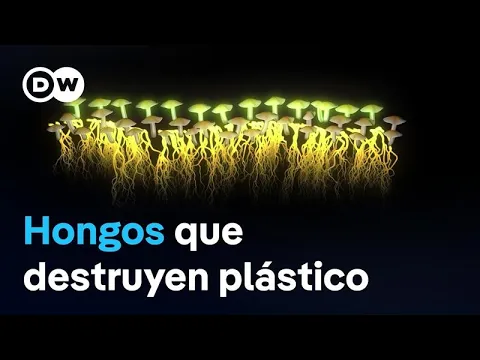

With information from the channel DW Español.
Now I want to hear from you: would you frequently eat a meat substitute made from mushrooms? And would you live in a house made from mycelium-inspired material? What convinces you more, the environmental promise or the step-by-step scientific proof? Share in the comments what excites you, what bothers you, and which application you think would arrive first in your city.






Seja o primeiro a reagir!