





 Portuguese
  English
  Spanish
  5 min of reading
  0 comments


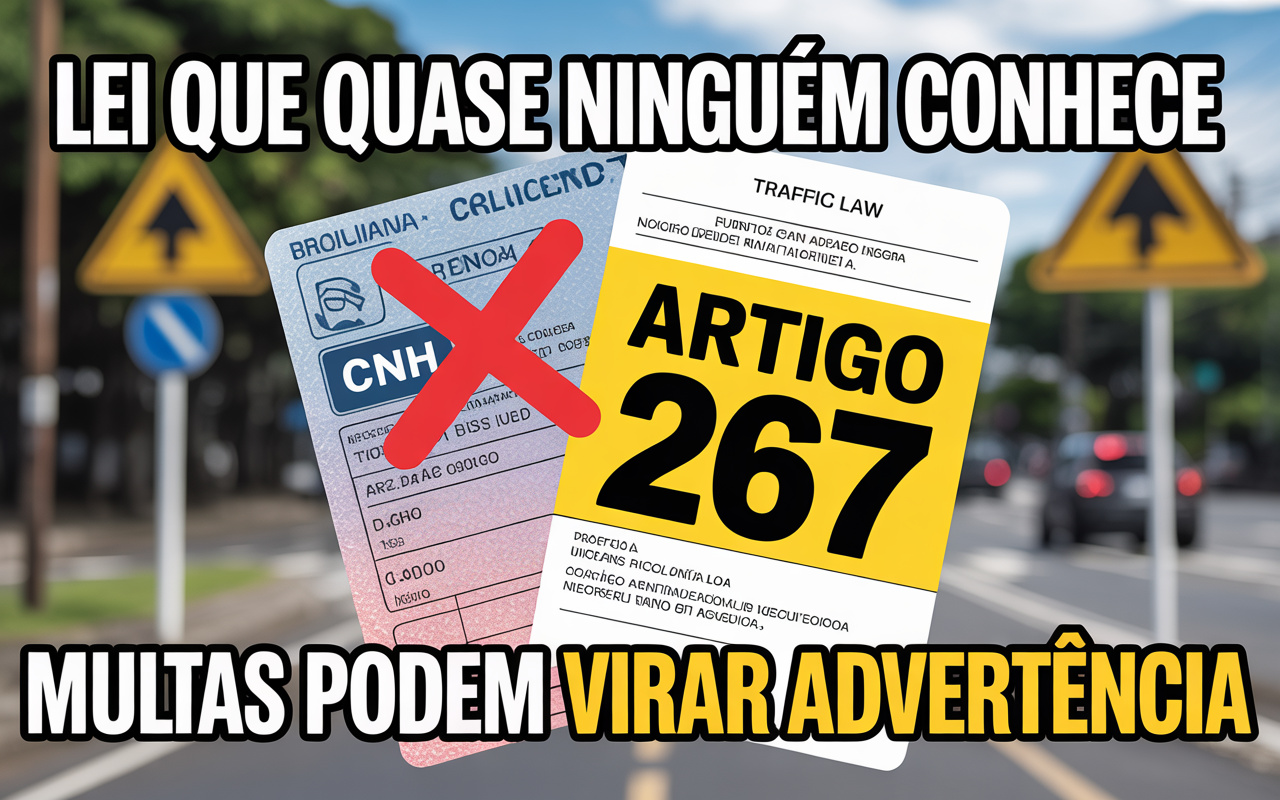
Little-Known Law Allows Converting Light and Medium Fines into Written Warnings and Zeroing Points on the CNH, a Right Provided in Art. 267 of the CTB.
The possibility of converting light and medium fines into written warnings, without payment and without points on the license, has been provided since 1997 in Article 267 of the Brazilian Traffic Code (CTB). Despite this, millions of drivers across the country continue to pay fines that could be converted, accumulating unnecessary points and even risking suspension of their CNH due to pure ignorance. This is one of the least publicized rights in Brazilian traffic, even though it is a strategic tool to preserve the driver’s record and reduce unjustified penalties.
The Origin of the Rule and Why It Is Rarely Disclosed
Article 267 was created to encourage education in traffic and avoid penalizing drivers who commit occasional and low-risk offenses. The logic is simple: those who drive regularly without serious infractions and have a good history should not be punished in the same way as habitual offenders. Therefore, the law allows for the substitution of the fine with a warning when the infraction is light or medium as long as there is no recurrence of the same type of conduct within a period of 12 months.
Although it has been in effect for almost three decades, the provision has never gained broad publicity. Many traffic agencies do not offer spontaneous guidance, and in some states, drivers are even unaware that they can request the benefit through digital means. This creates an unequal scenario: those who know the law avoid points and expenses; those who do not know pay and accumulate points.
-
The noise law will no longer be in effect at 10 PM starting in June with a new rule valid during the 2026 World Cup.

-
The Chamber opens a debate on driver’s licenses at 16 years old as part of a reform that includes around 270 proposals to change the Brazilian Traffic Code and may redesign rules for licensing, enforcement, and circulation in the country.

-
The new Civil Code could revolutionize marriages in Brazil with “express divorce” and changes that could exclude spouses from inheritance.
-
Banco do Brasil sues famous influencer for million-dollar debt and intensifies debate on delinquency, risks of seizure, and direct impact on Gkay’s credibility.


How the Conversion of the Fine into a Warning Works That Can Even Zero Points on the CNH
The rule is clear: whenever the driver commits a light or medium infraction, they have the right to request the conversion of the penalty into a written warning. This means:
- No fine payment
- No points recorded on the CNH
- No impacts on the driver’s record
- The driver’s history remains intact
The warning has an educational function, not a punitive one. It is sent to the driver as a formal notification, informing them of the irregular conduct, but without negative effects.
Infractions That Can Be Converted
The infractions eligible for conversion are all classified by the CTB as:
- Light (3 points)
- Medium (4 points)
Examples include:
- Parking irregularly in allowed locations with time restrictions
- Driving with headlights off in urban areas (when not classified as serious)
- Driving without carrying documents (provided that regularity is proven later)
- Exceeding the speed limit by up to 20%
- Driving with an arm hanging out of the window
- Using the horn at prohibited times or locations
These behaviors represent lower risks and, for that reason, can be treated as opportunities for correction, not punishment.
What Are the Requirements to Have the Right to the Benefit and Even Zero Points on the CNH
Article 267 establishes only two objective criteria:
- The infraction must be light or medium
- The driver must not have committed the same infraction in the last 12 months
The number of previous points or other fines in different categories does not matter. What matters is not repeating the same behavior within a year.
Moreover, since 2021, with Law No. 14.071, the traffic agencies have been able to convert the fine ex officio, meaning without the driver’s request when they believe that the warning better serves the educational purpose.
What the Traffic Departments Consider When Deciding
The Resolution No. 619/2016 of the National Traffic Council (Contran) reinforces the criteria and defines that the driver’s history can also be taken into account. As such, drivers with clean records have a higher chance of obtaining the conversion.
When the driver makes the request, the agency must analyze:
- Severity of the infraction
- Circumstances of the event
- Potential risk of the conduct
- History of specific recidivism
If all requirements are met, the agency is obliged to grant the conversion.
How to Request the Conversion — Official Step-by-Step
The procedure varies by state, but follows a national pattern. The driver must:
- Access the website or app of the Detran of the state where the infraction was registered
- Enter the Pre-Defense / Appeal area
- Select the option “Request Conversion into Written Warning”
- Fill out the form with fine details and personal information
- Await analysis from the issuing authority
In many states, such as São Paulo, Paraná, Bahia, Minas Gerais, and Pernambuco, the process is entirely digital.
If the request is denied, the driver can still appeal to the Jari (Administrative Board of Appeals for Infractions), reinforcing the criteria of the CTB and attaching proof of a good behavior history.
What Traffic Law Experts Say
Lawyers and experts point out that Article 267 is one of the most important mechanisms to ensure justice and proportionality in traffic. It prevents careful drivers from being punished for punctual failures and stops small slips from causing disproportionate effects, such as accumulating points and even the risk of suspension.
Recent court decisions reinforce that the issuing authority must apply the conversion whenever the legal requirements are met, under penalty of violating the principle of reasonableness.
Why This Right Continues to Be Ignored
There are three main reasons:
- Lack of official disclosure
- Unawareness of drivers
- Interest of agencies in maintaining revenue
There is no national campaign explaining this right. Most drivers only discover the possibility by consulting lawyers or specialized content.
A Powerful Tool to Preserve the CNH
In a scenario of complex traffic, intense highways, and increasing enforcement, knowing that light and medium fines can be converted into warnings means:
- Avoiding points that can weigh on the record
- Reducing the risk of suspension
- Saving money
- Maintaining a clean history
- Ensuring that penalties respect the proportionality of the law
Article 267 was created with a clear objective: to educate, not to punish. And for those who know the rule, it works exactly like that.










-

-

-

-

7 pessoas reagiram a isso.