





 Portuguese
  English
  Spanish
  4 min of reading
  0 comments


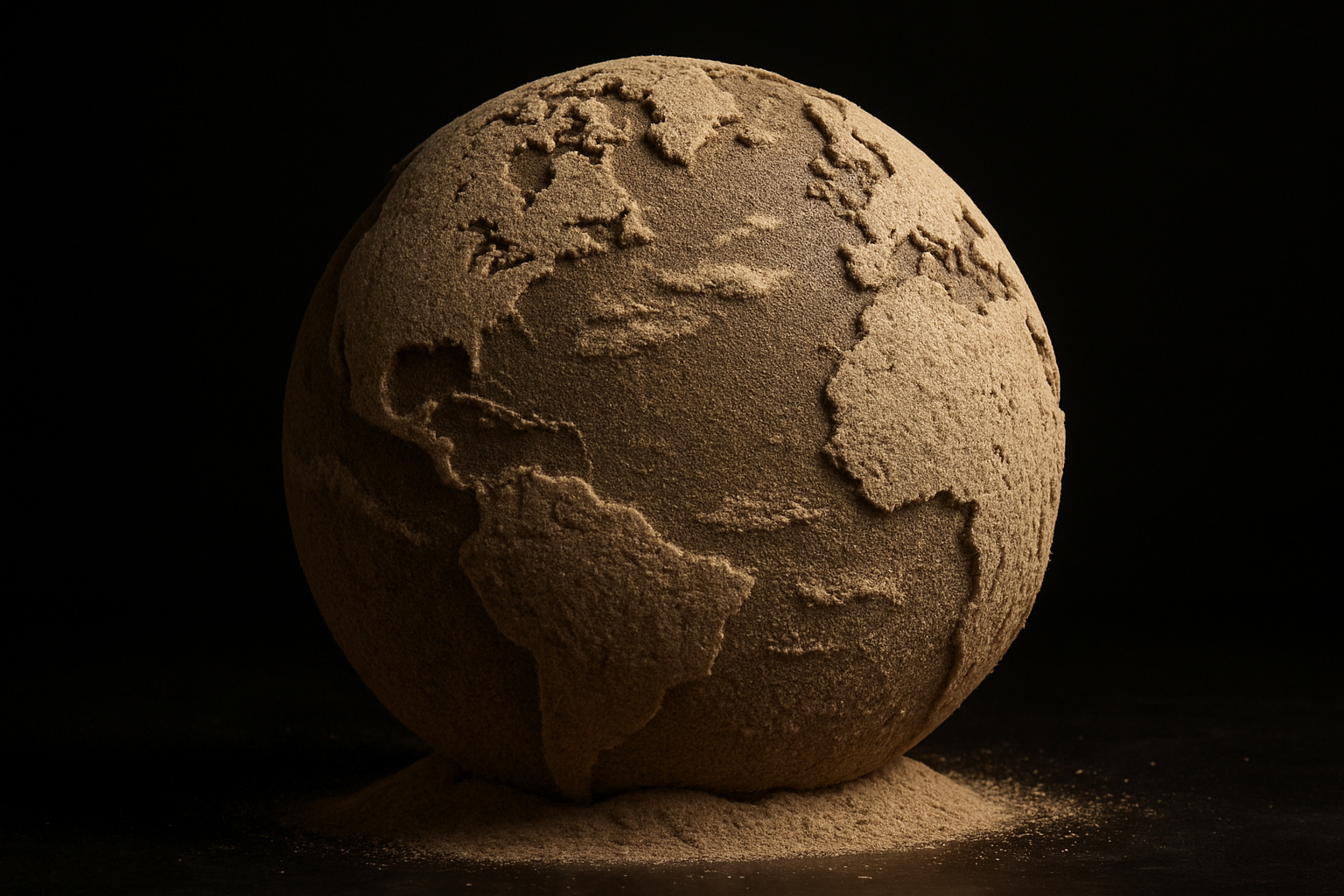
The Silent Expansion of Illegal Mining Has Turned a Common Natural Resource into a Market Dominated by Corruption, Violence, and Increasing Environmental Impacts, Affecting Communities and Ecosystems Around the World
The global sand crisis has ceased to be a warning limited to scientists and environmentalists, becoming a phenomenon with increasingly evident economic, social, and criminal impacts. Although it seems to be an abundant and cheap resource, sand has become central to modern infrastructure — and for this reason, it has been smuggled, exploited, and contested by violent gangs across several continents. This information was detailed in an international article that discussed how this “granular gold” has become the second most extracted material on the planet, second only to water.
As the industrialized world expands cities, increases concrete consumption, and creates new real estate hubs, demand is growing explosively. However, while the construction industry benefits, rivers, lakes, and entire ecosystems are being destroyed. In many countries, reporting this crime means putting one’s life at risk — as happened to activists who were pursued, threatened, and even attacked by members of the so-called sand mafia.

The Invisible Resource That Sustains Modern Life and Moves Billions, But Whose Extraction Exceeds the Natural Renewal Capacity
Despite being underestimated, sand is present in almost everything around us. It makes up the concrete of cities, the asphalt of roads, the glass of windows, and even the silicon in electronic devices. Additionally, it appears in unexpected products such as cosmetics, paints, wines, and even the rubber bands used in daily life. It is estimated that about 50 billion tons of sand and gravel are consumed annually — enough to cover the entire territory of Argentina with a 1-centimeter thick layer.
-
A rare storm transformed part of the Gulf into an unlikely scene of hail, extreme rain, and tornado risk in the middle of the desert, with volumes that exceeded the annual average in a single day.
-
Brazil catches the world’s attention with ships powered by ethanol and biodiesel that have lower emissions, an unprecedented certification with advantages in chartering, and a revolution in cabotage.
-
A couple who only has Sundays free has built a hand-dug pool, a hamburger joint, a dance hall, and a playground in their own home without hiring a mason, and even with breaks due to accidents and the pandemic, the work has never truly stopped.
-
Furniture made with aluminum and glass does not warp and has become an alternative to replace MDF in Brazil.

Of this total, 90% goes directly to the construction industry, a sector that is growing especially in developing countries. China and India lead in consumption, driven by rapid urbanization: every year, the world constructs the equivalent of nine cities the size of New York, putting further pressure on natural ecosystems. However, not all sand is suitable for this use. Desert sand, weathered by the wind, has rounded grains — unsuitable for making concrete. The industry’s preference is river sand, with its irregular shape that creates stronger structures.
However, this extraction occurs at such a high rate that nature cannot replenish the material. The result is an alarming scenario: accelerated erosion, habitat destruction, and environmental imbalance, mainly in tropical and coastal regions.


The Expansion of the Sand Mafia, Murders Linked to Smuggling, and the Devastating Impact on Communities and Entire Ecosystems
In many countries, the illegal extraction of sand has become so profitable that it has given rise to a market dominated by gangs, corrupt politicians, and highly organized criminal networks. Estimates indicate that over 50% of all sand removed in developing nations is obtained clandestinely. The lack of global monitoring, combined with the ease with which the material is mixed with legal loads, makes it almost impossible to trace its origin.
Interpol’s operation in Gambia revealed unprecedented levels of illegal extraction, exposing a problem that also occurs in Western Europe, North America, Southeast Asia, Latin America, and notably, in India. Near Rio de Janeiro, teams have caught workers removing sand from prohibited areas. After being mixed with legal sand, the load can proceed to construction sites, factories, or even cargo ships, without anyone questioning its provenance.
In regions dominated by gangs, violence has become routine. Hundreds of people have been murdered in recent years due to disputes over this resource — with cases reported in Mexico, Ghana, Indonesia, and, particularly intense, in interior India. Activist Sumaira, for example, was attacked in 2004 for denouncing illegal operations, making the issue even more urgent and personal.
In addition to human violence, the environmental impacts are profound. Excessive sand removal from rivers and beaches intensifies the risk of landslides and floods. Dredging — a process in which machines “scrape” the riverbed — completely destroys the habitat of plants, fish, and other organisms. Experts warn that this type of devastation generates prolonged, silent, and cumulative effects.
New technologies, such as the production of artificial sand from crushed stones and concrete recycling, emerge as promising alternatives. However, they are still expensive and require high energy consumption. As long as the extraction of natural sand remains cheap, the trend is for smuggling to continue to grow. To combat this crisis, strong public policies, anti-corruption efforts, awareness campaigns, and constant community involvement are necessary — something that is still far from reality in many countries.
Source: BBC News Brasil






-

-

-

5 pessoas reagiram a isso.