





 Portuguese
  English
  Spanish
  4 min of reading
  0 comments



When We Think of the Largest Structure Ever Built by Humans, We Usually Think of the Great Wall of China or the Pyramids. But What If the Answer Is a Vast Underground Network or a Colossal Excavation That Few Know About?
The question of what is the largest structure ever built by humans sparks fascination with monumental feats. Traditionally, the Great Wall of China and the Pyramids of Egypt dominate the popular imagination. However, a deeper analysis and consideration of different metrics of “grandeur” suggest that vast underground networks, like pipeline systems or immense mining operations, may hold this title.
Humanity has always been drawn to colossal constructions. Structures like the Great Wall of China and the Pyramids of Giza symbolize the peak of engineering in their times. However, our common understanding of “largest” often ties to visual impact and historical narrative, potentially overshadowing the magnitude of other human creations, such as vast underground networks. This article explores this question, redefining what can be considered the largest structure ever built by humans.
How Do We Measure the “Largest Structure”? The Various Metrics of Magnitude in Human Engineering
To evaluate which is the largest structure ever built by humans, one must go beyond simple height, like that of the Burj Khalifa. We consider metrics like total length (for pipeline or road networks), area (of deployment or pavements), volume (internal of buildings or excavated material in mines), and mass (total weight of materials). It is crucial to define whether a “structure” is a single object or an interconnected network, as this influences comparison.
-
A forgotten cord on the floor of a basement in Vienna leads a plumber to a box containing 30 kilograms of gold with Mozart’s face, hidden before World War II. The treasure, worth 2.3 million euros, was just centimeters away from a worker who ignored the sign a day earlier.

-
A couple buys an old chalet, breaks the kitchen floor for renovation, and finds over a thousand coins of gold and silver hidden since the English Civil War over 4 centuries ago.

-
Rigid bags with their days numbered: new trend prioritizes comfort in 2026.

-
YouTuber creates an excavator equipped with a giant 4.5-meter sword to challenge his brother to a rematch, and the invention quickly goes viral on social media.


Historical Icons in Perspective: The Real Size of the Great Wall and the Great Pyramid
The Great Wall of China is a monument of astonishing extent, with a total length of 21,196.18 km, including all its branches. However, it is a complex system of fortifications built over centuries, utilizing an estimated volume of up to 335 million cubic meters of materials.
The Great Pyramid of Giza, tomb of Pharaoh Khufu, has an estimated mass of 6 million tons and a volume of about 2.6 million cubic meters, being the tallest structure in the world for over 3,800 years. Both are incredible feats, but when compared to some modern structures under certain metrics, their position as “largest” may be reassessed.
The Vast Networks of Pipelines and Natural Gas Pipelines as Candidates for Largest Structure Ever Built by Humans
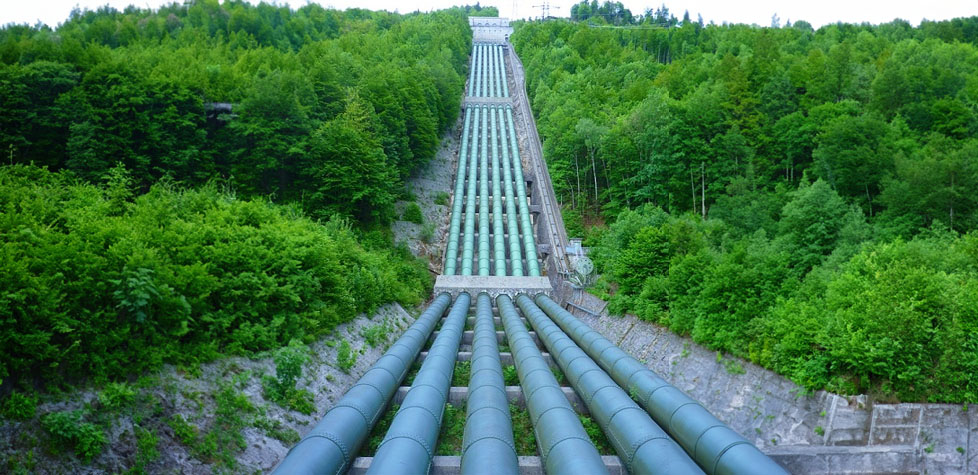
Pipeline and natural gas systems form an essential global network that is largely invisible. The “grandeur” of these networks is measured by their total length. The United States leads with a main transportation network of approximately 815,358 km.
Russia has the second largest, with about 314,163 km. Globally, the total extension of these transportation/transmission networks is estimated at around 2.28 million km. Specific gas pipelines, such as the West-East pipeline in China (8,707 km) and the Transneft pipeline system in Russia (50,800 km), are also examples of projects of enormous linear extent.
The Scale of Mining and Large Urban Systems
Mining operations represent some of the largest physical transformations induced by humans. The Bingham Canyon Mine (Kennecott Copper Mine) in the U.S. is often cited as the largest excavation made by humans, with over 1.21 km deep and 4 km wide. The Hull-Rust-Mahoning mine, also in the U.S., has moved over 2.2 billion tons of material (ore and waste).
Underground, the El Teniente Mine in Chile has over 3,000 km of underground tunnels. Large urban sewer systems also reach impressive scales, such as Paris’s (approximately 2,100 km) or Chicago’s TARP (177 km of large-diameter tunnels).
Why the Largest Structure Ever Built by Humans May Be Unknown to the General Public?
The disconnect between the real scale of these structures and public perception occurs for various reasons. Many of these networks and excavations are underground or located in remote areas, lacking the iconic visual appeal of monuments. Their purpose is primarily utilitarian, not symbolic or aesthetic. The dispersed nature of the networks and the complexity in measuring their “grandeur” make it difficult for the lay public to grasp.
Redefining the Largest Structure Ever Built by Humans
The quest for the “largest structure ever built by humans” does not have a single answer. The title depends on the metric used:
- Total Length of the Network: Global networks of pipelines and natural gas pipelines are unbeatable.
- Volume/Mass Excavated (Local Operation): Large open-pit mines like Bingham Canyon lead.
- Constructed Volume (Single Building): Boeing’s factory in Everett is the largest.
- Constructed Mass (Single Building): The Great Pyramid of Giza remains one of the most massive. The premise that underground or network systems are “larger” than traditional monuments holds true under length metrics or total volume moved. It is crucial to recognize the scale of human engineering beyond the visible, valuing the “invisible colossi” that sustain our civilization.








Seja o primeiro a reagir!