





 Portuguese
  English
  Spanish
  4 min of reading
  0 comments


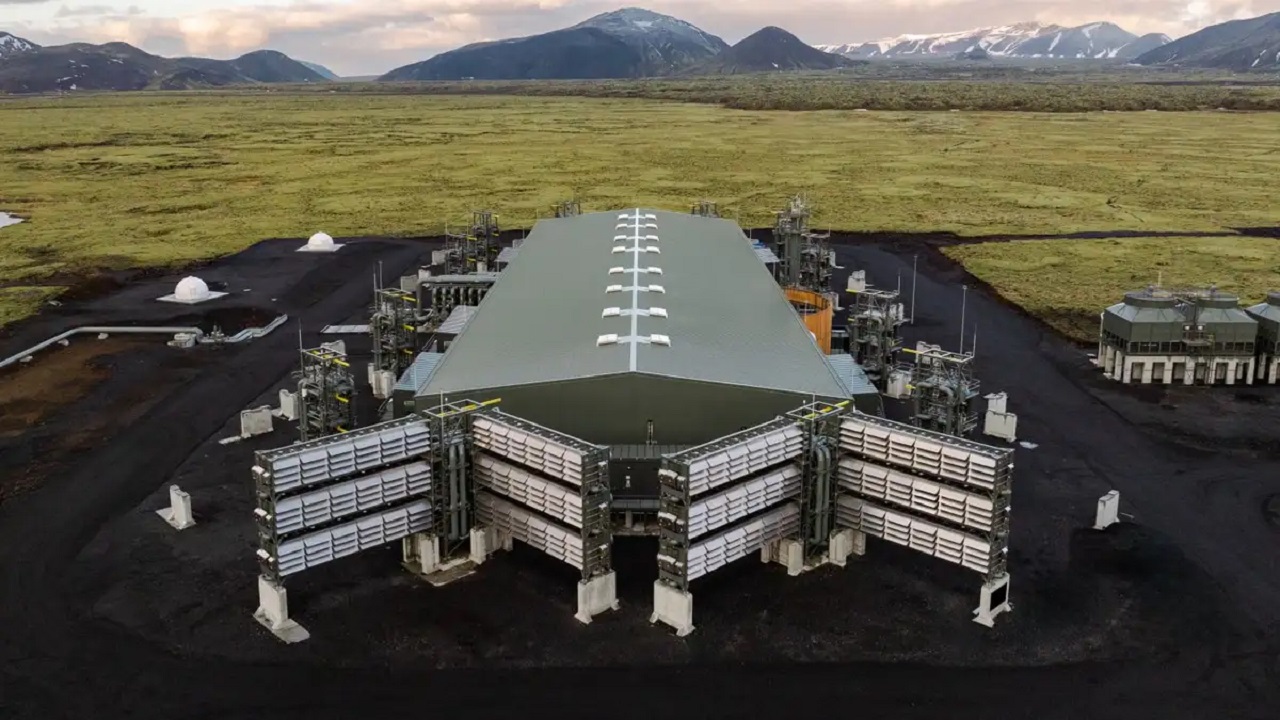
Iceland Inaugurated the World’s Largest Direct Carbon Capture Plant, Capable of Storing 36 Thousand Tons of CO₂ per Year in the Rocky and Volcanic Subsoil.
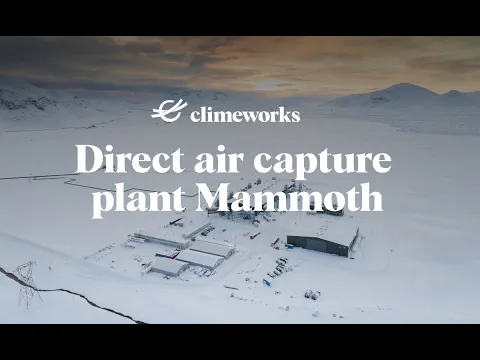
In the fight against climate change, Iceland has just taken on a role of silent protagonist. While major powers still discuss goals and promises, the Nordic country has launched the largest direct carbon capture and storage plant on the planet, called Mammoth — a project that sucks CO₂ directly from the air and injects it thousands of meters into the rocky and volcanic subsoil of the island, where the gas turns into rock.
With the capacity to capture up to 36 thousand tons of carbon dioxide per year, the project is the largest bet ever made on the so-called DAC (Direct Air Capture) technology, seen by many experts as a crucial tool for neutralizing emissions that are already in the atmosphere. Check out all the details of the largest carbon storage plant.
A Plant That Doesn’t Generate Energy — But Removes Carbon from the Air

Unlike solar or wind plants, the goal of Mammoth is not to produce electricity. Its mission is to “clean” the atmosphere, directly collecting carbon dioxide dispersed in the ambient air, even in minimal concentrations.
-
Embrapa’s discovery reveals an unexpected advancement by allowing the production of seedlings from the caatinga using brackish water, opening a new frontier for farmers to face drought more efficiently.
-
6 sources of free fertilizer that you are throwing away every day and can transform your garden without spending anything.

-
With a water crisis on the radar, Sabesp invests in reclaimed water for data centers and transforms sewage treatment into a solution that saves millions of liters and protects public supply.

-
Foresea achieves 100% offshore waste reuse in 2025, eliminates landfill disposal, and consolidates sustainable strategy with 1,500 tons recycled.

To accomplish this, the plant uses a capture technology developed by the Swiss startup Climeworks, which works as follows:
- Industrial fans suck atmospheric air into cylindrical modules.
- Inside, the air passes through chemical filters capable of selectively absorbing CO₂.
- Once saturated, the filters are heated to 100 °C to release the concentrated CO₂.
- The gas is then compressed and transferred underground, where it will be stored permanently.
From the Atmosphere to the Subsoil: The Secret of the Largest Carbon Storage Plant is in Iceland’s Rocks
The great differential of Mammoth lies in the subterranean carbon storage process, conducted in partnership with the Icelandic company Carbfix.
The captured CO₂ is mixed with water and injected about 800 meters deep into basalt rocks — abundant in Iceland due to its volcanic origin. In contact with this type of rock, the carbon dioxide undergoes a natural reaction and turns into calcium carbonate, a solid and stable mineral.
This process takes between 2 to 4 years and ensures that the captured gas never returns to the atmosphere. In other words, the plant literally turns pollution into rock.
Still Modest Capacity — But a Technological Milestone
Although 36 thousand tons of CO₂ per year may seem like a lot, the number represents only a fraction of what the world emits daily. For comparison, a single transatlantic flight emits about 1 ton of CO₂ per passenger.
However, Mammoth marks a fundamental advance:
- It is 12 times larger than Climeworks’ previous plant, Orca.
- It is the first DAC plant to operate with 100% geothermal renewable energy.
- It establishes a replicable and scalable model for the future of direct carbon capture.
Climeworks states that it intends to scale this technology to millions of tons per year by 2030, attracting investments from companies such as Microsoft, Shopify, JPMorgan, and Swiss Re, which have already signed carbon removal purchase agreements.
Iceland as the World’s Climate Laboratory
The choice of Iceland was not by chance. The country is a true geological and energy playground for innovation projects:
- It has abundant and cheap geothermal energy, ideal for powering DAC plants.
- It has vast basalt rock formations, perfect for the safe storage of carbon.
- It enjoys government and regulatory support for cutting-edge environmental projects.
Furthermore, the cold climate helps to reduce operational costs of capture units, as the process requires cooling in several stages.
Criticism, Limitations, and the Debate on Real Solutions
Despite the excitement, experts warn that direct carbon capture should not be seen as a substitute for emission reductions. This is because:
- It is a technology still expensive and with limited scale.
- It can be used by major emitters as a license to pollute more, rather than changing practices.
- The average cost per ton removed still ranges between US$ 600 and US$ 1,200, although it should decrease with scale.
Even so, the majority of IPCC reports (Intergovernmental Panel on Climate Change) already consider carbon removal an essential part of any viable scenario to limit global warming to 1.5 °C.
Mammoth: A Sign That the Future Has Already Begun
Mammoth is proof that, even in the face of a colossal climate challenge, science and engineering are advancing rapidly to provide concrete solutions.
The project also inaugurates a new phase in the carbon market: instead of just offsetting emissions with forests or dubious credits, companies can now purchase physical removal of CO₂ from the air, with traceability and certification.
And since the model is modular, similar plants can be installed anywhere in the world that has access to clean energy and favorable geology — opening opportunities for countries like Chile, Canada, Iceland, Kenya, and even regions of Brazil.
Capturing CO₂ from the atmosphere and turning it into rock may seem like science fiction, but it is now a reality. And Mammoth represents what could be a turning point in the fight against climatic collapse.
Iceland, a country with just 375 thousand inhabitants, shows the world that size doesn’t matter when innovation, science, and political will come together. While others discuss targets for 2050, it is already burying carbon today — meter by meter, ton by ton.










Seja o primeiro a reagir!