





 Portuguese
  English
  Spanish
  5 min of reading
  0 comments


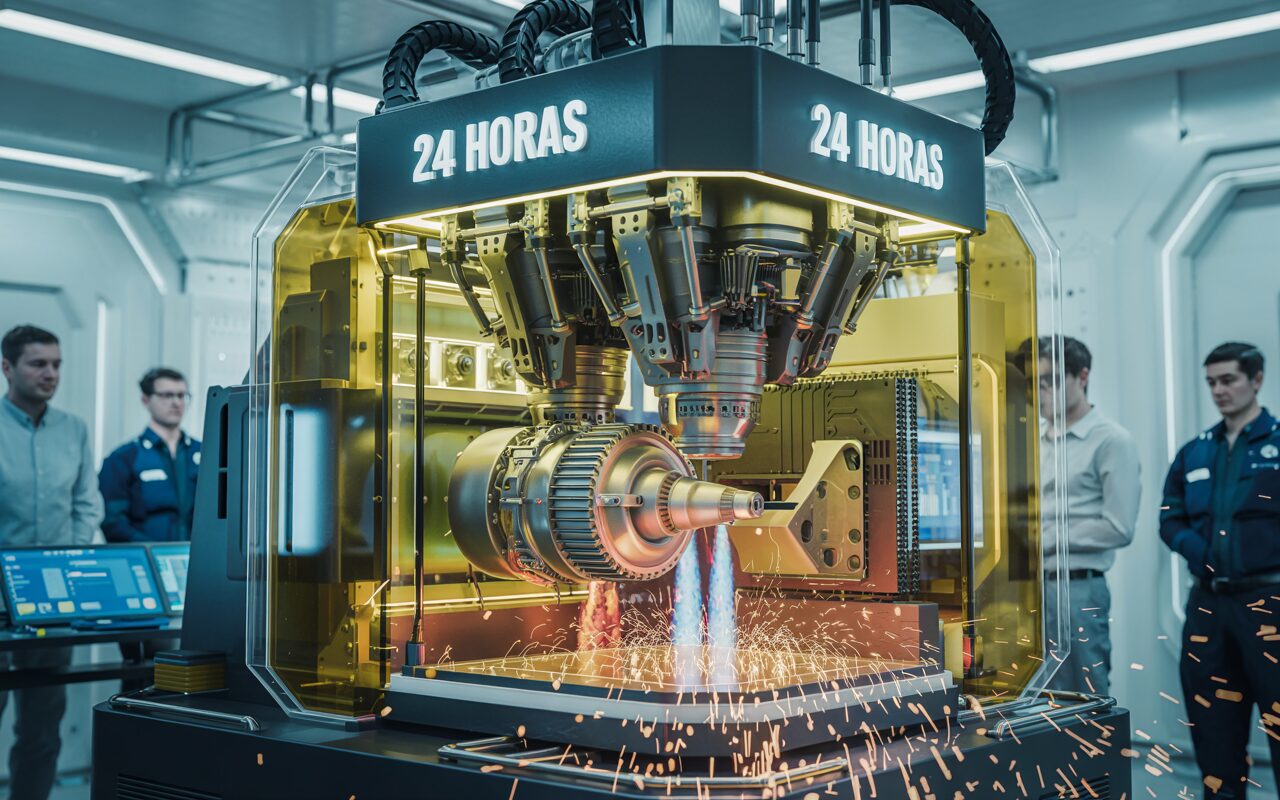
Imagine Building a Functional Rocket Engine in Just One Day. It Sounds Like Science Fiction, but It’s Reality Thanks to Relativity Space, an American Startup That’s Changing the Course of the Space Industry with Technology That Promises to Speed Up Space Exploration Like Never Before.
Founded in 2015 by Tim Ellis and Jordan Noone — former employees of Blue Origin and SpaceX — Relativity Space was born with the ambitious proposal to revolutionize the way rockets are designed, manufactured, and launched. While most companies in the aerospace sector still rely on traditional industrial processes and complex assembly lines, Relativity bet from the start on additive manufacturing — the technical name for industrial-scale 3D printing. The machine that prints rocket engines in 24 hours has been revealed! And we’re not talking about small parts: the company became famous for manufacturing, with its own printers, the largest 3D-printed object ever launched into space, the rocket Terran 1 – thanks to the world’s first rocket engine printer.
The Machine That Prints Rocket Engines in 24 Hours
At the center of this revolution is the Stargate, the world’s largest metal 3D printer, created by Relativity Space itself. It is capable of manufacturing complete rocket engines in just 24 hours, something that previously took weeks or even months with conventional processes.
This machine that prints rocket engines in 24 hours is powered by a special metal alloy (usually Inconel), melted by laser or electric arc beams, which are guided by artificial intelligence systems. The result: optimized, lightweight, robust, and highly efficient engines, created at an unprecedented pace.
-
At an altitude of 400 km by astronauts from the International Space Station, Paris transforms at night into a golden mesh so precise that it reveals the outline of the Seine River, avenues, and entire neighborhoods like a luminous map drawn over the Earth.

-
iPhone 17 reaches historic low price with 256 GB, 120 Hz display, and drops to R$ 5,703 on Shopee, featuring A19 chip, dual 48 MP cameras, battery life of up to 30 hours, and advanced AI features.

-
Trip to Mars getting closer: Pulsar Fusion, from the UK, advances with plasma ignition in fusion engine and could drastically reduce space travel time, making crewed missions faster, safer, and economically viable.
-
Made with recycled plastic, a Lego-inspired brick builds a 180 m² house in 15 days, providing thermal comfort, preventing moisture, and turning waste into income, kits, and accelerated construction in the country.


The Stargate also allows for the production of entire airframe structures, fuel tanks, and internal supports — all printed layer by layer, with extremely high precision.
Terran 1: The 3D-Printed Rocket That Proved the Impossible – Machine That Prints Rocket Engines in 24 Hours


In March 2023, Relativity Space launched the Terran 1, its first orbital rocket, made with over 85% 3D-printed components. Although the launch did not fully reach orbit, it was considered a historic milestone: for the first time, a nearly entirely 3D-printed rocket was successfully launched into space.
This achievement not only demonstrated the viability of the engine printer and Stargate technology but also positioned Relativity as one of the most promising names in the new commercial space race.
The Terran 1 featured two stages and was powered by nine Aeon 1 engines, also manufactured using 3D printing. The performance exceeded expectations, with all systems functioning properly up to stage separation.
Next Step: The Terran R and Reusable Rockets
With the lessons learned from Terran 1, Relativity Space is now focused on the development of the Terran R, a medium to large reusable rocket, capable of transporting up to 20,000 kg of payload to low Earth orbit (LEO). The project aims to directly compete with SpaceX’s Falcon 9.
The Terran R will be printed almost entirely in 3D using the latest version of the Stargate. The rocket will feature Aeon R engines, powered by liquid methane and liquid oxygen (LOX), in line with the global trend toward cleaner fuels for space exploration.
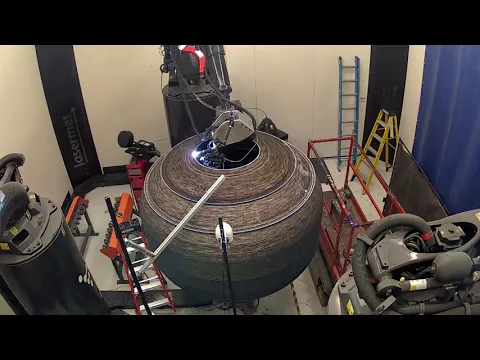
The reuse of vehicles, combined with the production speed provided by the engine printer, promises to drastically reduce launch costs and accelerate the delivery of satellites, modules, and commercial payloads for government and private clients.
How Does the 24-Hour Engine Printer Change the Game?
The additive manufacturing used by Relativity Space eliminates hundreds of intermediate processes from the traditional production chain. With this, the engines and components:
- Take less than a day to print
- Have fewer points of mechanical failure
- Have more optimized and lightweight geometries
- Can be quickly modified with software adjustments
Moreover, local and digital production reduces dependence on large factories and allows rockets to be manufactured on demand, even in remote environments — such as lunar bases or space stations in the future.
This approach reduces by up to 100 times the number of parts needed in a conventional rocket, simplifying both design and maintenance.
Relativity Space’s Vision: Printing in Space
The long-term goal of Relativity goes beyond manufacturing rockets on Earth. The company hopes that one day, its Stargate printers will produce infrastructure directly in space, on the Moon or Mars.
According to Tim Ellis, the company’s CEO:
“3D printing is not just an innovation to speed up production on Earth — it is essential to establish human presence on other planets. We cannot rely on interplanetary transport for everything. We need to manufacture where we are.”
This bold vision connects the machine that prints rocket engines in 24 hours with a future where colonizing Mars and building orbital stations will no longer depend on shipments from Earth, but rather on local production in microgravity.
Competition and International Recognition
Since the launch of Terran 1, Relativity Space has gained notoriety in the aerospace sector. It has received investments exceeding US$ 1.3 billion from funds like BlackRock, Fidelity, and Baillie Gifford, in addition to contracts with NASA and private satellite companies.
Among the closest competitors are:
- SpaceX (with the Falcon 9 and Starship, although with conventional methods)
- Rocket Lab (partial use of 3D printing in Rutherford engines)
- Blue Origin (focusing on suborbital flights and partially printed engines)
- Axiom Space and Sierra Space, which are studying orbiting printers
Even among giants, Relativity stands out for its efficiency in cutting-edge 3D printing technology and its scalable and sustainable business model.
Printed Rockets: Fiction That Became Reality
The idea of using 3D printing to build spacecraft and space components appeared in science fiction works, such as Star Trek, decades ago. Today, it is reality thanks to Relativity Space and its machine that prints engines in 24 hours.
The company has gone beyond the concept and applied the technology on a real scale, proving that it is possible:
- Reduce production time
- Cut logistical costs
- Increase operational safety
- Produce on demand
- Expand access to space
This means that in the near future, space missions can be planned much more quickly, even by countries or startups that previously did not have access to cutting-edge aerospace technology.
Despite the success, Relativity Space faces some challenges:
- Ensure reliability in complete orbital launches
- Increase the reuse capacity of Terran R
- Compete with the cost per kg launched of SpaceX’s Falcon 9
- Expand its industrial capacity to meet global demand
The company continues to invest in engine testing, thermal simulations, and improvements in the latest version of Stargate, which is already in its fourth generation.
The Machine That Prints Rocket Engines in 24 Hours Is Just the Beginning
Relativity Space is shaping the future of the space industry with its machine that prints engines in 24 hours and rockets made almost entirely through additive manufacturing.
If before it took an army of engineers and months of work to build an engine, now it just takes a digital file, a Stargate printer, and 24 hours of automated processing.
This innovation represents a new paradigm in space exploration, with direct impact on sectors such as:
- Defense and security
- Satellite telecommunications
- Space tourism
- Space mining
- Exoplanetary colonization
The question is no longer whether rockets can be printed. It’s: how long will it take until they are assembled and launched automatically from a lunar base?








Seja o primeiro a reagir!