





 Portuguese
  English
  Spanish
  5 min of reading
  0 comments


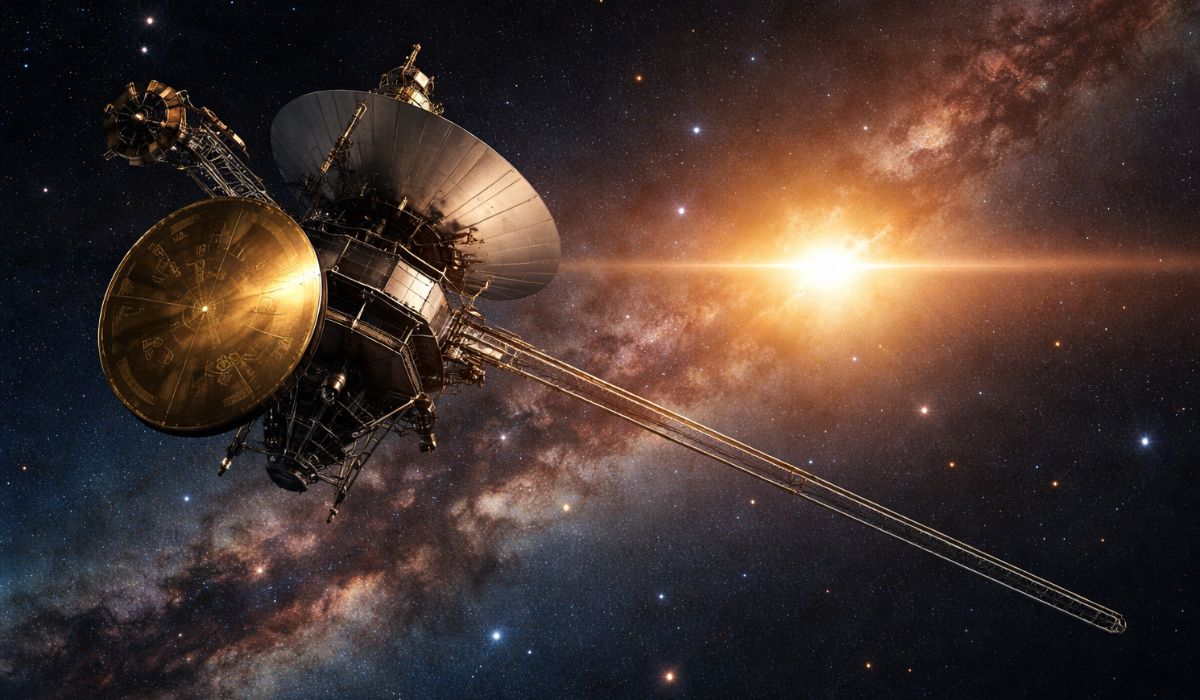
A Cultural Capsule Sent Into Deep Space Accompanies the Voyager Probes Since 1977 and Gathers Sounds, Images, and Scientific References About Earth, in One of the Most Known Records of Space Exploration and Human Attempts at Interstellar Communication.
Launched in 1977, the Voyager probes carry one of the most well-known projects in the history of space exploration: a gold-plated disc created to gather sounds, images, and scientific references about Earth.
Tethered to the spacecraft, the so-called Golden Record was conceived as an interstellar message to present the planet, its life, and part of its cultural production to any intelligence that may one day encounter these machines in space.
Currently, the two Voyagers continue their journey, and Voyager 1 is still the farthest human-made object from Earth.
-
Spain surprises the world by erecting 62 artificial dunes, mixing sand with natural remains of posidonia, and causing the structure to lose only 1.4% of its volume in 1 year.

-
With 16 Bulava missiles, improvements in acoustic stealth, and a design focused on silent patrols, Russia’s nuclear submarine was born to ensure Moscow’s invisible retaliation and has become one of the pillars of its maritime strength.

-
‘Populous’ city in Rio among the worst in Brazil in national ranking and exposes silent development crisis.

-
Couple buys house in the South Zone of São Paulo, opens a hidden door in the garage, and finds a secret wine cellar with dozens of old wines forgotten since the 1970s.


Voyager Mission and the Exit from the Solar System
The proposal did not emerge as an element of fiction, but as part of a scientific mission from NASA.
The two probes were sent to study the giant planets of the Solar System, taking advantage of a planetary alignment that allowed visiting several worlds in sequence.
After fulfilling this main objective, the mission was extended.
Over the decades, the Voyagers crossed the heliosphere’s boundaries, a region dominated by solar wind, and entered interstellar space.
Voyager 1 made this crossing on August 25, 2012; Voyager 2, on November 5, 2018.
What Is the NASA Golden Record
In this context, the Golden Record began to occupy a specific place within the mission.
In addition to the instruments designed to measure particles, plasma, and radiation, each probe also received a cultural capsule.
NASA describes the object as a 12-inch phonograph record, made of gold-plated copper, with content selected to portray aspects of life and culture on Earth.
The item was not designed as a decorative piece.
It was created to store information in a readable format, provided that the eventual discoverer can decipher the signals recorded and understand the instructions inscribed on its cover.
What Is Recorded on the Golden Record
The material was gathered by a committee chaired by astronomer Carl Sagan.
The collection approved by NASA includes 115 images, natural sounds, greetings in 55 languages, and a musical selection of around 90 minutes.
Among the sound recordings are noises from the Earth environment, such as wind, thunder, birds, and whales, as well as human speech and compositions from different eras and traditions.
Also included were printed messages from then-President of the United States, Jimmy Carter, and then-Secretary-General of the UN, Kurt Waldheim.
This selection helps explain why the record became more well-known than some of the scientific equipment of the probes themselves.
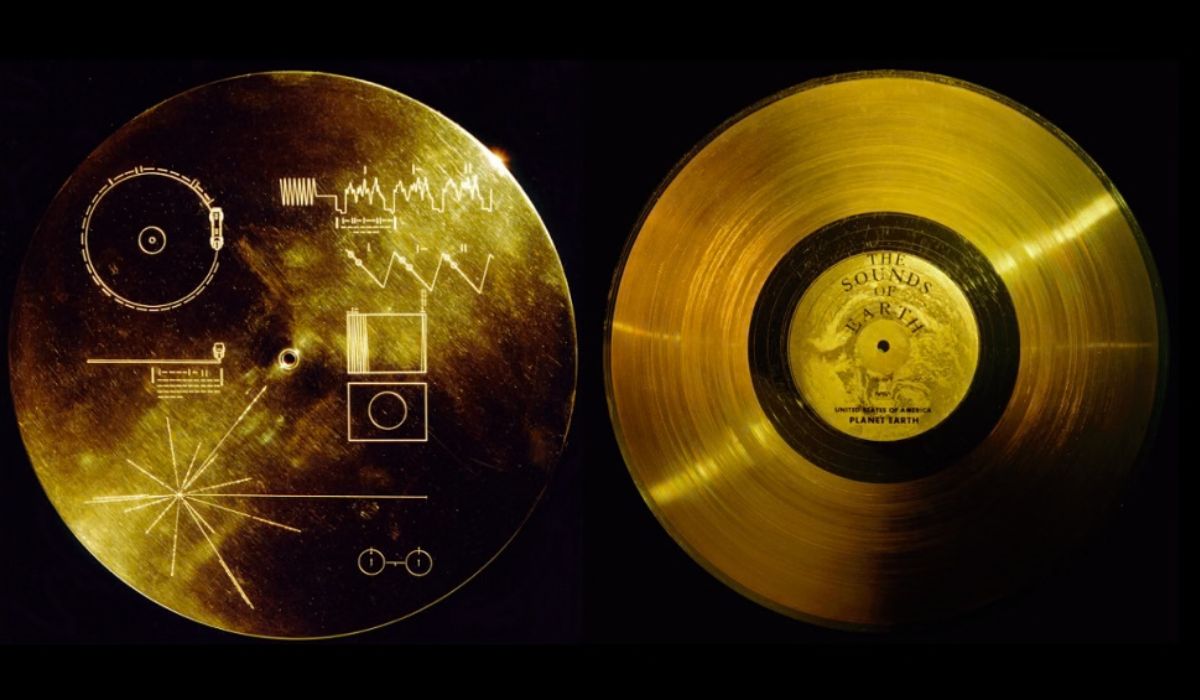
In attempting to condense Earth into audio and image, the project brought together science, language, music, and visual representation in the same medium.
Nevertheless, the content was not organized as an encyclopedic file and does not aim to summarize the entirety of human experience.
What exists there is a symbolic cut, defined by technical and cultural choices made in the 1970s, within the available timeframe before the launch.
How the Map of the Golden Record Indicates the Location of Earth
On the record’s cover are some of the elements most studied by researchers and communicators of the mission.
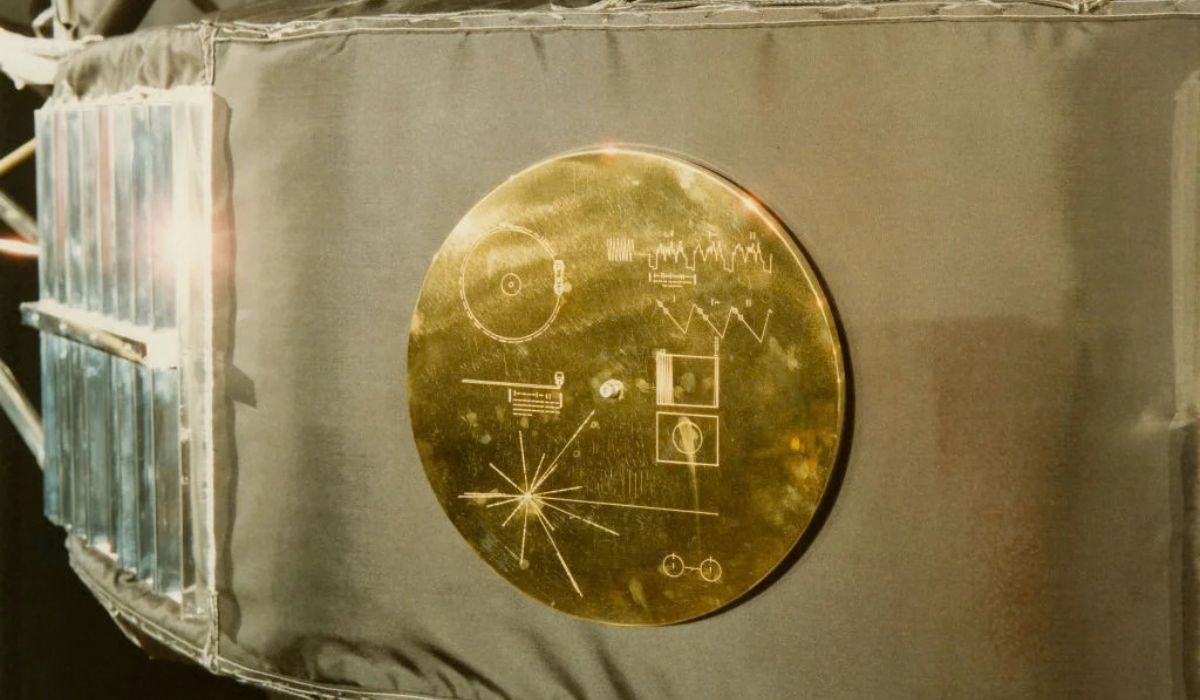
According to NASA, the protective cover contains symbolic instructions on how to reproduce the content, how to reconstruct the images recorded in the analog signal, and how to locate the origin of the spacecraft in the cosmos.
This means the record does not merely gather sounds and figures.
It also includes a set of reading guidelines and an astronomical location scheme.
This is where the so-called “map” to find Earth appears.
Recorded on the cover, the diagram uses 14 pulsars as reference points.
Pulsars are neutron stars that emit regular signals and can be identified by their precise periods.

From the Sun’s relative position in relation to these objects, the drawing indicates where our system is located.
On the same surface, another important symbol presents the hyperfine transition of the hydrogen atom, used as a basis for units of time and measure.
According to the mission team, this set of marks would serve as the initial key for decoding the record.
The Meaning of the Golden Record in Space Exploration
Although popular formulation says that the object “teaches how to find Earth,” the technical description is more specific.
The scheme provides a reference for the location of the Solar System in relation to the pulsars recorded on the cover.
Earth appears as the origin world of the probe within this broader context, rather than as an address designed on a planetary scale.
Still, the record is often cited by experts and by the mission’s institutional communication as an example of scientific communication applied to space exploration.
The longevity of the Voyagers also explains the lasting interest over the decades.
Voyager 1, launched on September 5, 1977, has surpassed its initial role as a probe intended for flybys of Jupiter and Saturn and continues in an extended mission.
Voyager 2 performed flybys of Jupiter, Saturn, Uranus, and Neptune, something no other spacecraft has repeated to date.
The two remain the only human machines operating in interstellar space, even as instruments are gradually being turned off to conserve power.
Thus, the record has come to be treated not only as part of a space mission but also as a historical record of a period in scientific exploration.
It brings together elements produced during the Cold War and preserves a portrait of Earth crafted from the technical and cultural viewpoint available at that moment.
NASA itself defines the artifact as a time capsule sent with the Voyagers.
As the probes continue to move away, the record preserves this set of references created at the end of the 1970s.
The interest surrounding the Golden Record is tied to the combination of scientific language and cultural representation.
On one side, there are codes, physical units, pulsars, and geometric instructions.
On the other, there are songs, voices, sounds of nature, and images chosen to represent the planet.
Nearly 50 years after its launch, the message remains trapped within a solitary machine, now at a distance that has already surpassed the limits of the Solar System.
What continues to be debated among scientists, researchers, and communicators is the symbolic reach of this attempt to present Earth to deep space.







-

-

-

3 pessoas reagiram a isso.