





 Portuguese
  English
  Spanish
  5 min of reading
  0 comments


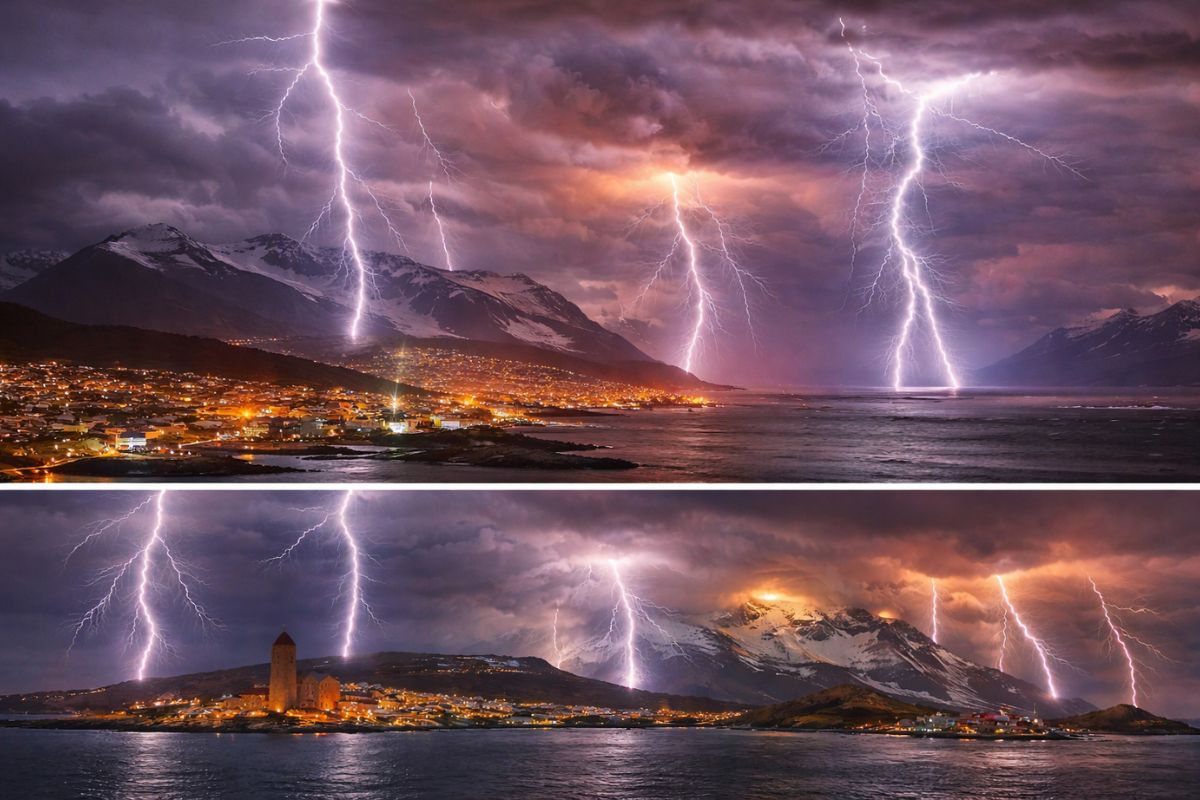
A mass of hot air of giant proportions covered the South of Brazil, Uruguay, almost all of Argentina, and advanced to sectors close to the Antarctic Peninsula, causing lightning and thunder in places where thunderstorms almost never occur, such as Ushuaia in Tierra del Fuego, the Falkland Islands where the temperature reached 20 degrees, and the South Georgia Islands that house one of the largest penguin colonies on the planet
A mass of hot air stretched from the South of Brazil to the vicinity of the Antarctic Peninsula and caused an extremely rare phenomenon this Sunday (29): lightning and thunder in regions of the extreme south of the continent where thunderstorms almost never happen. Ushuaia Airport, in Tierra del Fuego, recorded rain with thunder and the presence of Cumulonimbus clouds. The same mass of hot air that left Brazil pushed the temperature in the Falkland Islands to 20 degrees, when the normal for this time of year is between 10 and 13 degrees, and generated lightning even in the remote South Georgia Islands, an archipelago that houses one of the largest penguin colonies on the planet.
According to MetSul, the extent of the mass of hot air is what makes the event so exceptional. It covers areas of the South of Brazil, Uruguay, almost all of Argentina, the Magallanes region in Chile, Tierra del Fuego, the Falkland Islands, and advances to the South Georgia Islands, in the extreme south of the Atlantic Ocean. Lightning in places so close to Antarctica is a rare event because the cold climate of these regions normally prevents the formation of tall, charged clouds that produce thunderstorms.
Why the mass of hot air managed to reach so close to Antarctica
The mass of hot air that caused the lightning in the extreme south of the continent originated from above-normal temperatures in the South of Brazil and expanded southward continuously, covering a huge stretch of the continent.
-
Larger than a football field, with a wingspan of 117 meters, six Boeing 747 engines, and a capacity of 250 tons, the Stratolaunch Roc turns the sky into a gigantic hypersonic launch ramp and accelerates the way the U.S. tests weapons from Mach 5 to Mach 10.

-
Neuralink, the company specialized in brain chips founded by Elon Musk, announced that it intends to implant thousands of brain chips thanks to large-scale production.

-
Hummer H1X3: The 60-ton car, 14 meters long, and $25,000 tires – all for a single owner in the United Arab Emirates.

-
A city in the United States has a secret to handle peak electricity demand and can supply power to about 300,000 homes for up to 4 hours.


The extent of this mass of hot air is unusual: it did not lose strength while crossing Argentina and continued advancing to latitudes where the air is normally cold all year round, reaching sectors close to the Antarctic Peninsula.
When the mass of hot air meets the cold air that predominates in these southern latitudes, the temperature difference creates atmospheric instability. This instability is what generates clouds with significant vertical development, capable of producing lightning and thunder.
Under normal conditions, the cold air of the extreme south prevents the convection necessary for thunderstorms, but the mass of hot air coming from Brazil provided enough heat and moisture for Cumulonimbus clouds to form even in Ushuaia and the Falkland Islands.
Lightning in Ushuaia and 20 degrees in the Falklands: what the mass of hot air caused
At the beginning of Sunday night, the weather report from Ushuaia Airport, in the extreme south of Argentina, recorded rain with thunder (code TSRA in aviation) with a temperature of 10 degrees and the presence of Cumulonimbus clouds. Ushuaia is considered one of the southernmost cities in the world, and thunderstorms there are events that attract the attention of meteorologists.
The mass of hot air that came from Brazil temporarily transformed the atmosphere of a region where the normal weather is light and persistent rain with low clouds, not thunderstorms with lightning.
In the Falkland Islands, the temperature in Mount Pleasant reached 20 degrees, a value that seems modest for those living in Brazil but is extremely high for the archipelago at the end of March. The normal highs are between 10 and 13 degrees at this time. The thermal anomaly caused by the mass of hot air was so intense that the Falklands recorded a temperature almost double what was expected for the period, a fact that illustrates the scale of the phenomenon.
Lightning in the South Georgia Islands: where penguins live and thunderstorms are almost never seen
The South Georgia Islands are located in the extreme south of the Atlantic Ocean and house one of the largest penguin colonies on the planet. The environment is so cold and hostile that the local fauna is dominated by species adapted to ice and the cold sea. Strong to intense cold winds blow for most of the year.
Recording lightning in this archipelago is extraordinary because the low temperatures limit the amount of water vapor in the atmosphere, and without enough vapor, there is no way to form the tall clouds that produce electrical discharges.
Maps of electrical discharges from early Sunday night showed lightning in the extreme south of the continent and in the South Georgia Islands themselves.
The mass of hot air that left Brazil managed to push heat and moisture to latitudes where penguins live in colonies of hundreds of thousands of individuals and where the climate normally makes thunderstorms practically impossible.
The event demonstrates the reach and intensity of thermal anomalies that can cross entire continents.
Why lightning is so rare near Antarctica and what this event means
Lightning depends on clouds with significant vertical development, formed in environments with heat and moisture. In the southern regions close to Antarctica, low temperatures limit the available water vapor, and the clouds tend to be low and stratiform, producing light and continuous rain.
The low incidence of solar radiation throughout the year also reduces surface heating, which weakens convection, the essential process for the separation of electrical charges within clouds that generates lightning.
When a massive hot air mass like the one that left Brazil reaches these latitudes, it temporarily provides the heat and moisture that are lacking for convective clouds to form.
The result is thunder and lightning in places where the local population and scientists studying the region can go years without witnessing a single thunderstorm.
The event is an indicator of how large-scale thermal anomalies can temporarily alter the atmospheric behavior of entire regions of the planet.
From Brazil to the land of penguins: when the heat goes too far
A mass of hot air left the South of Brazil, crossed Uruguay and all of Argentina, and reached the doors of Antarctica, causing lightning in Ushuaia, 20 degrees in the Falkland Islands, and thunder in the South Georgia Islands, where penguins live in huge colonies and thunderstorms are practically unknown.
The event is rare, impressive, and demonstrates that a sufficiently extensive mass of hot air can temporarily alter the climate of regions that are among the coldest and most remote on the planet.
Did you imagine that a mass of hot air from Brazil could cause lightning near Antarctica? Do you think events like this will become more frequent with climate change? Have you seen any rare meteorological phenomena in your region? Leave your comments and share this article with those who are fascinated by weather and meteorology.








Seja o primeiro a reagir!