





 Português
  Inglês
  Espanhol
  4 min de leitura
  0 comentários


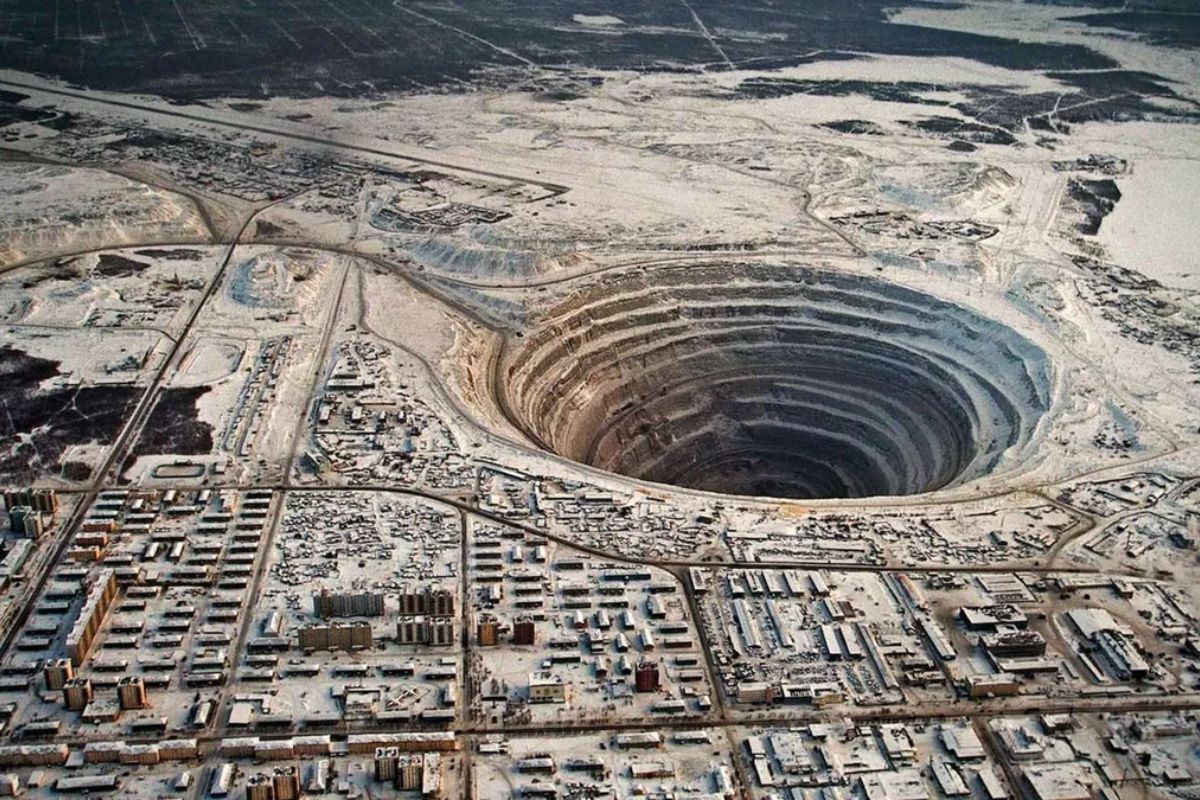
With a Diameter of 1.2 Km and Depth of 525 Meters, the Mirny Diamond Mine in Russia Is One of the Largest Craters Ever Excavated by Man, with a History of Engineering Challenges, Disasters, and a Billion-Dollar Future.
In the heart of inhospitable Siberia, a colossal scar on the landscape tells the story of one of the most ambitious engineering undertakings of the 20th century: the Mirny Diamond Mine. This gigantic crater, operated by the Russian state-owned company ALROSA, was not only a source of wealth but a strategic pillar that sustained the Soviet Union’s economy and, later, Russia’s.
Discovered in 1955, during the height of the Cold War, the Mirny Diamond Mine faced extreme challenges, from excavation in frozen ground to a catastrophic flood that paralyzed its operations in 2017. In 2025, the mine’s future is being rewritten with a new billion-dollar project to explore its deeper reserves, a strategic move aimed at reaffirming Russia’s dominance in the global diamond market.
The Discovery of 1955: The Soviet Race for Diamonds During the Cold War
The history of the Mirny Diamond Mine began with a high-priority search. After World War II, the Soviet Union urgently needed a domestic source of diamonds, both for industrial use and to generate foreign currency and compete with the West.
-
The world’s first octopus farm wants to open in the Canary Islands and is already provoking an international reaction: the plan aims to produce 3,000 tons per year.

-
Drought may be creating stronger superbugs in the soil and helping antibiotic resistance reach hospitals, warns a study highlighting a problem that could grow alongside extreme weather.

-
The biggest scam in history: Napoleon’s France deceived the United States by selling them a territory that was Spanish.

-
Why is the Danakil Desert so dangerous? It has unstable terrain and how extreme temperatures and toxic gases turn the region into one of the most hostile environments on Earth.


The turning point came on June 13, 1955, when a team of Soviet geologists discovered a kimberlite pipe, the volcanic rock that hosts diamonds, in the remote Republic of Sakha (Yakutia). The discovery, named “Mir” (Peace), was of such strategic importance that its discoverers received the Lenin Prize, one of the highest honors of the USSR. To support the mine, the city of Mirny was founded from scratch that same year, a monumental project to attract workers to one of the most inhospitable places on the planet.
Engineering in Ice: The Challenges of Digging the Mirny Diamond Mine in Permafrost
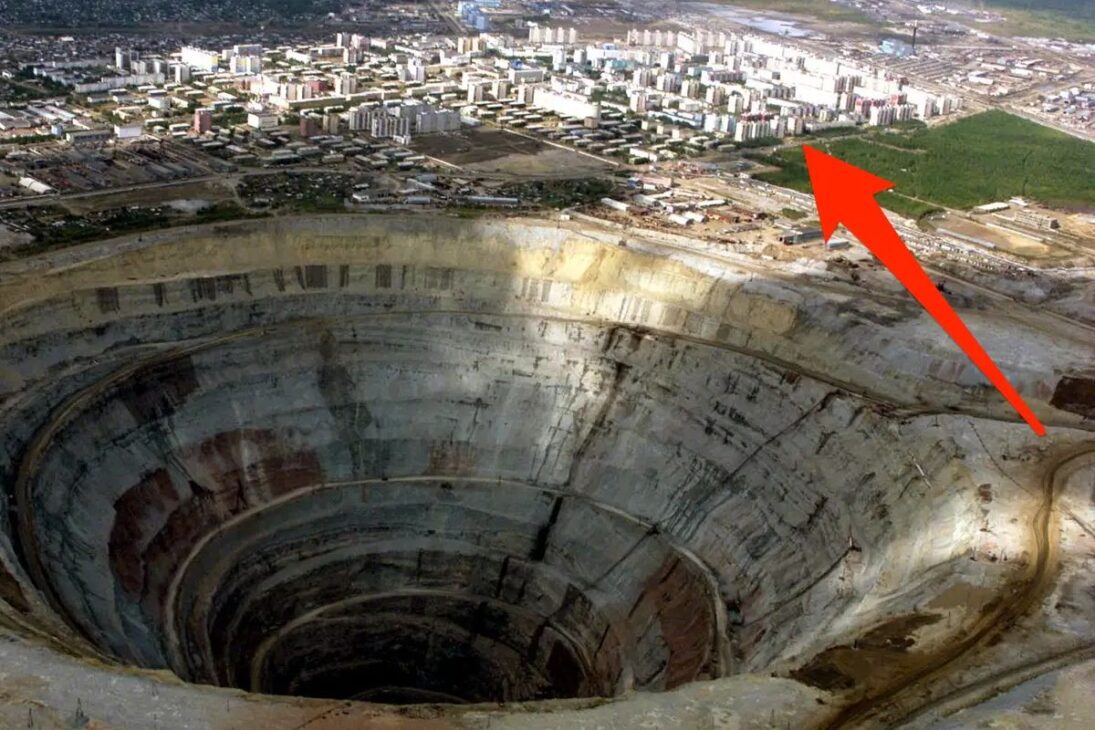
Developing the open-pit diamond mine starting in 1957 was a battle against the ice itself. Engineers faced seven months of severe winter, with temperatures plummeting to -40°C, freezing the ground, truck tires, and engine oil.
To overcome the permafrost, the Soviets employed brutal and creative methods. Jet engines from decommissioned airplanes were used to melt the frozen surface, and where that was insufficient, dynamite was used to blast the ground. For 44 years, this effort sculpted one of the world’s largest artificial craters, with 525 meters deep and 1.2 kilometers in diameter. Open-pit mining ceased in 2001 when it became unfeasible to continue.
The Tragedy of 2017: The Flood That Stopped Underground Mining
With the end of surface mining, operations migrated underground. A new underground mine was officially commissioned in 2009 to reach the deeper deposits. However, the old crater, which had accumulated a massive volume of water over the years, became an imminent danger.
On August 4, 2017, the mine’s past came back to exact its toll. The immense lake that formed in the abandoned crater breached the rock barrier separating it from the underground galleries. A catastrophic flood engulfed the tunnels, killing eight workers and destroying the modern operation with the remnants of its own legacy.
The “Mir-Profundo” Project and the Reopening of the Mine


After years of uncertainty, the Russian state-owned company ALROSA launched one of the world’s most ambitious mining projects to revive the sleeping giant. The “Mir-Gluboky” (Mir-Deep) project plans to build a completely new underground mine designed to circumvent the risks that led to the 2017 disaster.
With an estimated investment of over US$ 1.2 billion, construction began in 2023. The schedule anticipates production to start between 2032 and 2034. The goal is to extract an estimated reserve of over 170 million carats, with an annual production of around 3 million carats, ensuring the mine’s importance for another 30 years.
The Environmental Impact and the Legend of the “Helicopter Vortex”
The story of the Mirny Diamond Mine is also one of profound socio-environmental impact. Its exploitation, especially during the Soviet era, caused chemical and even nuclear contamination in the Viliui River basin and disrupted the way of life of the Sakha indigenous people.
The scale of the mine also fueled myths. The most famous is that the crater creates a ‘vortex’ powerful enough to knock down helicopters. The scientific reality is that the temperature difference between the cold air at the surface and the warm air at the bottom of the mine creates strong air currents and turbulence, making low-altitude flight dangerous. The no-fly zone over the mine, however, is standard safety practice in any large mining operation, and not because of a vortex.








-

-

-

-

-

27 pessoas reagiram a isso.